

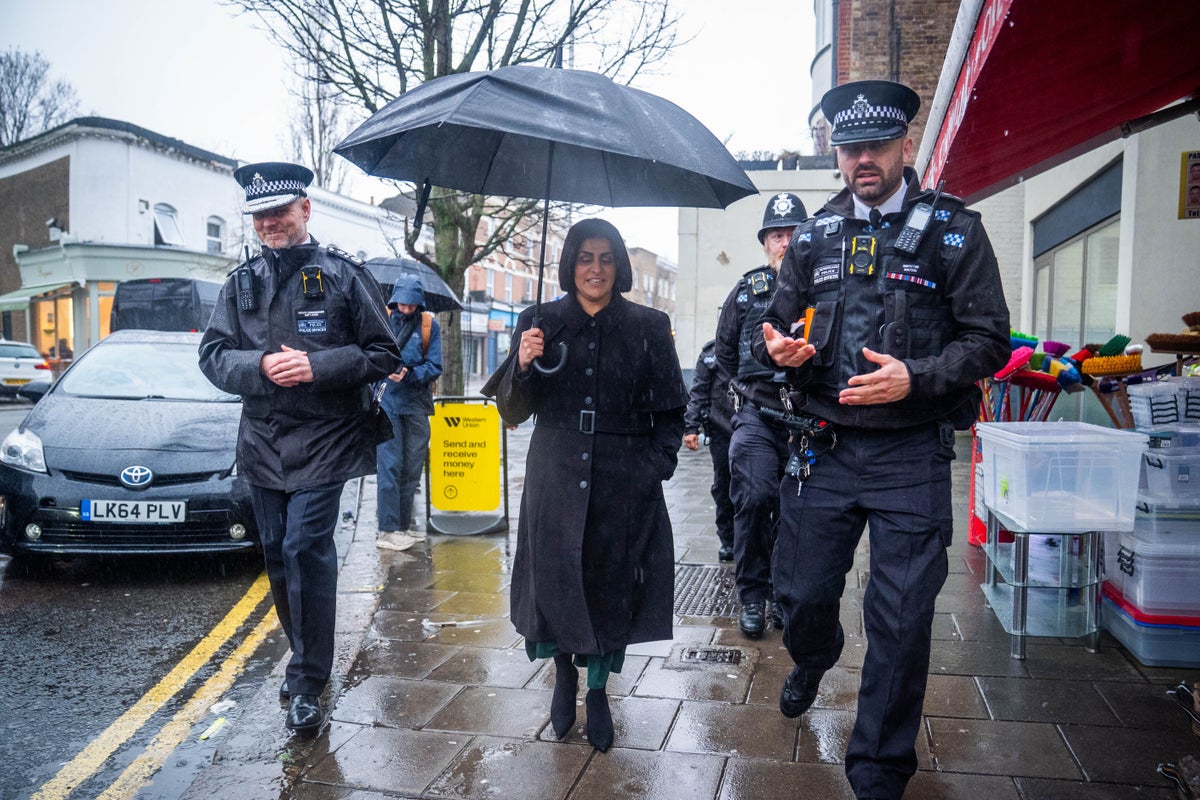
Shabana Mahmood has proved to be one of this government’s few outstanding ministerial successes. In a cabinet remarkably short of effective communicators, she has been plain-spoken and seems more sensitive to public opinion than many of her colleagues.
As Labour’s poll ratings sink, so she has grown more combative, and enjoyed rapid promotion. She wants to be seen as a “reformer at the Home Office” and has already initiated changes to the immigration system, which is obviously a matter of major public concern.
Nowhere, however, is the scale of her ambition more apparent than in the proposed reforms to British policing contained in the white paper she unveiled in the House of Commons on Monday.
Even before it was published, Ms Mahmood had made an encouraging start by dropping the practically impossible task of policing “non-crime hate incidents” – an aspect of law enforcement that has caused confusion, invited ridicule, and undermined the authority of officers when they have to deal with a genuinely serious case of, for example, stirring up racial hatred through social media.
As the home secretary has said of police officers, they should indeed be “catching criminals, cutting crime, and making sure people in our neighbourhoods feel safe”. “I want them out of the business of essentially policing social media – that’s not where they need to be,” she declared. Policing the streets, if you will – not policing tweets.
There will also be a genuine embrace of technology, if Ms Mahmood has her way. She announced plans to ramp up the use of AI and live facial recognition as she unveiled sweeping reforms to fix Britain’s “broken” policing system.
Abolishing the elected police and crime commissioners is also a sensible move. They usually lacked the expertise, necessary powers and democratic legitimacy to do the job. Ms Mahmood will need to exercise care, in future, to ensure local accountability for policing while avoiding the risk of undue pressure from local councillors. The white paper goes even further than that, however, setting out the most substantial reforms in 60 years.
Ms Mahmood’s document deserves to be taken seriously, but there will rightly be public scepticism. There are no proven historical cases in which a reorganisation of police areas delivered a noticeable reduction in crime.
The police chiefs complain about the untidiness of having 43 different forces in England and Wales, with duplication of functions, illogical lines of responsibility, and waste. There is certainly a case for expanding the functions of a national force beyond the existing National Crime Agency. Where the challenges are national and international – because organised crime and terrorism exist at an unprecedented scale and level of sophistication – there is no alternative to a “British FBI”.
Yet there seems to be much less point in amalgamating mostly county forces into larger regional forces. Economies of scale in areas such as procurement and IT could be achieved through closer cooperation between existing bodies. Areas such as motorway patrols are already benefiting from more flexible arrangements.
In addition, larger structures tend to have more layers and more bureaucracy, and are just as prone to internal rivalries – if not more so. Big does not mean beautifully efficient. The example of Police Scotland, welded out of eight regional forces some 13 years ago, is not an inspiring example of success.
Most of what Ms Mahmood terms “everyday crime” is local, and the public will rightly be sceptical if their town or city loses more police stations. The damage caused to “neighbourhood policing” by the loss of local intelligence when the coalition government cut 20,000 posts in the 2010s has still not been repaired.
The optimal balance of localism, efficiency and accountability in policing can be debated, and Ms Mahmood is wise to subject her ideas to scrutiny and take her time over such sensitive changes, with the process set to run well into the 2030s. Where Ms Mahmood is on far more dangerous, indeed unconstitutional ground, is with her proposal to give a home secretary the power to fire chief constables and other senior officers on the grounds that, as she put it recently, they have “failed the public”.
No home secretary of any party should possess such a power outside obvious cases of medical incapacity or actual criminality at the top. Suella Braverman, in the news with her unsurprising defection to Reform UK, is a warning from recent history.
Braverman was a lamentable home secretary who spent too much of her time publicly haranguing the commissioner of the Metropolitan Police for the way his commanders tried to keep the King’s peace during protest marches about Gaza. She recklessly used the term “two-tier policing” to undermine officers doing their job. She was a bully, but she could never remove the Met commissioner from office – and that is how it should be.
The recent case of Craig Guildford, the now-retired chief constable of the West Midlands, certainly highlights what happens when the leader of a police service has clearly “failed the public”. After it was found that he had exaggerated evidence to justify his force’s decision to ban Maccabi Tel Aviv fans from a Europa League fixture against Aston Villa, he had to go.
But such a decision needs to be taken with due care and statutory process, with a balance of national and local accountability, and recourse to legal appeals. The responsibility for sacking a senior officer should be diffused – such a decision should not rest on the word of a politician. That would be a reform too far, even for Ms Mahmood.