

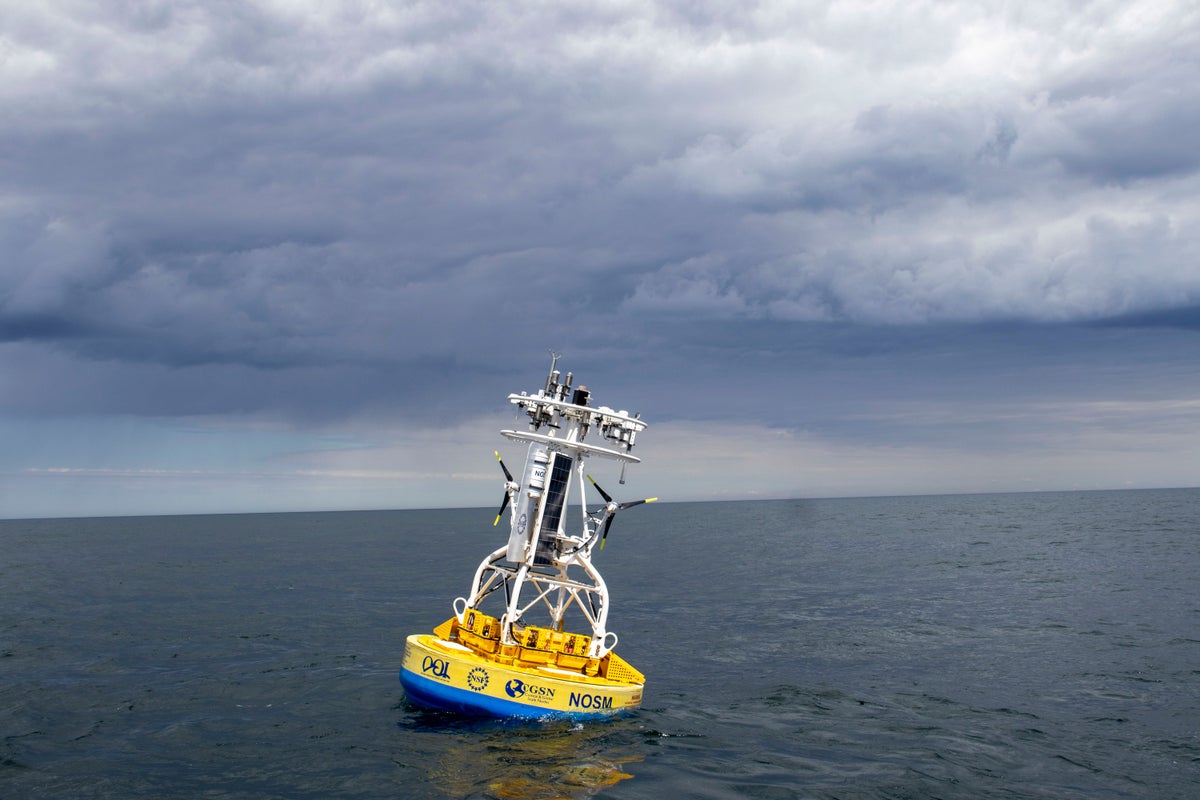
A portion of one of the most ambitious ocean monitoring networks ever built will go dark this month when scientists board a research vessel and motor off the Oregon coast to pull a research buoy from deep out of the Pacific.
The buoy 80 meters (260 feet) below the water’s surface will be removed June 16 from the Ocean Observatories Initiative — a network of more than 900 ocean sensors built at a cost of $386 million that has continuously collected real-time data for more than a decade. But last month, the National Science Foundation announced it would dismantle most of the system, pulling instruments from waters off Oregon, Washington, Alaska, North Carolina and Greenland by 2027.
Funded by the foundation, the observatories have tracked everything from ocean circulation and marine ecosystems to climate change and extreme weather. Its data has been freely available and has informed more than 500 scientific publications. The project was slated to run for another 15 to 20 years.
In an emailed statement, the foundation said the decision is not a cancellation, but a “descoping” aligned with a “wider strategy of a nimbler approach to prioritize support for evolving scientific priorities and emerging technologies, as well as smart lifecycle management within its research infrastructure portfolio.” The foundation added that its decision drew in part on a 2025 National Academies report on the future of ocean science.
But for the scientists who built and operated the system — and the researchers, educators and students who rely on its data — the timing feels particularly punishing.
An El Nino event, which disrupts weather patterns and supercharges marine heat waves, is predicted to arrive along the Pacific coast this summer. One marine heat wave is already pushing unusually warm water off California.
Without the Oregon and Washington moorings and the network of underwater gliders the Ocean Observatories Initiative operated in the region, researchers say they’ll lose much of their ability to measure what’s happening below the surface, which is precisely where the most significant oceanographic signals are.
“It’s a crippling loss of information,” Ed Dever, a professor at Oregon State University who helped lead the initiative’s Pacific Northwest operations, told The Associated Press Tuesday. Scientists can get some data from the surface, such as temperature and the distribution of chlorophyll, which drives photosynthesis in plants, but information below cannot be gathered from satellites alone, including low oxygen zones.
The initiative launched in 2015 after more than a decade of community planning and construction. It was designed as a 25 to 30-year project, built in part around the oceanographic consensus that detecting meaningful climate signals requires at least three decades of continuous data. “We’ve just got to the 10 year record,” Dever said, “which will give you some hints, but it won’t continue on.”
One significant piece will remain: a seafloor cable network managed by the University of Washington off the Pacific Northwest coast, which will continue providing data on volcanic and seismic activity in the region.
Scientists had seen warning signs as the administration’s proposed 2026 budget included a 55% cut to the science foundation. Official word to begin shutting down arrived in early May.
The initiative was coordinated by the Woods Hole Oceanographic Institution in collaboration with the University of Washington and Oregon State University, as well as past partners including Rutgers University and Scripps Institution of Oceanography.
The initiative operated on roughly $48 million a year, not including the cost of research vessels, which adds substantially to the overall price. Prior to budget cuts, which began in 2025, around 60 to 70 people worked directly on the project across its partner institutions, Dever said.
“What’s happening with the Ocean Observatories Initiative is not unique,” he said. “This is just one of a number of science facilities that is being dismantled at the present time. It seems to really mark the end of a federal commitment to basic scientific research — a commitment that has served this nation very well for the last 70 years.”
___
Alexa St. John contributed to this report from Detroit.
___
Follow Annika Hammerschlag on Instagram: @ahammergram.
___
The Associated Press receives support from the Walton Family Foundation for coverage of water and environmental policy. The AP is solely responsible for all content. For all of AP’s environmental coverage, visit https://apnews.com/hub/climate-and-environment