

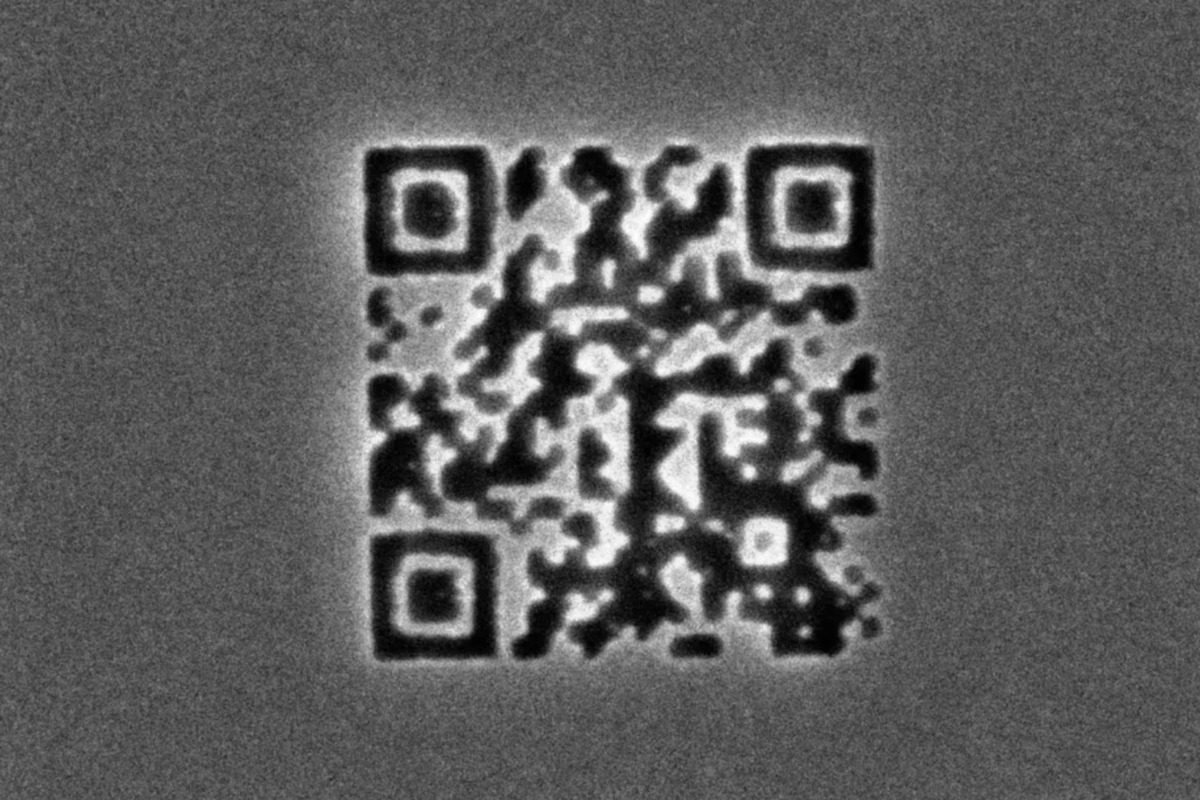
Scientists have created a QR code that is smaller than most bacteria, offering a novel way to store data.
Using beams of charged particles, a team from Vienna University of Technology in Austria engraved the working QR code onto a special type of ceramic that allows it to be stored and read for centuries.
Measuring just 1.98 square micrometres, the achievement has been officially confirmed by Guinness World Records.
The QR code, which leads to the university’s website, is so small that it is impossible to view using visible light, meaning it can only be viewed under an electron microscope.
“The structure we have created here is so fine that it cannot be seen with optical microscopes at all,” said Professor Paul Mayrhofer from Vienna University of Technology’s Institute of Materials Science and Technology.
“But that is not even the truly remarkable part… We have created a tiny, but stable and repeatedly readable QR code.”
The breakthrough was made using thin ceramic films, which are typically used to coat high-performance cutting tools.
This means that despite its minuscule size, the material is able to retain the QR pattern even under extreme conditions.
According to the scientists, the QR code engraving on the ceramic can last for hundreds of years longer than the magnetic and electronic storage devices currently used to store data.
“We live in the information age, yet we store our knowledge in media that are astonishingly short-lived,” said Alexander Kirnbauer, a senior scientist at Vienna University of Technology.
“With ceramic storage media, we are pursuing a similar approach to that of ancient cultures, whose inscriptions we can still read today. We write information into stable, inert materials that can withstand the passage of time and remain fully accessible to future generations.”
The use of ceramic also means that it does not require any power or maintenance to maintain the stored information.
If scaled up, more than two terabytes of data could fit within the area of a single A4 sheet of paper.
The researchers said they now plan to explore whether different types of data storage techniques would work using the engraving technique.
“We now aim to use other materials, increase writing speeds, and develop scalable manufacturing processes so that ceramic data storage can be used not only in laboratories but also in industrial applications,” said Dr Kirnbauer.
“At the same time, we are investigating how more complex data structures – far beyond simple QR codes – can be written robustly, quickly, and energy-efficiently into ceramic thin films and read out reliably.”