


UK TimesUK Times
  • Home
  • News
  • TV & Showbiz
  • Money
  • Health
  • Science
  • Sports
  • Travel
  • More
    • Web Stories
    • Trending
    • Press Release
What's Hot

M1 northbound between J12 and J13 | Northbound | Vehicle Recovery

11 February 2026
Starmer latest: Badenoch accuses PM of ‘stuffing government with paedophile apologists’ amid Lord Doyle row – UK Times

Starmer latest: Badenoch accuses PM of ‘stuffing government with paedophile apologists’ amid Lord Doyle row – UK Times

11 February 2026

M2 westbound between J6 and J5 | Westbound | Road Works

11 February 2026
Facebook X (Twitter) Instagram
UK TimesUK Times
Subscribe
  • Home
  • News
  • TV & Showbiz
  • Money
  • Health
  • Science
  • Sports
  • Travel
  • More
    • Web Stories
    • Trending
    • Press Release
UK TimesUK Times
Home » Radioactive pig-boar hybrids are thriving in Fukushima after nuclear disaster – now scientists know why – UK Times
News

Radioactive pig-boar hybrids are thriving in Fukushima after nuclear disaster – now scientists know why – UK Times

By uk-times.com11 February 2026No Comments3 Mins Read
Facebook Twitter LinkedIn Telegram Pinterest Tumblr Reddit WhatsApp Email
Radioactive pig-boar hybrids are thriving in Fukushima after nuclear disaster – now scientists know why – UK Times
Share
Facebook Twitter LinkedIn Pinterest Email

Sign up for our free Health Check email to receive exclusive analysis on the week in health

Get our free Health Check email

Get our free Health Check email

Health Check

Japanese scientists have finally decoded the genetic mechanisms behind the boom of radioactive pig-boar hybrids in Fukushima’s abandoned evacuation zone.

Following the 2011 Fukushima nuclear accident and evacuation of people, a small number of domestic pigs escaped from the town’s farms and began reproducing alongside native wild boar in the area.

With no further introduction of pigs to the area and minimal human activity, the region has become the site for a natural experiment to understand domestic pig hybridisation with their wild relatives.

Such hybridisation between domestic and wild animals is a growing concern worldwide, particularly in areas where feral pigs and wild boar increasingly overlap, and is often linked to ecological damage.

However, the biological mechanisms behind these changes have remained poorly understood.

In the latest study, geneticists from Fukushima examined the rare event and found that domestic pig genes got diluted across generations, but their rapid reproductive capacity persisted in the hybrid hogs.
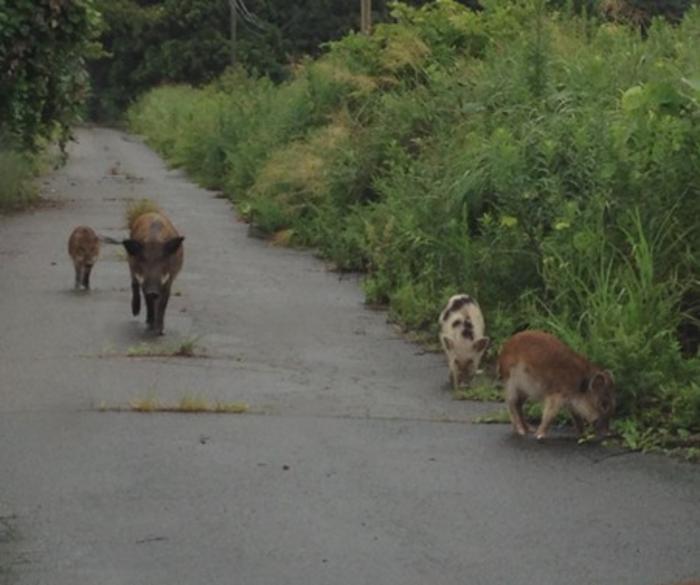
Wild boar with visible traits linked to domestic pig ancestry in Fukushima’s evacuation zone
Wild boar with visible traits linked to domestic pig ancestry in Fukushima’s evacuation zone (Associate Prof. Hiroko Ishiniwa from Mukogawa Women’s University, Japan)

Wild boars live outdoors and naturally breed once per year, while pigs reared by humans reproduce year-round with larger litters.

But when these two populations hybridise, how their genes exactly intermingle remains unknown. Researchers assessed tissue samples from 191 wild boars and 10 domestic pigs that lived at the Fukushima exclusion zone between 2015 and 2018.

They probed into two types of DNA in the two kinds of hogs – their mitochondrial DNA (mtDNA), which is passed down only from the mother, and their nuclear DNA, inherited from both parents.

This allowed them to track maternal ancestry separately from overall genetic mixing.

DNA analysis also helped scientists determine how much domestic pig genetic material remained in the hybrid pig-boar population, and how quickly the domestic pig genes were being diluted.

Researchers found that when domestic pigs bred with wild boar, their offspring still carried the domestic mother’s mtDNA for around five generations.

This indicates that over time, the mix of genes in these hybrids became more like wild boar than domestic pigs, meaning hybrids kept breeding back with wild boar.

The findings show that domestic pig genes dropped quickly across generations, more quickly than many scientists previously assumed.

However, the pigs’ rapid, year-round reproductive cycle persisted, with subsequent generations more wild boar-like.

“We wish to emphasise that this mechanism likely occurs in other regions worldwide where feral pigs and wild boars interbreed,” said study author Donovan Anderson from Hirosaki University.

“The findings can be applied to wildlife management and damage control strategies for invasive species. By understanding that maternal swine lineages accelerate generation turnover, authorities can better predict population explosion risks,” said Shingo Kaneko, another author of the study.

Share. Facebook Twitter Pinterest LinkedIn Tumblr Telegram Email

Related News

M1 northbound between J12 and J13 | Northbound | Vehicle Recovery

11 February 2026
Starmer latest: Badenoch accuses PM of ‘stuffing government with paedophile apologists’ amid Lord Doyle row – UK Times

Starmer latest: Badenoch accuses PM of ‘stuffing government with paedophile apologists’ amid Lord Doyle row – UK Times

11 February 2026

M2 westbound between J6 and J5 | Westbound | Road Works

11 February 2026

A30 westbound between A303 and A35 | Westbound | Overturned Vehicle

11 February 2026
Butcher who cut her ex-girlfriend in half and buried her in Derby garden is jailed for life – UK Times

Butcher who cut her ex-girlfriend in half and buried her in Derby garden is jailed for life – UK Times

11 February 2026

A66 westbound at a minor junction between A1027 and A1150 | Westbound | Road Works

11 February 2026
Top News

M1 northbound between J12 and J13 | Northbound | Vehicle Recovery

11 February 2026
Starmer latest: Badenoch accuses PM of ‘stuffing government with paedophile apologists’ amid Lord Doyle row – UK Times

Starmer latest: Badenoch accuses PM of ‘stuffing government with paedophile apologists’ amid Lord Doyle row – UK Times

11 February 2026

M2 westbound between J6 and J5 | Westbound | Road Works

11 February 2026

Subscribe to Updates

Get the latest UK news and updates directly to your inbox.

© 2026 UK Times. All Rights Reserved.
  • Privacy Policy
  • Terms of use
  • Advertise
  • Contact Us

Type above and press Enter to search. Press Esc to cancel.

Go to mobile version