
Wilting in the summer sun, a line of tourists waits to climb Notre Dame cathedral and meet its gargoyles.
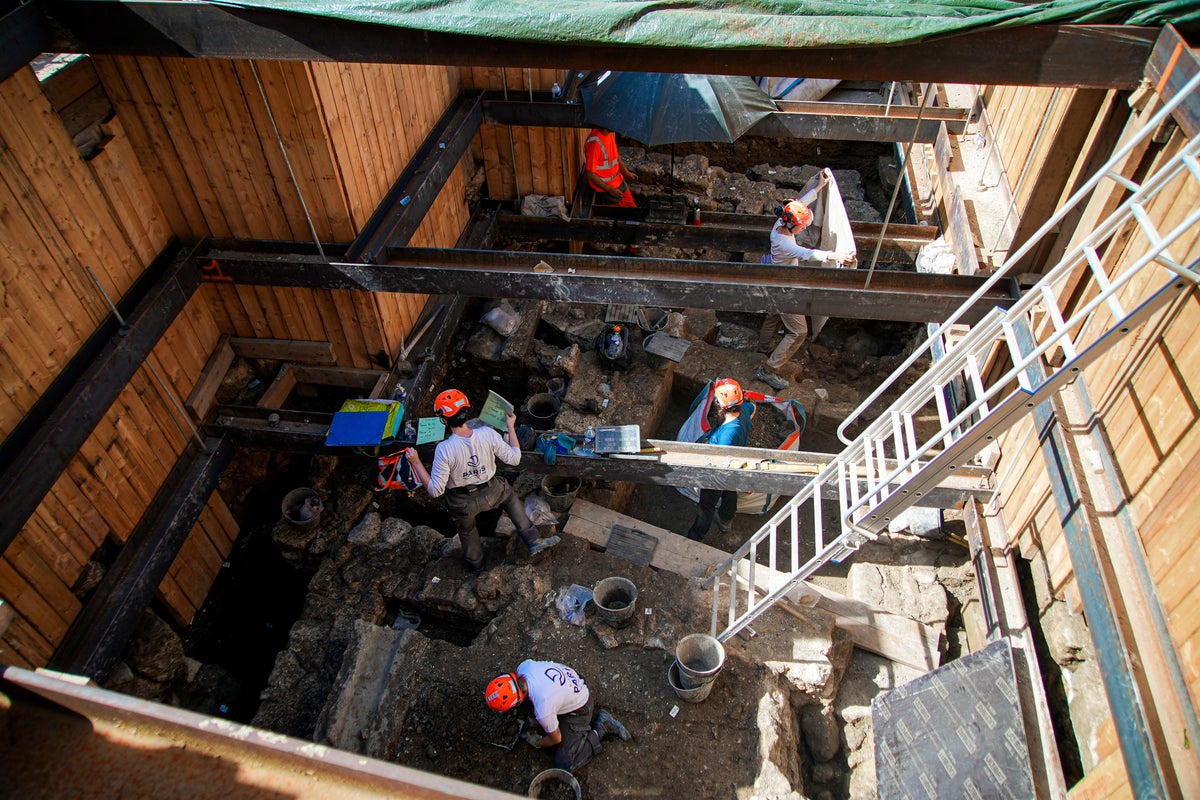
Four meters (13 feet) beneath them, a team of archaeologists is digging the other way — straight down and back in time, to Roman Paris 2,000 years ago.
In 2019, fire brought Notre Dame’s spire crashing down as the world watched. The cathedral was rebuilt and reopened in late 2024, and now Paris wants to soften the hot, bare square in front of it with trees and shade.
But in a city this old, the soil cannot be turned until what lies beneath it is excavated, in case it is damaged during works.
So a slice of Notre Dame’s forecourt has become an excavation site — an open pit ringed by barriers and crossed by a wooden walkway, a few steps from the line-up.
A modern Da Vinci Code
French media have dubbed it the “dig of the century.”
“It’s a rare opportunity for us to work on something that’s tangibly going to make a difference to the history of Paris,” Lucie Altenburg, a conservator with the Paris archaeology unit, told The Associated Press.
Among the hundreds of objects already found: a 4th-century coin stamped with the face of the Emperor Constantine, and shards of medieval pottery painted on the inside with marks no expert has yet deciphered — like a modern Da Vinci Code.
“It makes Notre Dame feel alive again,” said Emily Carter, 34, a tourist from Manchester waiting in line with her two children. “You come to see the cathedral, then realize there’s another city under your feet. That’s almost more moving.”
The first traces appear 50 centimeters (20 inches) down; 4 meters (13 feet) lower, the team is still pulling up the past. Some days they fill 15 crates — from ground that has lain untouched for decades.
Ancient cities have archaeologists monitoring digs
This is the bargain in every old city: the past is not in a museum down the street — it is under the street.
Cities rise. Each age builds on the rubble of the last, and the ground climbs with it; in Rome, it has risen about 9 meters (30 feet) since the empire fell in the 5th century AD.
When Athens built its metro for the 2004 Olympics, it set off the largest excavation in Greek history and turned up tens of thousands of objects, now shown in the stations themselves. Paris is no different.
It all comes from the island in the Seine, the Ile de la Cite, where Paris began.
Centuries later, Notre Dame rose on the same ground.
At the cathedral’s birth in 1163, the entire square was packed with medieval houses, split by a single street, said Camille Colonna, the archaeologist leading the dig.
Digging down, her team has reached their cellars — and therefore also the time in history they represent.
Below them lie Merovingian and Carolingian grain pits, from the sixth to the tenth centuries; below those, darker and deeper still, a dense Roman quarter from the fourth and fifth centuries.
Twenty centuries are stacked in 4 meters of earth — or about the height of two-and-a-half Napoleon Bonapartes standing on top of one another.
“Here you can see the layers — medieval Paris, Roman Paris, maybe even before that,” said Yasmine Benali, 22, an archaeology student watching from behind the barriers. “It makes the city feel less like a postcard and more like something still being discovered.”
Coins, ceramics and mysterious markings
The richest finds here come from the foulest place: the deep pits beneath the medieval houses, old latrines that doubled as rubbish dumps.
Out of them the team keeps lifting whole jugs and cups — thrown away centuries ago, yet still intact — among the broken plates and animal bones.
It’s “rare to find complete ceramics,” said Valentine Breloux, an archaeologist with the unit.
Here the soft waste cushioned them, and centuries later they miraculously came up whole.
Then some other objects came that confounded experts. As conservators cleaned what looked like ordinary medieval pottery, they found faint reddish writing painted on the inside — the same mysterious markings on shard after shard.
What they mean has yet to be deciphered.
Of everything she has cleaned from Notre Dame, Breloux said, these are the most “astonishing.”
Coins can help date the layers
The coins came up as black discs, eaten by rust. But under an X-ray, a face returned: it was Constantine, the Roman emperor who ruled in the early 300s AD.
Such objects also “can be invaluable in giving us the date of the (underground) layer,” Altenburg said.
The Roman finds are the ones the archaeologists value most — the deepest, oldest, and least understood. In Roman times, the town was called Lutetia, and its center lay across the river, on the Left Bank.
As the Roman empire collapsed, people pulled back to the Ile de la Cite, where Notre Dame would later rise, and fortified the island with walls of stone taken from earlier buildings.
Colonna’s team found some proof: a Roman doorstep found in the dig, taken from a much bigger building, carried over, turned upside down, and laid in a road as paving.
Paris houses thousands of finds in an archaeology center
Every find leaves the pit and travels north, to the city’s archaeology center — what Colonna calls “a huge archaeological store,” a treasure house of Paris.
For archaeologists, the cathedral dig is a rare treat. In France, like elsewhere, they work only where building work is about to begin — a bit like how industrial quarry workers end up unearthing dinosaur remains.
“This only happens because the city of Paris decided it wanted to beautify the area,” Altenburg said.
The new square should be mostly finished by 2028: a kind of woodland clearing, with 160 new trees and a thin film of water sliding over the stone to cool it in summer — part of how Paris is bracing for ever hotter summers induced by global warming.
The tourists who now wait in the bare sun beneath the gargoyles will, in a few summers, line up in the shade.
The old underground parking lot will reopen as a visitor center looking onto the Seine.
Until then, the Notre Dame team wants to go deeper still — past the Romans, toward whoever came before them, the Gauls who gave the city its first name.
“The hope is that we are able to go back in time even further than we’ve ever been before,” Altenburg said.
___
Nicolas Garriga in Paris contributed