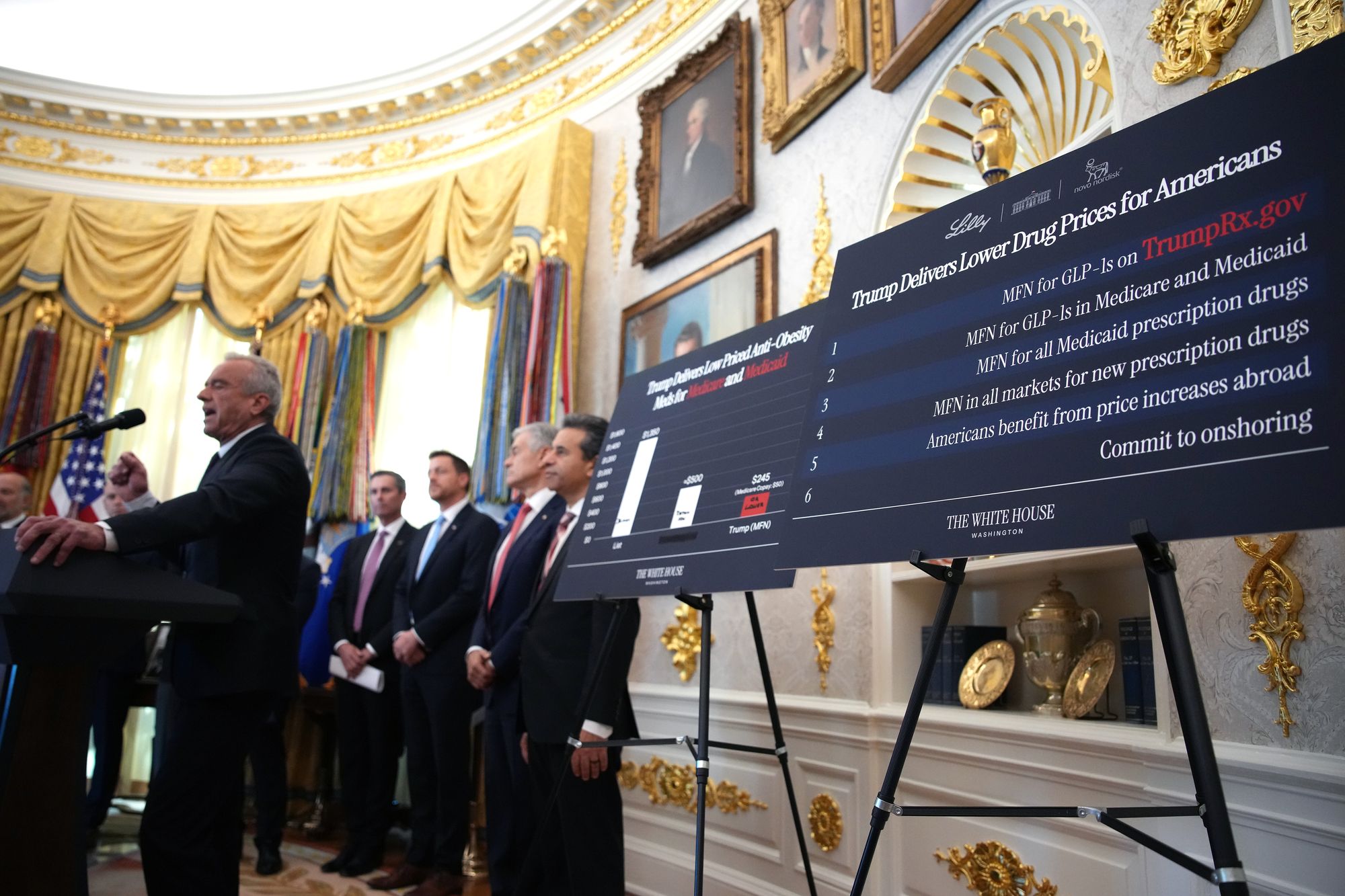
Millions more Americans will qualify for obesity medications at just $50 a month under a new Medicare program starting on Wednesday, bringing these highly effective drugs to people aged 65 and older at an affordable price.
The US Centers for Medicare & Medicaid Services’ 18-month trial program will, for the first time, offer Novo Nordisk’s Wegovy and Eli Lilly’s Foundayo and Zepbound as a weight-loss treatment alone.
Medicare, which also covers people with disabilities, had previously been barred from weight-loss coverage, paying for the drugs only when prescribed for co-conditions like cardiovascular issues and severe fatty liver disease. The program now offers three pathways for some subscribers to qualify.
Eligible patients are estimated in the single-digit millions, a US official recently stated. Wall Street analysts predict this will amount to billions of dollars in revenue for the drugmakers. This new pricing marks a remarkable shift from recent years, when patients faced steep out-of-pocket costs for these drugs, with or without insurance.
However, some doctors and pharmacists who spoke to Reuters warned that the Medicare approval process for the medicines will be slow and complicated. Concerns were also raised that the coverage might not be extended after 2027, while eight experts emphasized that regular follow-up care, a nutrition plan, and exercise are particularly important for older people.
Dr Christina Nguyen of weight-loss clinic Knownwell in Atlanta, said: “This is a big win. For decades, medicine has failed to recognise obesity as a disease. Even with (program) restrictions, we’ll be able to offer medications to many patients for the first time.”
PATIENTS MORE THAN READY
Katie Smith, 71, a retired teacher in Manassas, Virginia, said her doctor prescribed a GLP-1, but the cost at her pharmacy was prohibitive.
“The quote is $1,298.99. Medicare won’t cover it, because I’m not diabetic or have sleep apnea,” she said of conditions that are covered.
Smith said she has limited mobility after a spinal cord injury from a car accident in her 20s. She uses a walker, has weakness on one side and permanent nerve damage.
“It’s not good to be carrying this extra weight around. They say it’s diet and exercise. I’ve tried it all,” she said. “It could be that I won’t tolerate (a GLP-1), but I would so like to try it.”
Sandi Henderson, 77, of Oxnard, California, previously had lap-band surgery, but had to have the band removed following issues. She now takes a compounded GLP-1 because she cannot afford branded drugs, which sell for $149 to $399 a month for cash through the companies, or more at retail pharmacies.
“I’m thrilled. The ability to have this drug accessible to people who haven’t been able to afford it – just wow, it brings tears to my eyes,” Henderson said in a phone interview. “Then add to that, we’re going to save $1,000 plus that we can invest in other forms of our health.”
PENT-UP DEMAND
Executives from Eli Lilly and Novo Nordisk have pointed to estimates of as many as 20 million people qualifying for the program, though health research organization KFF this week said nearly 4 million would be eligible, based on 2023 data.
A CMS spokesperson declined to provide specific enrollment expectations, but Medicare Director Chris Klomp has estimated eligibility to be in the single-digit millions.
There is no shortage of pent-up demand. Yale Medicine obesity specialist Dr. Jorge Moreno said he has had some patients reschedule appointments to July, after the pilot program has launched.
“There is a lot of excitement already from patients,” he said. “I’ve been getting messages on an almost daily basis.”
Knownwell’s Nguyen said her practice has hired additional clinicians and prepared patients to expect signing up could take “a couple of weeks or more” for pre-authorization.
Two pharmacy trade organizations said they expect snags in the program’s implementation due to the mid-year launch, with little time for pharmacists to learn about the details and the requirement of prior authorization from prescribing clinicians.
They and a third trade group expect pharmacies to keep limited inventories of the expensive GLP-1 drugs. That could lead to increased wait times for patients, they said.
FOLLOW-UP AND RISKS
“This is an important access development, but older adults should approach GLP-1 therapy as part of a comprehensive obesity-care plan, not as a stand-alone medication,” said Dr. John Batsis, a geriatric specialist at University of North Carolina. “For older adults, the main concern is not simply pounds lost, but what type of weight is lost.”
With the rise of GLP-1 medications, concerns have mounted over the potential loss of muscle mass, and if weight is regained, whether it is as fat or muscle.
One of the biggest risks is the temporary nature of the program, said Dr. Elbert Huang, a primary care physician and director of University of Chicago’s Center for Chronic Disease Research and Policy.
If the pilot works well it could become a bridge to enhanced coverage by insurers who have expressed reservations about the program.
“To me, the big scientific uncertainty is how long does one need to stay on the drugs to reap the benefits of the weight loss?” Huang said. “If you’re someone signing up for this program, which is only in place temporarily, what happens after 2027?”