

The EU entry-exit system (EES) is “working absolutely like clockwork” in some places – but elsewhere it is “technological chaos”. That is the view of a leading expert on European red tape, Dr Nick Brown. But he predicts the next stage of European travel bureaucracy, the Etias “euro-visa”, will begin by the end of the year.
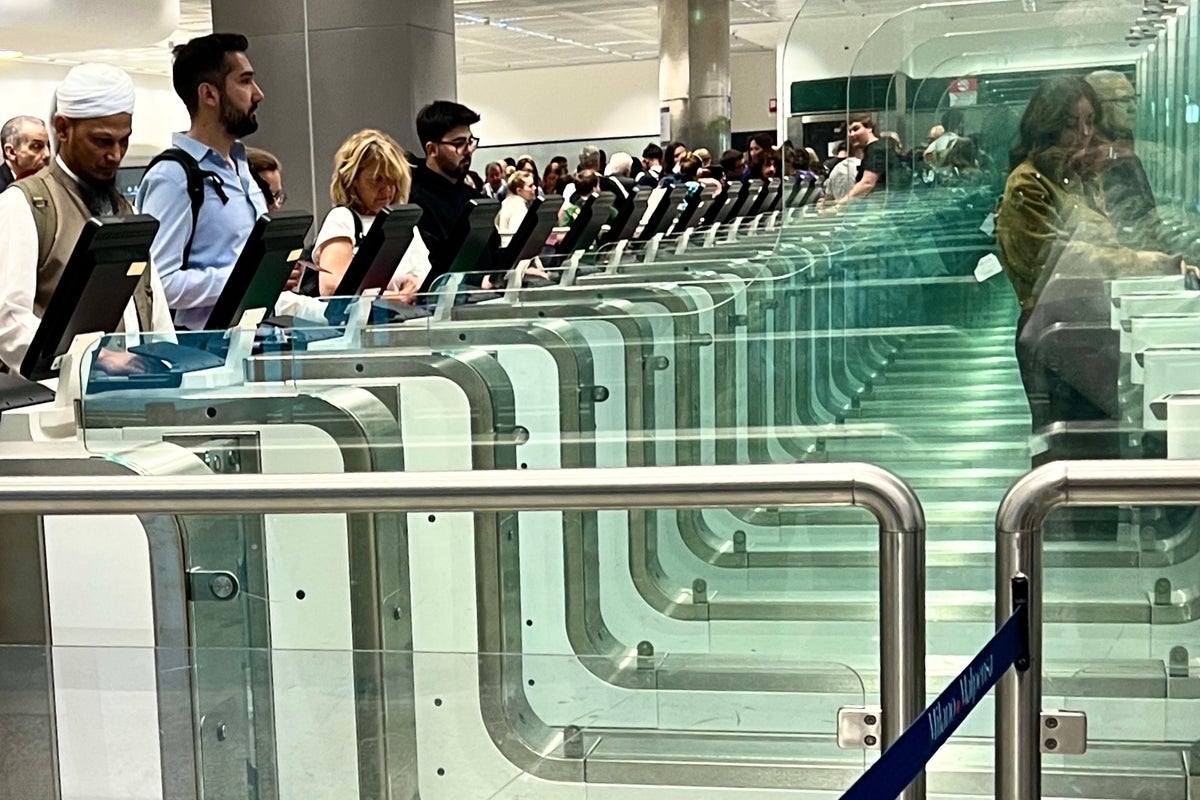
Since 10 April, all Schengen area frontiers are supposed to operate the entry-exit system according to clearly specified rules. The target group is “third-country nationals”: Americans, Australian, Venezuelans and many other citizens from outside the EU and wider Schengen area.
British travellers make up the majority of these visitors. Each time a traveller registers, they are supposed to have their facial biometric and four fingerprints from the right hand collected. On subsequent departures and arrivals, only one biometric – usually the face – is taken.
But the roll-out has proved extremely inconsistent and has triggered multiple problems: from more than 100 passengers left behind in Milan Linate airport due to long delays at passport control, to gridlock in Dover as the May half-term holiday got under way.
Speaking to The Independent’s daily travel podcast, Dr Brown summed up the failings.
“It’s a whole combination of things that go wrong when large organisations and governments try to put in place big systems,” he said.
“With ambitious plans in some places, EES is working absolutely like clockwork. In others, it isn’t. We hear stories of the national authorities doing the wrong thing, and in other cases we hear of technological chaos.”
Dr Brown, who has worked in IT for European bodies and elsewhere around the world, now lives on the Spanish island of Mallorca – where, he says, the system is working well.
“When I go to Palma airport, everything seems very, very well organised and run. The machines are working. People are giving the ‘right’ amount of biometrics. When they leave, they don’t even have to go to the famous EES kiosks, because the eGate does all of the exit formalities for them.”
As an Irish citizen, Dr Brown enjoys a permanent fast track at EU and UK borders. But before a flight to London earlier this month, he “did a little bit of time and motion” at Palma airport.
“People walked up, put their passport in. As long as they got the right page of their passport to put in the reader – the cardboard one, not the one with the little security copy of your photo – they were taking 45 seconds, reading the passport, creating the entry in the system, taking their photo, and taking their fingerprints.
“Actually a couple of people were looking around going, ‘Is that it?’ And the very helpful front-of-house staff were saying, ‘Yep, that’s fine’.
“Then you go to the eGate because the kiosk just pre-registers your biometric. The eGate is what actually admits you to Spain. So it’s absolutely possible to do it right.”
Dr Brown contrasts the smooth progress at Palma with Milan, where problems have been reported at all three airports serving the city.
“Milan appears to be making up everything as it goes along,” he said. “Systematically fingerprinting everybody going out even though they were fingerprinted coming in. They’re not giving any sort of leeway when planes are getting delayed.”
In other locations, collecting biometrics – which adds substantially to the time taken at borders – has been suspended when queues build up. Such flexibility, says Dr Brown, is reasonable.
“The rules are actually designed so that it doesn’t matter absolutely if you don’t get your biometrics done on one or other occasion. We’re not running a nuclear programme here. The idea is that the vast majority of people will have their biometrics taken or checked on most entries, and member states are expected to do that.”
The European legislation for the entry-exit system was passed early in 2016, before the UK voted to leave the EU and negotiated to become “third-country nationals” and therefore subject to EES.
The decisions hugely expanded the scope of the entry-exit system, says Dr Brown.
“EES was never designed to be implemented at 400 airports. It was designed to be implemented at 30 or 40 big airports where the planes come in from the Gulf, from North America, and the Americans and various other nationalities get off the plane.”
He is confident, though, that improved eGate technology will solve the problems in the years ahead.
Given the chaotic roll-out of the EES, many people have expressed scepticism that the European Travel Information and Authorisation System (Etias) will go ahead as planned in the fourth quarter of 2026.
The so-called euro-visa scheme involves an online permit that costs €20 (£17) and is valid for three years.
But Dr Brown says: “I think the EU will declare EES a success, and so they will maintain that date.
“Nobody needs to worry about that too much, however, because firstly it might slip. Also there will be a six-month phase-in period during which time Etias will not be required.
“Let’s say it goes live on 1 October. They’re not going to expect everyone who’s in a plane halfway across the Atlantic at that point when they land to go, ‘Well, why didn’t you get an Etias with the inflight wifi?’
“So you’ll have six months to get it. On that basis, you wouldn’t actually need it to get on the plane until 1 April [2027].”
He also predicted the new permit will not cause chaos at airports on arrival in the EU: “As with the US Esta, and as with the UK ETA for all but British and Irish nationals, if you don’t have an Etias, they aren’t going to let you on the plane.
“It might even make the EES process quicker because everyone who’s landing – their passport will already be in EES. So it might speed things up a little.”
Read more: What does the EU’s new entry-exit system mean for British travellers?