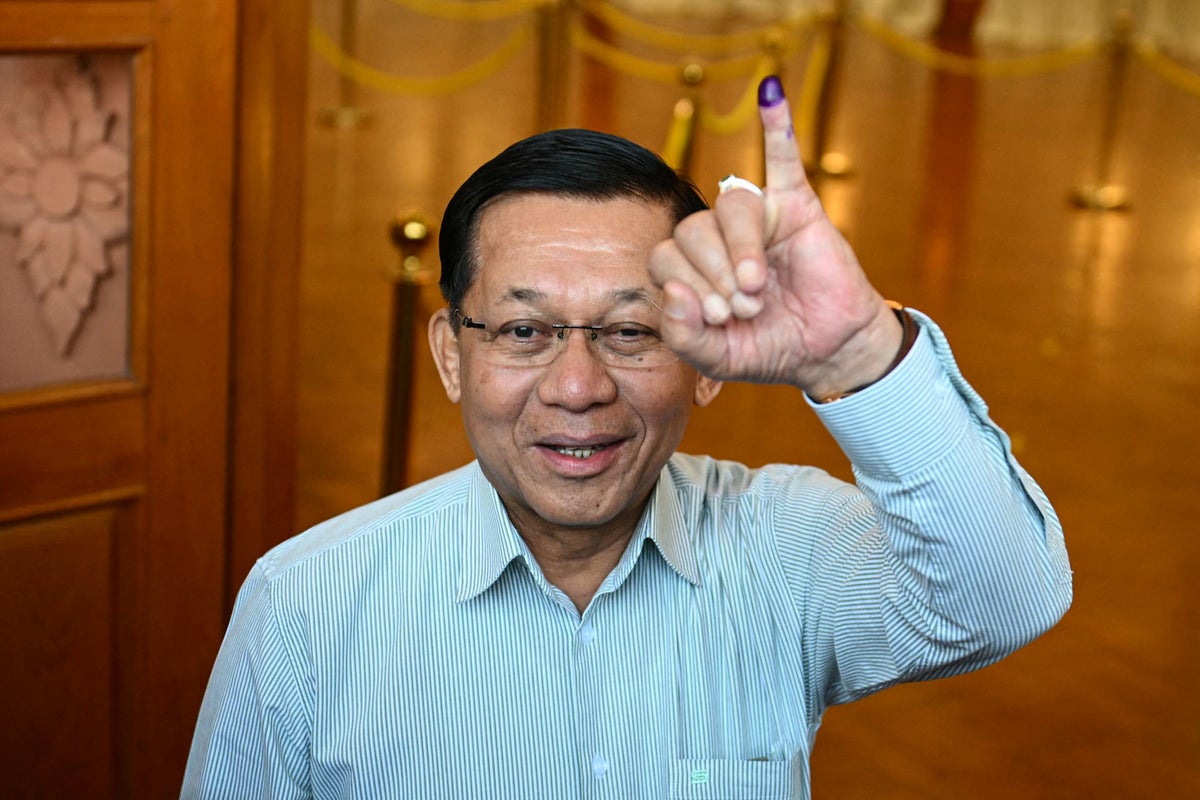
Myanmar’s lower house of the parliament nominated junta chief Min Aung Hlaing for the presidency on Monday, following a general election that paved the way to legitimise military rule.
Min Aung Hlaing, who has led Myanmar’s military since 2011, was one of two people named as vice-presidential candidates by lawmakers.
The nomination marks the initial step in the presidential race, with the union parliament set to choose the head of state from three vice-presidential candidates, as required under the constitution. Min Aung Hlaing, who has been sanctioned by several Western nations, including the US, is set to be chosen as the president, having been nominated alongside two loyalists who are not seen as serious contenders.
The war-torn nation opened its first parliamentary session in more than five years this month following an election that did not include major opposition parties, ensuring that the ruling military is set to retain a firm grasp on power.
Myanmar has been gripped by violence since a 2021 coup, in which the military wrested power from the democratically elected government of Nobel peace laureate Aung San Suu Kyi. The country has since been embroiled in a civil war, which killed thousands of people and displaced millions. The conflict intensified in 2023 after the Three Brotherhood Alliance launched offensives against the army.
“Senior General Min Aung Hlaing is proposed as a vice presidential candidate,” Kyaw Kway Htay, a lawmaker from a military-aligned party, said on the floor of the lower house of parliament, according to the state media.
The move follows a controversial election held amid raging conflict in December and January, won by the military-backed Union Solidarity and Development Party but widely derided as a sham by the UN and many Western countries. However, the regime has rejected the criticsm, arguing that the elections were free and fair and a pathway to peace.
The military and its allies hold nearly 90 per cent of the seats in the two-chamber parliament.
Under the country’s military-drafted 2008 Constitution, analysts say that presidential candidates cannot be active-duty military personnel or civil servants at the time of their nomination.
In a rare public signalling of transition by the military that has dominated Myanmar for decades, Min Aung Hlaing’s deputy said last week that the secretive institution’s leadership was set for a reshuffle. “This has been Min Aung Hlaing’s goal all along,” said independent analyst Htin Kyaw Aye, pointing to the general’s potential presidential role.
“It’s just a shift from ruling as a military leader to ruling as president.”
His loyalist Ye Win Oo has been appointed Myanmar’s commander-in-chief of defence services, according to military-owned Myawaddy TV.
Born to a family from Myanmar’s south, Min Aung Hlaing studied law before entering the military and rising steadily through the ranks, culminating in his promotion to military chief in 2011.
A rigid military leader and considered a ruthless operator, Min Aung Hlaing has also relied on a finely tuned ability to manage the country’s elites, using tactics that include handing important positions to loyalists and punishing political rivals.
He was seen as coveting the presidency, driven in part by the military party’s poor 2020 election showing to back the coup that ousted Aung San Suu Kyi.
Suu Kyi, Myanmar’s 80-year-old former leader, is serving a 27-year prison term on charges widely viewed as spurious and politically motivated. Her party won landslide victories in the 2015 and 2020 elections, but was forced to dissolve in 2023 after refusing to register under new military rules.