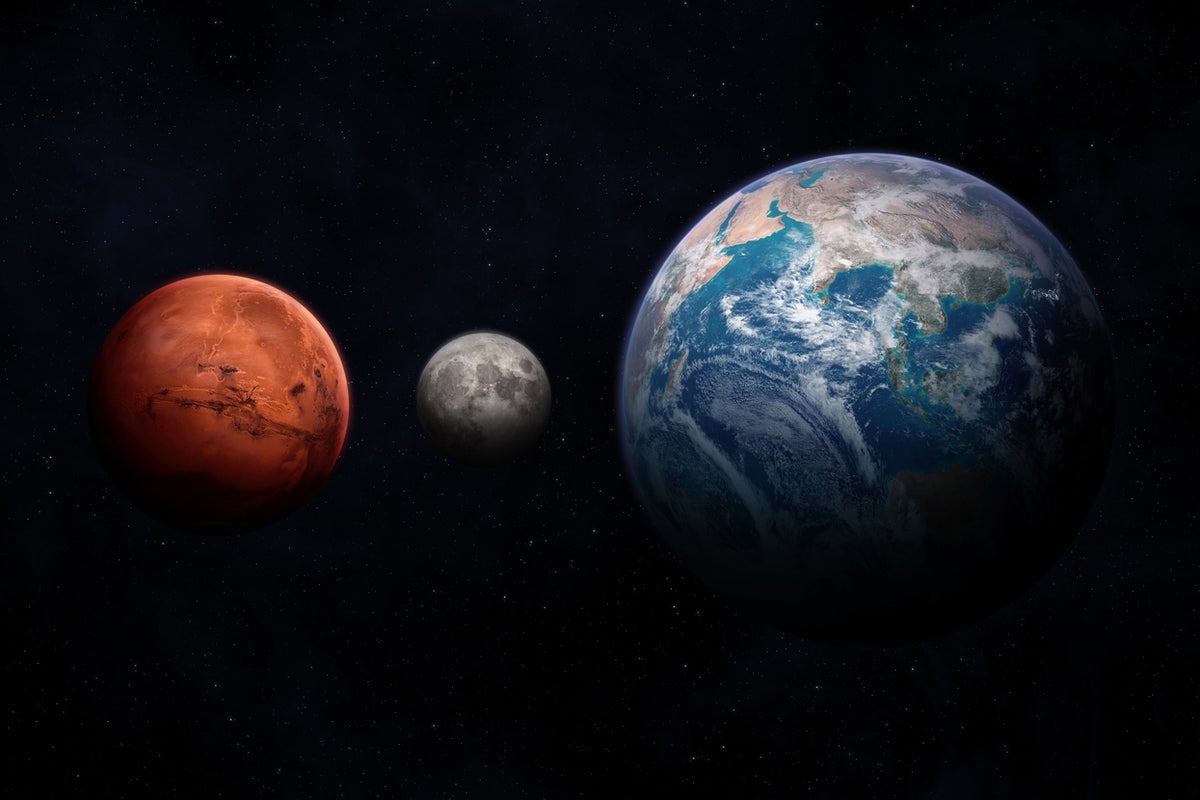
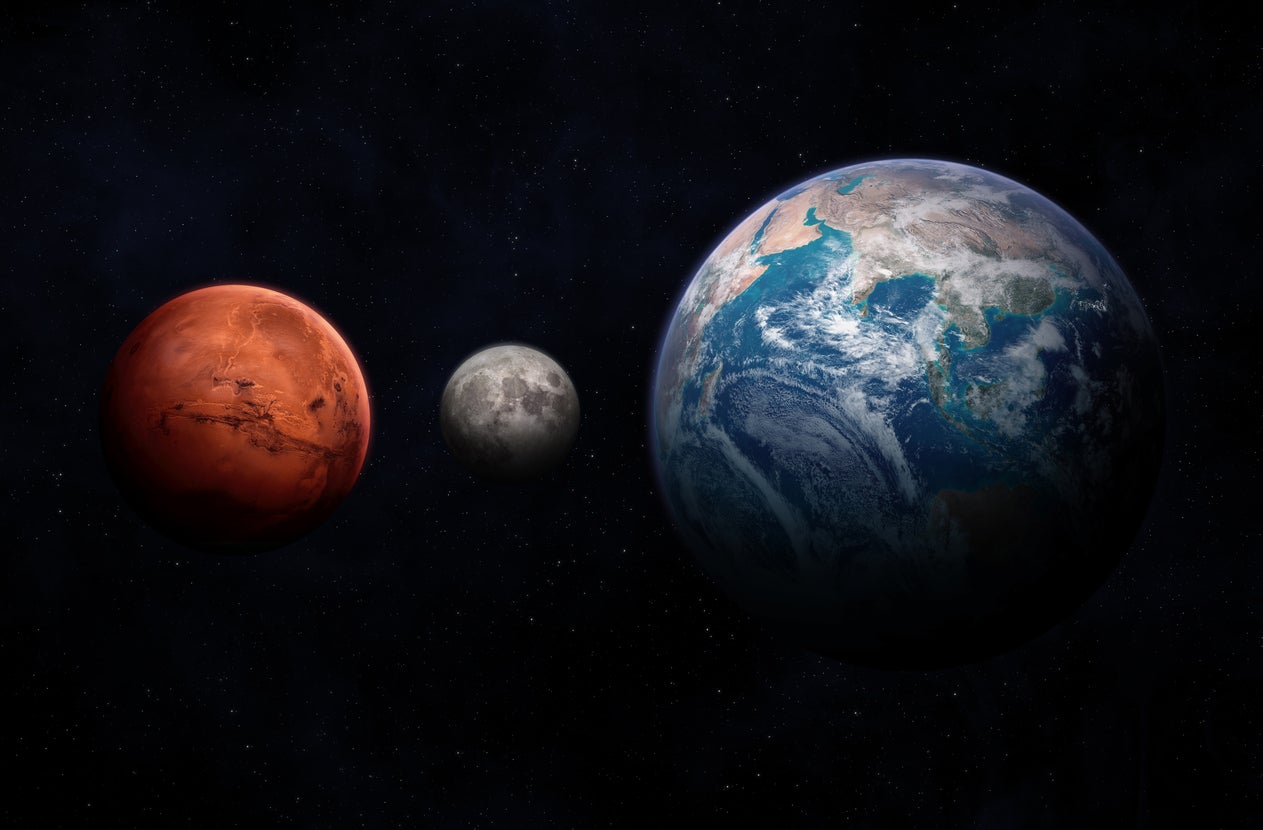
Mars is half the size of Earth, with a tenth of our planet’s mass, and at the nearest point in its orbit is over 33 million miles away. Yet new research highlights the extraordinary influence the red planet has on our own world.
Just as the Moon’s gravity drives the oceans’ tides, Mars’s gravity is now understood to play a significant role in shaping longer-term climate patterns on Earth, including the conditions which trigger ice ages.
Stephen Kane, a professor of planetary astrophysics at the University of California, launched a research project after examining recent studies linking shifts in Earth’s climate to faint gravitational tugs from Mars.
“I knew Mars had some effect on Earth, but I assumed it was tiny,” Professor Kane said. “I’d thought its gravitational influence would be too small to easily observe within Earth’s geologic history. I kind of set out to check my own assumptions.”
The previous studies had indicated that patterns preserved in deep‑sea sediment layers mirror long‑term climate cycles supposedly influenced by Mars, despite its small mass and vast distance from Earth.
Professor Kane took a very different approach, however, and ran large computer simulations of the solar system’s behaviour and of the long-term variations in Earth’s orbit and tilt, which govern how sunlight reaches the surface of our planet over tens of thousands to millions of years.
These cycles of shifting orbit and position, called Milankovitch cycles, are central to understanding how and when ice ages begin and end.
An ice age is a long period during which the planet has permanent ice sheets at the poles. Earth has experienced five, or possibly six, major ice ages in its 4.5 billion-year history. We are currently living through the Quaternary Ice Age, which began 2.6 million years ago, and reached a peak, or glacial maximum, during the Anglian stage, in which the ice sheet stretched as far south as the Isles of Scilly off Cornwall, and to what is now north London.
Within the five or six major ice ages that have swept across our planet, lasting millions of years, there are also smaller cycles of fluctuating ice levels.
The research team found the computer models predicted that Mars has a particular influence over these shorter cycles – one which lasts around 100,000 years, and another which lasts around 2.3 million years.