
UK TimesUK Times
  • Home
  • News
  • TV & Showbiz
  • Money
  • Health
  • Science
  • Sports
  • Travel
  • More
    • Web Stories
    • Trending
    • Press Release
What's Hot
Elizabeth Banks confronts AI in stylish new SXSW thriller

Elizabeth Banks confronts AI in stylish new SXSW thriller

21 March 2026
‘Most and least affordable’ parts of Britain for first-time buyers revealed – UK Times

‘Most and least affordable’ parts of Britain for first-time buyers revealed – UK Times

21 March 2026
Anger as Tennessee Senate passes bill forcing schools to display the Ten Commandments – UK Times

Anger as Tennessee Senate passes bill forcing schools to display the Ten Commandments – UK Times

21 March 2026
Facebook X (Twitter) Instagram
UK TimesUK Times
Subscribe
  • Home
  • News
  • TV & Showbiz
  • Money
  • Health
  • Science
  • Sports
  • Travel
  • More
    • Web Stories
    • Trending
    • Press Release
UK TimesUK Times
Home » King Harold’s 200-mile forced march to Battle of Hastings ‘implausible’, historians say – UK Times
News

King Harold’s 200-mile forced march to Battle of Hastings ‘implausible’, historians say – UK Times

By uk-times.com21 March 2026No Comments3 Mins Read
Facebook Twitter LinkedIn Telegram Pinterest Tumblr Reddit WhatsApp Email
King Harold’s 200-mile forced march to Battle of Hastings ‘implausible’, historians say – UK Times
Share
Facebook Twitter LinkedIn Pinterest Email

Get the free Morning Headlines email for news from our reporters across the world

Sign up to our free Morning Headlines email

Sign up to our free Morning Headlines email

Morning Headlines

New research suggests that the widely accepted narrative of King Harold’s army undertaking a near 200-mile forced march to the Battle of Hastings in 1066 is likely incorrect, with evidence pointing to troops largely travelling by ship instead.

The traditional account posits that after his victory at the Battle of Stamford Bridge in Yorkshire, Harold’s forces were compelled to rush south on foot to face the Norman invasion.

However, Professor Tom Licence, a medieval history and literature expert at the University of East Anglia, argues this narrative stems from a Victorian “misunderstanding”.

He contends that the Anglo-Saxon Chronicle, a key early record of English history, was misinterpreted.

While the Chronicle appears to imply Harold dismissed his fleet, forcing a foot march, Professor Licence suggests a record stating ships “came home” was mistakenly taken by Victorian historians to mean Harold disbanded his navy.

They actually returned to their home base of London and remained operational throughout the year, he argues.

“Harold’s weary, unmounted men covering nearly 200 miles in 10 days and then continuing straight to the Hastings peninsula is implausible given medieval roads and the aftermath of battle,” said Prof Licence.

“Only a mad general would have sent all his men on foot in this way if ship transports were available.”

He said that he noticed “multiple contemporary writers referring to Harold’s fleet, while modern historians were dismissing those references or trying to explain them away”.

“I checked the evidence for him having sent the fleet home and found that it was just a misunderstanding,” Prof Licence said.

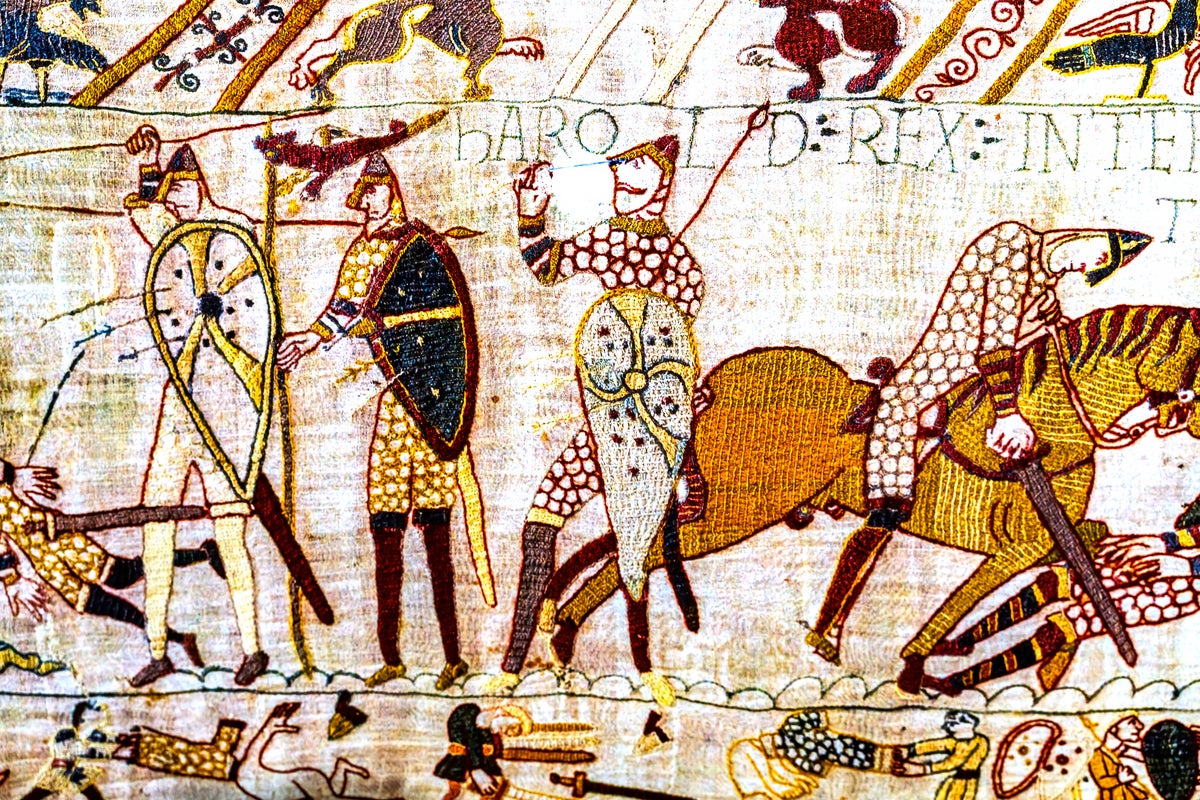
The Bayeux Tapestry depicting King Harold struck in the eye by an arrow
The Bayeux Tapestry depicting King Harold struck in the eye by an arrow (Bayeux Museum)

“I went looking in the sources for evidence of a forced march and found there wasn’t any.

“Harold’s campaign was not a desperate dash across England, it was a sophisticated land‑sea operation.

“The idea of a heroic march is a Victorian invention that has shaped our understanding, or misunderstanding, of 1066 for far too long.”

Contemporary sources describe Harold sending hundreds of ships to block Duke William of Normandy – also known as William the Conqueror – after the Norman landing.

Prof Licence said the fleet was used to defend the south coast, then to support Harold’s campaign against the Viking invasion led by Harald Hardrada, then to head back south to face the Norman invasion.

Prof Licence said the research “reframes the events of 1066 and highlights a previously overlooked aspect of Anglo‑Saxon maritime capability”.

“Harold was not a reactive, exhausted commander, he was a strategist using England’s naval assets to wage a co-ordinated defence,” he said.

Harold’s death in the Battle of Hastings is depicted in the Bayeux Tapestry, which shows him clutching an arrow to his eye.

The victorious William became the first Norman king of England.

Professor Michael Lewis, curator of the Bayeux Tapestry Exhibition at the British Museum, said: “With the Bayeux Tapestry coming to the British Museum later this year, Prof Tom Licence’s research shows there is much still to be learned about the events of 1066.

“It is clearly a fascinating discovery that following the Battle of Stamford Bridge Harold took an easier, more logical, trip south by ship to meet Duke William in battle, rather than a long trek overland, as has long been supposed.

“Hopefully this new research inspires people to also come and see the tapestry whilst it is in London.”

Prof Licence is to present his research at The Maritime and Political World of 1066 conference at Oxford University on March 24.

Share. Facebook Twitter Pinterest LinkedIn Tumblr Telegram Email

Related News

‘Most and least affordable’ parts of Britain for first-time buyers revealed – UK Times

‘Most and least affordable’ parts of Britain for first-time buyers revealed – UK Times

21 March 2026
Anger as Tennessee Senate passes bill forcing schools to display the Ten Commandments – UK Times

Anger as Tennessee Senate passes bill forcing schools to display the Ten Commandments – UK Times

21 March 2026
Trump’s former counterterrorism chief Joe Kent hits back over FBI leak probe in Megyn Kelly interview: ‘I did nothing wrong’ – UK Times

Trump’s former counterterrorism chief Joe Kent hits back over FBI leak probe in Megyn Kelly interview: ‘I did nothing wrong’ – UK Times

21 March 2026
Cuba refuses to let US Embassy in Havana import diesel for its generators – UK Times

Cuba refuses to let US Embassy in Havana import diesel for its generators – UK Times

21 March 2026
Trump admits Melania doesn’t like the sound of construction at the White House but ‘it makes me happy’ – UK Times

Trump admits Melania doesn’t like the sound of construction at the White House but ‘it makes me happy’ – UK Times

21 March 2026
Taylor Tomlinson’s Netflix special is too ungodly for many churches. This one welcomed her. – UK Times

Taylor Tomlinson’s Netflix special is too ungodly for many churches. This one welcomed her. – UK Times

21 March 2026
Top News
Elizabeth Banks confronts AI in stylish new SXSW thriller

Elizabeth Banks confronts AI in stylish new SXSW thriller

21 March 2026
‘Most and least affordable’ parts of Britain for first-time buyers revealed – UK Times

‘Most and least affordable’ parts of Britain for first-time buyers revealed – UK Times

21 March 2026
Anger as Tennessee Senate passes bill forcing schools to display the Ten Commandments – UK Times

Anger as Tennessee Senate passes bill forcing schools to display the Ten Commandments – UK Times

21 March 2026

Subscribe to Updates

Get the latest UK news and updates directly to your inbox.

Recent Posts

  • Elizabeth Banks confronts AI in stylish new SXSW thriller
  • ‘Most and least affordable’ parts of Britain for first-time buyers revealed – UK Times
  • Anger as Tennessee Senate passes bill forcing schools to display the Ten Commandments – UK Times
  • Family of ex-Yankees star Brett Gardner sues Costa Rican resort one year after son’s tragic death at 14
  • Trump’s former counterterrorism chief Joe Kent hits back over FBI leak probe in Megyn Kelly interview: ‘I did nothing wrong’ – UK Times

Recent Comments

No comments to show.
© 2026 UK Times. All Rights Reserved.
  • Privacy Policy
  • Terms of use
  • Advertise
  • Contact Us

Type above and press Enter to search. Press Esc to cancel.

Go to mobile version