A new mural unveiled in a central Tehran square contains a direct warning by Iran to the United States to not attempt a military strike on the country.
The painted image of several damaged planes on the flight deck of an aircraft carrier bears the slogan: “If you sow the wind, you will reap the whirlwind.”
The unveiling of the mural in Enghelab Square comes as the USS Abraham Lincoln aircraft carrier and accompanying warships move towards the region. U.S. President Donald Trump has said the ships are being moved “just in case” he decides to take action.
“We have a massive fleet heading in that direction and maybe we won’t have to use it,” Trump said Thursday.
Enghelab Square is used for gatherings called by the state, and authorities change its mural based on national occasions. On Saturday, the commander of Iran’s paramilitary Revolutionary Guard warned that his force is “more ready than ever, finger on the trigger.”
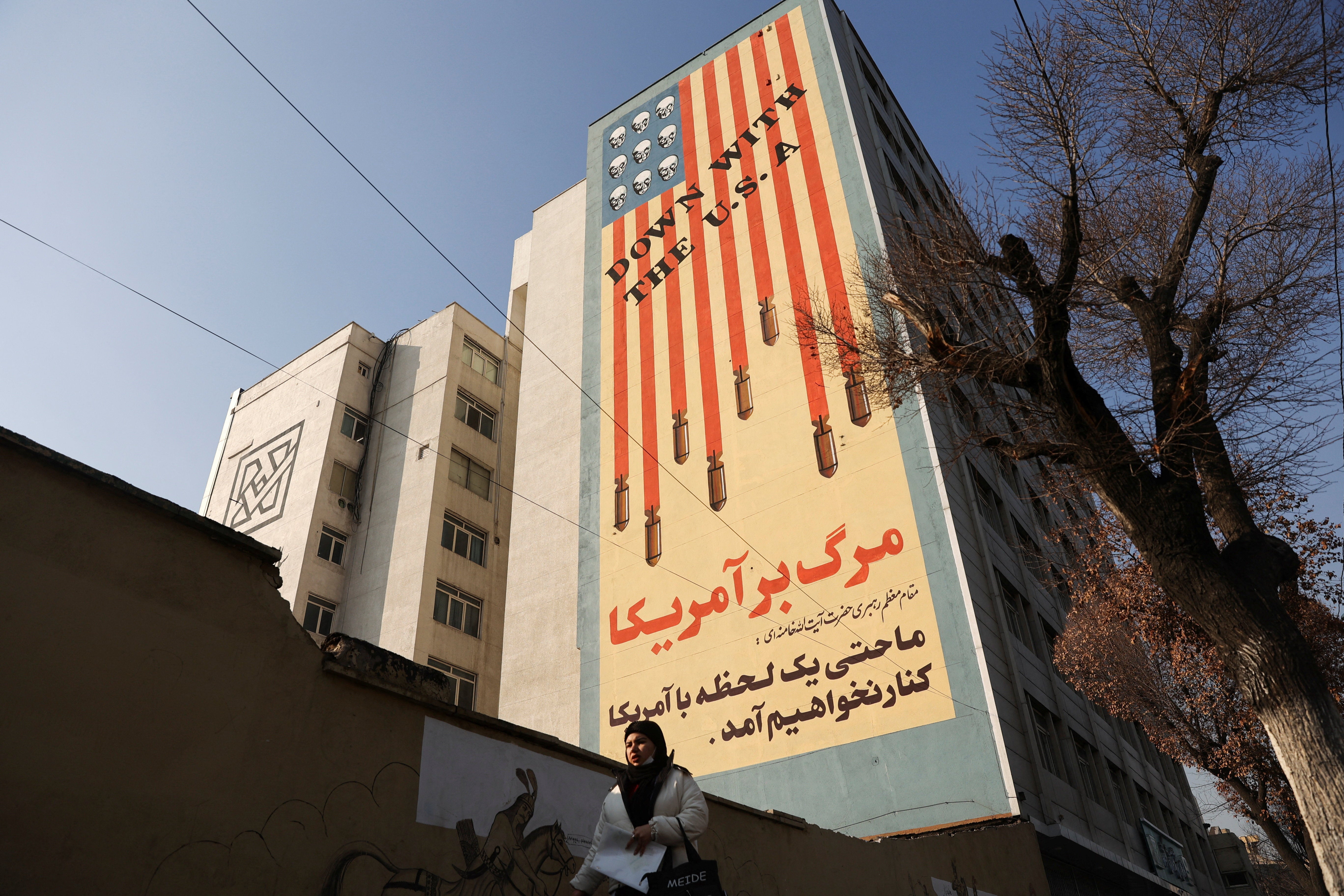
Tension between the U.S. and Iran has spiked in the wake of a brutal crackdown on nationwide protests that saw thousands of people killed and tens of thousands arrested. Trump had threatened military action if Iran continued to kill peaceful protesters or carried out mass executions of those detained.
There have been no further protests for days, and Trump claimed recently that Tehran had halted the executions of about 800 arrested protesters — a claim Iran’s top prosecutor called “completely false.”
But Trump has indicated he is keeping his options open, saying on Thursday that any military action would make last June’s U.S. strikes on Iranian nuclear sites “look like peanuts.”
U.S. Central Command said on social media that its Air Force F-15E Strike Eagle now has a presence in the Middle East, noting the fighter jet “enhances combat readiness and promotes regional security and stability.”
Similarly, the U.K. Ministry of Defense said Thursday that it deployed its Typhoon fighter jets to Qatar “in a defensive capacity.”
The protests in Iran began on Dec. 28, sparked by the fall of the Iranian currency, the rial, and quickly spread across the country. They were met by a violent crackdown by Iran’s theocracy, which does not tolerate dissent.
The death toll reported by activists has continued to rise since the end of the demonstrations, as information trickles out despite a more than two-week internet blackout — the most comprehensive in Iran’s history.
The U.S.-based Human Rights Activists News Agency on Sunday put the death toll at 5,459, with the number expected to increase. It says more than 40,800 people have been arrested.
The group’s figures have been accurate in previous unrest and rely on a network of activists in Iran to verify deaths. That death toll exceeds that of any other round of protest or unrest there in decades, and recalls the chaos surrounding Iran’s 1979 Islamic Revolution. The AP has not been able to independently verify the toll.
Iran’s government has put the death toll at a far lower 3,117, saying 2,427 were civilians and security forces, and labeled the rest “terrorists.” In the past, Iran’s theocracy has undercounted or not reported fatalities from unrest.