

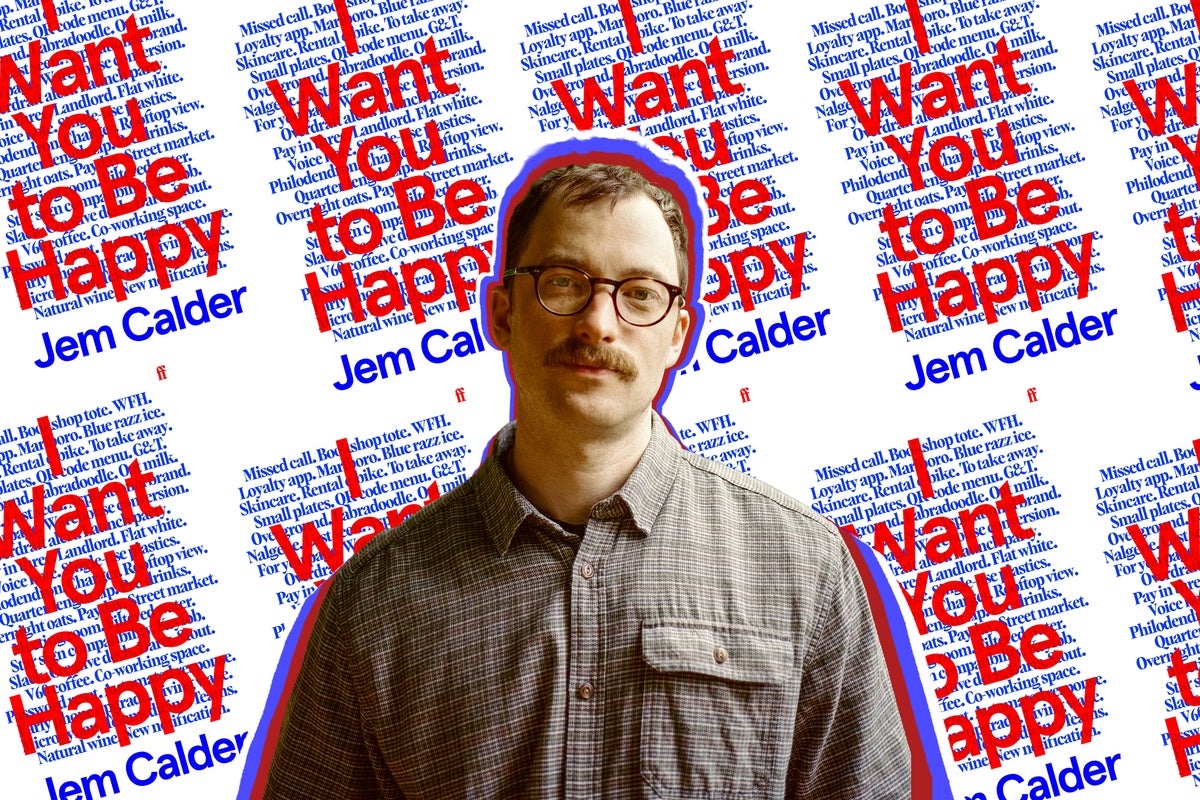
The cover of Jem Calder’s I Want You to Be Happy, one of the most talked-about debut novels of the year, is swathed in phrases that would make a Victorian man very confused. Slack. For you page. Last seen. Voice note. WFH. Small plates. Bookshop tote. The book’s likely millennial and Gen Z audience, though, are well versed in this parlance. These are the words that summon the onslaught-iness of modern life. Here, communication is instant, constant, but also faceless. Culture is funnelled through algorithms and trendy viral merch. It has become normal to pay £14 for a caramelised hispi cabbage.
Calder evokes this bleak state of affairs in his pages with a deft humour, his characters trapped in an eternal quest to optimise their lives, drowning in overwhelm while also trying to deal with the weird, messy stuff of just being a human in the world. Chuck, a copywriter in his mid-thirties, is a wannabe novelist who’s just broken up with his long-term fiancée, probably because of some kind of early-onset midlife crisis. On a night out, he meets Joey; she’s 23, works in a coffee shop, lives in a grotty houseshare, and yearns to be a poet. A poet! For a man whose sole interactions are now on Teams calls and with Deliveroo drivers, what could be more alluring?
Published this month to a wave of hype, helped along by an enthusiastic blurb from Sally Rooney (“I couldn’t stop reading”), I Want You to Be Happy is set to be the “It” book of the summer. It will prompt enjoyable debates (is Chuck a loser? Did anyone actually enjoy going to a Halloween party in their twenties?), but it might also leave you feeling a bit chastened by Calder’s merciless observations of how our hours of pointless scrolling and spending are making us feel empty inside.
It might be slightly reassuring, then, to know that these existential conundrums have always been with us to some degree. I Want You to Be Happy conjures the same mood as one of Calder’s favourite writers, the American novelist Richard Yates – and he was writing in the 1960s. Yates’s stories of a suffocating middle-class suburbia are full of men and women in miserable marriages, trapped by the confines of the nine-to-five, wondering whether to abandon their dreams. April and Frank Wheeler from Revolutionary Road could have been Chuck and Joey, if Frank had been able to ghost April rather than marry her before he ever really knew her and then silently hate her for years.
Calder, 34, didn’t do a creative writing degree, instead learning his craft from the close study of authors like Yates and Elizabeth Taylor. “If I read something I really like, then I’ll read it again and really try and figure out what the mechanics of it are,” he tells me when we meet at the Barbican cinema café, the sort of artsy venue where you might bump into one of his characters.
In prose that is pared back and compulsively readable, Calder captures the sometimes exhilarating, sometimes cruel (and maybe, in the end, impossible) experience of being young in London. Here, everything is too expensive and everyone is looking at their phone all the time, so, in lieu of finding anything solid to hang on to, Chuck and Joey cling to each other.
In the novel, brands and apps all largely have the same attritional effect of making modern life chillingly convenient, frictionless and full of distractions. “There’s a constant interchangeability that gets quite unsettling after a while. You do kind of feel like a ghost,” says Calder. Chuck and Joey want to live creative lives, yet can’t help succumbing to 10pm internet wormholes or the nag of a smartphone in their pocket (at one point, Joey “dual-thumbed through the internet for thirty continuous minutes”). They know culture can give their lives meaning, but could never bring themselves to be “content creators”. They want to do something real.
Having grown up in an isolated “farmy area” in Cambridge, under the shadow of a threatened Stansted airport expansion that would have seen his family home knocked down, Calder now lives in London. Mustachioed, spectacled and sweater-wearing, he studied English at Leeds and describes writing as “a very private thing”. Currently he works in an “extremely dull job” where he “edits reports for large companies”; none of his colleagues know he is about to publish a major novel. “I am a bit concerned, because I had an interview with The Guardian at the weekend and I’m conscious that people in my office might have read it.”
He has had both Chuck’s job and Joey’s – copywriter and coffee-shop worker – but copywriting sapped the creative energy he wanted to keep for his fiction. A few years ago, he wrote for Granta about taking inspiration from American writer George Saunders and sneaking time to write fiction at his “real” job: “I wrote in the address bar of my web browser, in spreadsheet cells, in emails I addressed to myself.”
Calder shares an increasingly common trait of zeitgeisty authors: he is actually not very online. You won’t find any social media profiles of him on the internet – he made a choice a decade ago to drastically cut back on that aspect of his life. “I had to pare down a lot of distractions because I wasn’t reading as much as I wanted to. That was pretty much the first thing to go; like, that was obviously a waste of my time.”
So he may not see the posts on Goodreads about Chuck being “an insufferable piece of s***”. Calder’s leading man is emotionally closed off, drinks too much, and phones it in at work – but is he really a loser, or actually quite vulnerable? “I do feel like I’ve read a few things recently where men are quite idealised characters and the women feel more real, and I wanted to have the male character have this kind of ugliness and darkness, and this kind of problematic thought process that doesn’t even sit very comfortably with him,” Calder explains. “Like he’s just host to all these thoughts.” When he was writing Joey’s scenes, she often felt “like a reprieve from some of the darkness you get with him”. But some readers have also related to Chuck. “Someone was telling me that they were the mother to someone they thought was a Chuck. I was like, damn, that’s funny.”
I Want You to Be Happy’s “It” book status means inevitable comparisons to Rooney, who helped set Calder’s career in motion after she accepted a short story of his when she was the editor of Irish literary magazine The Stinging Fly. That led the way for the publication, in 2022, of Reward System, his first short story collection. But his novel wryly sees comparisons like this off at the pass; looking at the blurbs on a poetry book that Joey covets, Chuck scoffs: “The only good thing they can say about this is it reminds them of other things.”
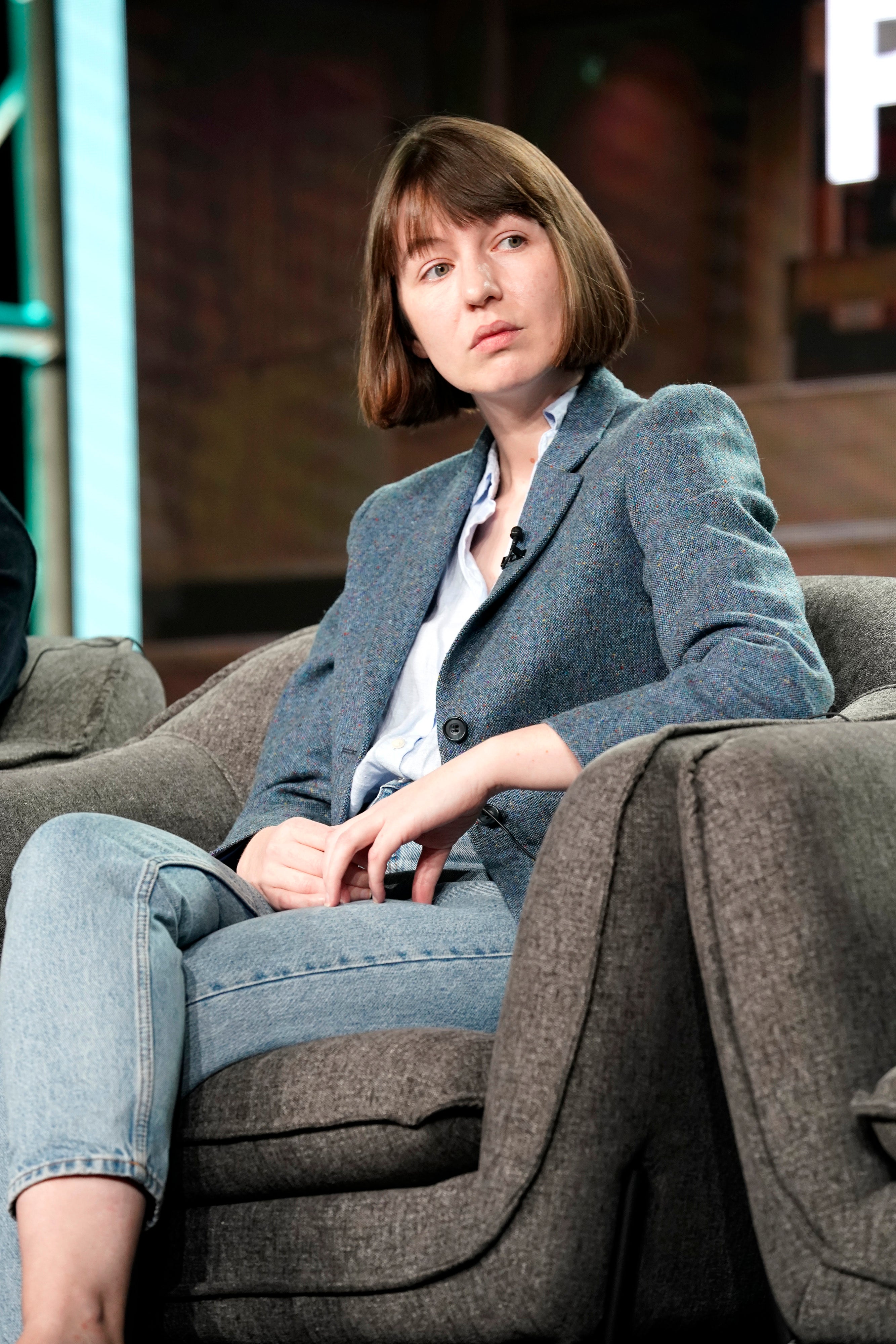
One Rooney-esque element of the novel, though, is sex that that isn’t sexy: Chuck and Joey have a lot of intimate encounters that feel eerily lonely and disconnected. Given this material, it’s a surprise to hear that Calder’s mum is one of his first readers (along with his girlfriend and agent). “She just has really good taste, to be honest,” he explains. “She has a very ‘no bulls***’ reading style.”
What tips I Want You to Be Happy into true brilliance is a dazzling, excruciating setpiece towards the end of the book, where Chuck shares the first draft of his novel with Joey. It’s a moment that feels full of risk and danger for both parties, because the small business of baring your soul through art always does. What is Calder like when he shares his work…? “I’m incredibly, incredibly sensitive about it,” he laughs. “There are times in the past where I haven’t accepted editors’ insights, and I live to regret those. Yeah, I get extremely upset when people don’t like my books.”
A lot of people will like I Want You to Be Happy, which you can readin one sitting; it slips down like a thimble of wine at an overpriced hipster bar. The writing of it came to Calder “like a complete gift from above”, arriving in his mind clearly and in full. “I kind of just transcribed it,” he says. But some readers have found its ending too bleak. Perhaps you shouldn’t read it if you’re 23 (it makes being in your mid-thirties seem quite depressing), but there is something noble about the choices Chuck and Joey make: an exhausted acceptance of a life of creative decks and flat whites and constant notifications on the one hand; a rejection of it on the other.
For me, there’s something hopeful in those final pages. Calder agrees. “It’s an optimistic ending, for sure.”
‘I Want You to Be Happy’ is published by Faber