

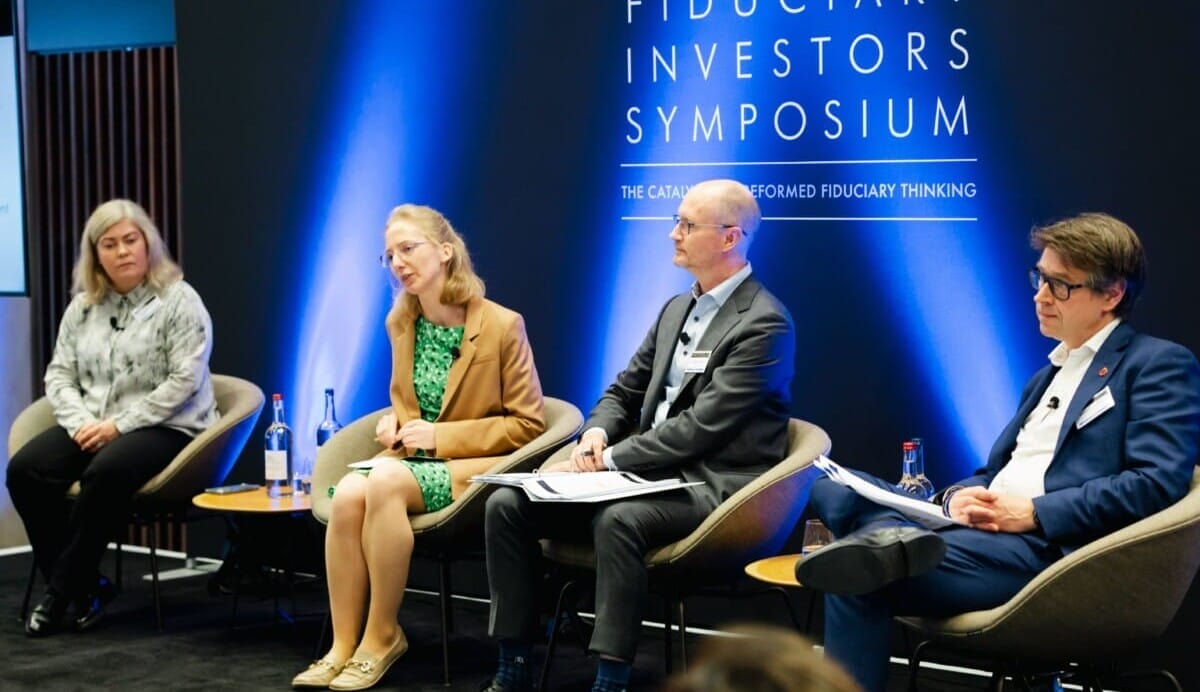
Karoliina Lindroos (L), Karolina Malisauskaite, Brendan Swift (Conexus Financial) and Richard Tomlinson. Photo: Jack Smith
Institutional investors the world over are increasingly examining the extent to which they invest in the defence sector as issues around national security move to the centre stage. The prospect of compelling returns, as European countries like Germany and Poland crank up defence spending, is also leading investors to look again at a sector set to account for a much larger slice of the index in coming years.
For some, like Finland’s €63 billion ($73 billion) pension insurer Ilmarinen, investing in defence sits relatively comfortably with its stakeholders who share a long border with Russia, which invaded Ukraine nearly four years ago.
But for others, putting more capital to work in defence and investing “in things that kill people” remains a highly complex conversation and made for one of the compelling panel sessions at the Fiduciary Investors Symposium Oxford.
Last year, Ilmarinen changed its ESG policies to enable investment in the controversial weapons sectors of NATO countries. The new policy facilitates the consideration of investment in companies that have revenue linked to controversial weapons, excluding biological and chemical weapons, and comes with violation screens and a due diligence process.
“Previously, we allowed investments in conventional weapons and dual use, but we had a zero limit on investing in companies with any revenue linked to controversial weapons – so all companies with any involvement in controversial weapons were excluded,” said Karoliina Lindroos, head of responsible investments, Ilmarinen Mutual Pension, speaking at the conference.
The old strategy ruled out investment in technology companies and airlines, not just pure play defence companies and the need for a rethink came when Russia invaded Ukraine, she continued.
“We considered the need for credible defence in Europe, and also foresaw that many companies would start to have more business linkages with defence and security. We thought that this type of binary policy may not serve us as well as it served us in the past, and we needed more nuance. In practice, companies operating in other sectors such as remote sensing or communications are now building use cases and linkages to defence and security. These types of transformation, where different technology companies integrate into the defence ecosystem, is changing the sector,” she said.
As the investment sector expands, defence is likely to become a larger part of the MSCI.
That’s something that KLP, the Norwegian passive investor with a keen ESG focus is well prepared to navigate through an established policy shaped around exclusions and in-depth due diligence.
Karolina Malisauskaite, analyst at KLP, explained how the investor screens out companies at risk of human rights violations in a strategy that has recently led to a series of exclusions of corporates supplying goods to Israel that have breached humanitarian law in Gaza.
But she said screening out companies is complicated because it is up to governments whether they license exports to countries in active conflict.
KLP has a nuanced approach to nuclear investment whereby it doesn’t exclude all companies that have a tie to nuclear weapons. Rather, it ascertains how central the company’s contribution is to the production and maintenance of nuclear weaponry.
And when the investor excludes a defence company, it typically re-invests into the same sector by overweighting other companies in aerospace or industrial and machinery sectors, natural candidates to provide to the defence sector.
Change the framing
Pension funds further away from Europe’s front line are typically a few steps behind in their thinking.
Richard Tomlinson, chief investment officer of LPPI, said only now are the investment team at the LGPS pool beginning to have important conversations about investing in defence. “The world is very different now and that does mean you need to change the way you frame things.”
The conversation has revealed the different levels of knowledge and dispersion of opinions amongst stakeholders, and the need for trustee boards to engage on the issue. Government leadership, alongside an honest debate about the size of the threat and the need for capital, would also help.
“Getting stakeholder cohesion is very difficult and requires a clear policy process,” he said.
Investors also reflected on the many different strands of the defence industry, and how the opportunity set is changing. Companies don’t just make missiles; the sector encompasses innovation and technology spanning AI, autonomous vehicles and drones so that a blanket exclusion would reduce the investment universe. Moreover, in the UK, defence is now a major part of an industrial strategy.
Elsewhere, index stalwarts like Airbus, Rolls-Royce Group, BAE Systems and Thales, to name a few, have many other consumer-related seams to their businesses.
Cybersecurity is also a vital seam to national security as hybrid warfare grows. And for some investors, investing in defence is the D (democracy) of ESG, and should be part and parcel of contributing to a world worth living in.