
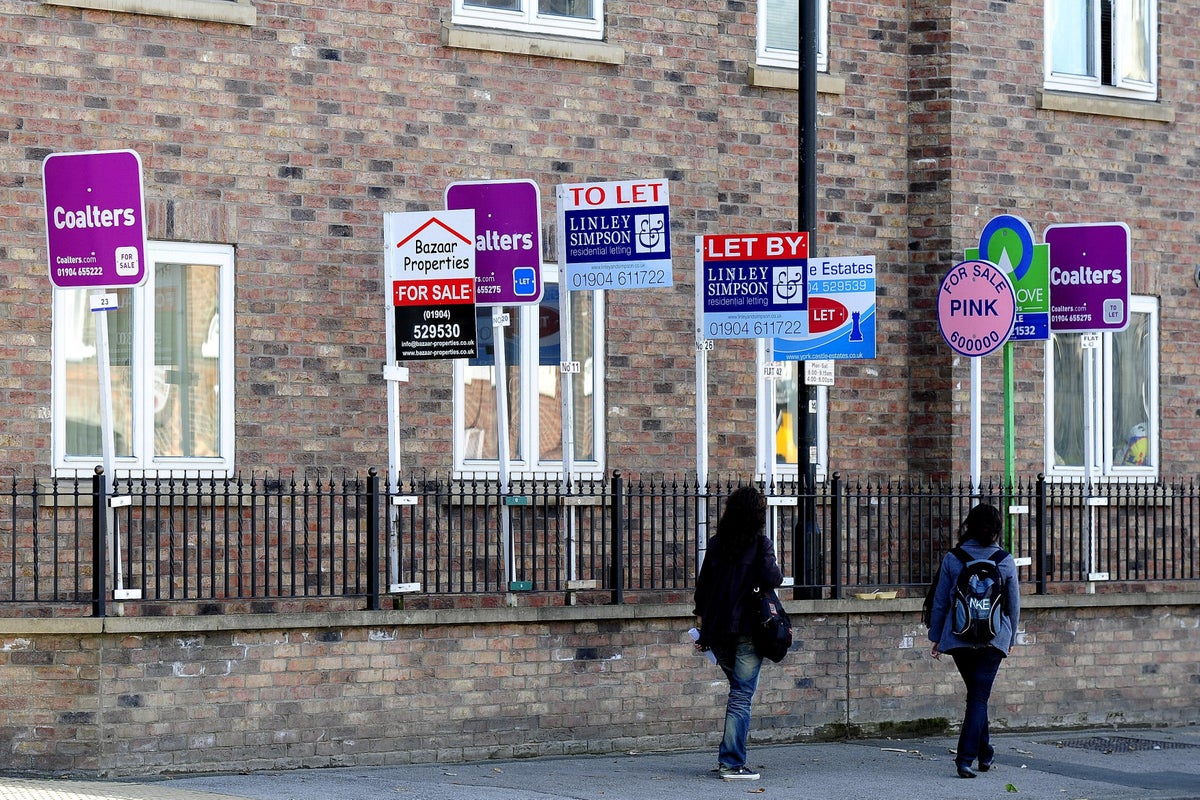
The average price tag on a home jumped by £4,333 month-on-month in May amid “surprisingly strong” market confidence, according to a property website.
Across Britain, the typical price of a home coming to market increased by 1.2% to reach £378,304, Rightmove said.
The increase was stronger than the average 1.0% month-on-month rise seen in May in recent years, the website added.
Despite the increase, average prices have fallen by 0.3% since May 2025, the report said.
The annual price fall of 0.3% also masks major regional discrepancies, Rightmove added.
It said asking prices in the more affordable North East (2.7%) and North West (2.6%) of England are continuing to increase annually while London (minus 2.4%) and the South East (minus 1.6%) are seeing annual asking price falls.
This uneven price performance is unfolding amid an 11-year high for buyer choice, with the number of homes for sale at its highest level for this time of year since 2015, the report said.
With 32% of listings of existing homes for sale seeing a price reduction, new sellers need to price more competitively, as over-optimistic initial pricing is leading to longer selling times, Rightmove said.
Homes priced realistically from the outset tend to sell faster, with properties that required a price reduction spending 127 days on the market on average, compared with just 36 days for those without a price reduction – a gap of around three months, the report added.

Get a free fractional share worth up to £100.
Capital at risk.
Terms and conditions apply.
Go to website
ADVERTISEMENT
Get a free fractional share worth up to £100.
Capital at risk.
Terms and conditions apply.
Go to website
ADVERTISEMENT
Colleen Babcock, property expert at Rightmove, said: “It’s normal to see asking prices pick up as we move through the spring selling season.
“What’s notable this month is that activity in the market is staying fairly steady, even with ongoing cost‑of‑living pressures and wider global uncertainty.
“The number of sales agreed is holding up well, consistent with trends we’ve seen in 2026 so far.
“However, this overall positive national monthly snapshot masks a North-South divide in year-on-year seller pricing power.
“Prices are rising in the North but all sellers should note that buyer choice is now at its highest level for this time of year since 2015.
“Getting the asking price right from the outset is therefore increasingly important, as homes priced too ambitiously are taking longer to sell.
“Our research shows that a home that’s been reduced takes on average 91 more days to sell than a home that hasn’t needed to be reduced.
“That’s where agents have a key role to play, working closely with sellers to set realistic prices from day one to help homes to attract immediate interest and sell more quickly.”
Matt Smith, a mortgage expert at Rightmove, said: “While mortgage rates remain higher than many buyers would like, the picture on affordability has become a little more supportive this month.
“Small rate falls can make a meaningful difference to monthly budgets, and when combined with greater flexibility in lending following last year’s review of affordability rules, many buyers are still able to make the numbers work.
“This helps to explain why activity has continued to hold up, particularly among first‑time buyers.
“Price sensitivity is clearly feeding through into more restrained pricing at the entry level but importantly this reflects affordability shaping the market rather than a drop‑off in appetite.
“Where homes are priced realistically and budgets stack up, many buyers are still pressing ahead with their plans.”
Rightmove’s research was released as property firm Hamptons said that investor activity in the housing market has picked up sharply this year as higher mortgage rates and the Renters’ Rights Act prompted a reshuffling of the rental market.
The act gave private tenants in England stronger rights and protections.
The uplift in buying activity has predominantly been driven by bigger investors buying from smaller landlords, Hamptons said.
Faced with higher borrowing costs and increased regulation, some landlords have chosen to exit the sector, according to the property firm, with many properties being bought by another investor.
It said buy-to-let investment has picked up in northern Englan while investment activity in southern England has remained “broadly flat”.
The pace of rental price growth also continued to accelerate in April, Hamptons said.
Tenants newly moving into homes paid 1.9% more than a year earlier on average, taking the average rent across Britain to £1,396 per month.
This marked the fifth month in a row in which the pace of rental growth has strengthened, with rents rising at the fastest rate in 11 months, Hamptons said.
Rising costs are also being felt by tenants renewing existing contracts, Hamptons said. In April, the average price of a renewal rose by 3.2% annually to reach £1,312 per month.
Aneisha Beveridge, head of research at Hamptons, said: “It’s predominantly in areas where the economics of buy-to-let stack up best that homes sold by landlords are most likely to stay within the rental market.
“Higher yields across much of the North of England are more likely to offset rising mortgage and tax costs.
“Across much of the South, meanwhile, homes sold by landlords are more likely to be bought by a first-time buyer or owner-occupiers trading up.”
Hamptons’ lettings index uses data from the Connells Group to track changes to the cost of renting and is based on achieved rather than advertised rents.
Here is the average monthly rent paid on newly-let homes in April, followed by the annual increase or decrease, according to Hamptons:
London, £2,369, 3.6%
East of England, £1,279, 0.7%
South East, £1,481, 1.4%
South West, £1,245, 0.0%
East Midlands, £998, 0.5%
West Midlands, £1,097, 1.7%
North East, £860, 3.0%
North West, £1,040, 0.8%
Yorkshire and the Humber, £944, 1.9%
Wales, £876, minus 1.0%
Scotland, £1,031, 2.4%
Britain, £1,396, 1.9%