Hawaii is grappling with its most severe flooding in over two decades, as torrential rains battered ground already saturated by a recent winter storm. Officials warned of further downpours expected throughout the weekend.
Oahu’s iconic North Shore, famed for its big-wave surfing, was submerged under muddy floodwaters. The deluge dislodged homes and vehicles, prompting evacuation orders for 5,500 residents north of Honolulu. Authorities also raised concerns about the potential failure of a 120-year-old dam.
Governor Josh Green stated the storm’s cost could top $1 billion, including damage to airports, schools, roads, people’s homes and a Maui hospital in Kula.
“This is going to have a very serious consequence for us as a state,” Green said at a news conference.
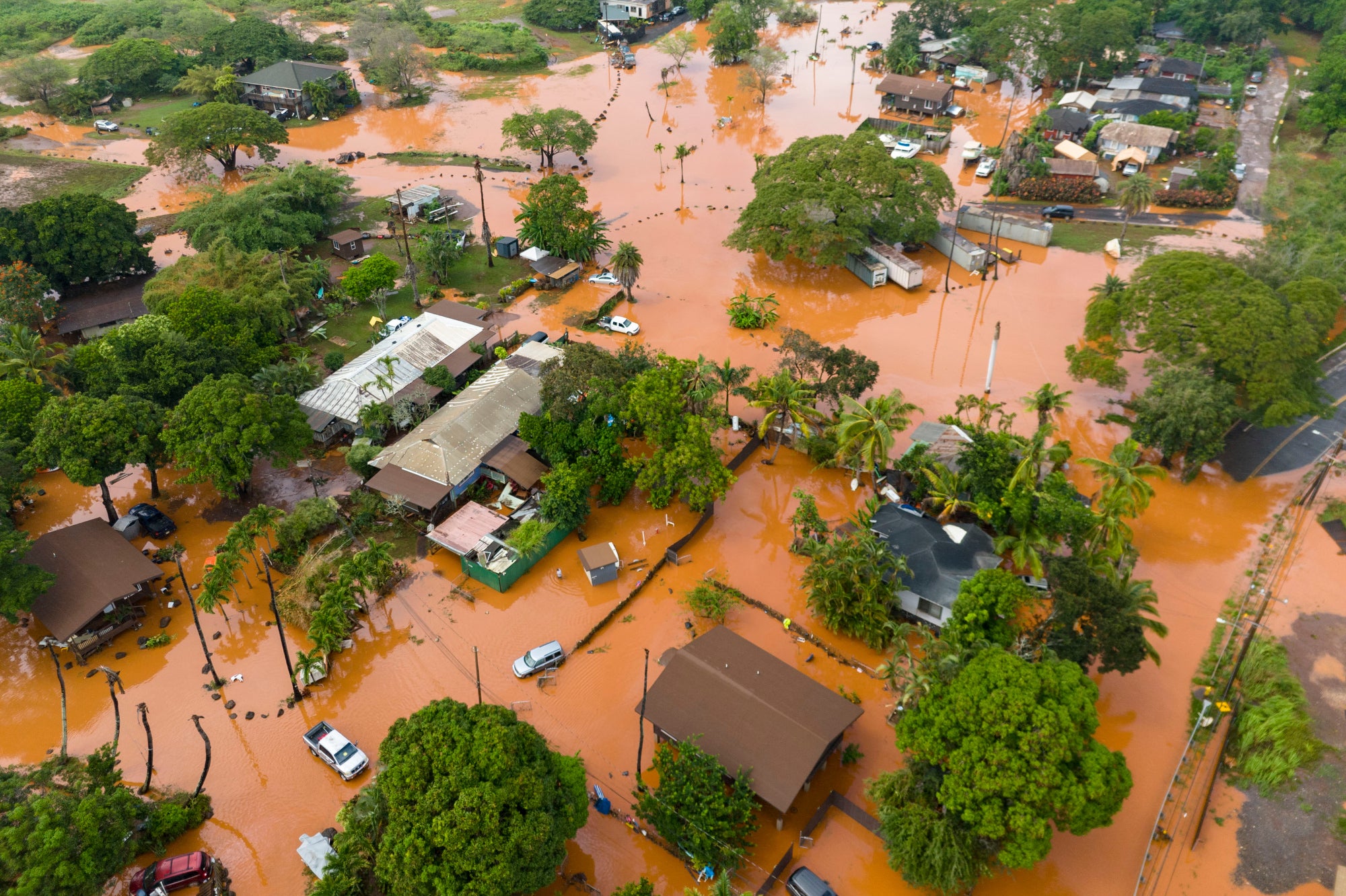
Most of the state was under a flood watch, with Haleiwa and Waialua in northern Oahu under a flash flood warning, according to the National Weather Service.
Green said his chief of staff spoke to the White House and received assurances the islands would have federal support.
Most serious flooding since 2004
No deaths were reported and no one was unaccounted for. About 10 people were taken to a hospital with hypothermia, he said.
Crews searched by air and by water for people who had been stranded — efforts that were hampered by people flying personal drones to get images of the flooding, said Ian Scheuring, a spokesperson for Honolulu.
The National Guard and Honolulu Fire Department airlifted 72 children and adults who had been attending a spring break youth camp at a retreat on Oahu’s west coast called Our Lady of Kea’au, according to city and camp officials. The camp is on high ground but authorities didn’t want to leave them there, the mayor said.
Green said the flooding was the state’s most serious since 2004 floods in Manoa inundated homes and a University of Hawaii library.
Dozens — if not hundreds — of homes were damaged Friday but officials haven’t been able to fully assess the destruction, Honolulu Mayor Rick Blangiardi said. Some 5,500 people were under evacuation orders.
“There’s no question that the damage done thus far has been catastrophic,” he said.
Officials blamed some of the devastation on the sheer amount of rain that fell in a short amount of time on saturated land. Parts of Oahu received 8 to 12 inches (20 to 30 cm) of rain overnight. Kaala, the island’s highest peak, got nearly 16 inches (40 cm) in the past day, the National Weather Service said.
More rain was expected: Blangiardi said 6 to 8 inches (15 to 20 cm) of rain was forecast to fall on Oahu in the next two to three days.
Winter storm systems known as “Kona lows,” which feature southerly or southwesterly winds that bring in moisture-laden air, were responsible for the deluges in the past two weeks. The intensity and frequency of heavy rains in Hawaii have increased amid human-caused global warming, experts say.
Eyes on an aging dam
Officials have been closely watching the Wahiawa dam, which has been vulnerable for decades, saying it was “at risk of imminent failure.”
Water levels in the dam receded by late Friday but that could change if more rain falls. Overnight into Friday, the dam went from 79 feet to 84 feet (24 to 25.6 meters) — just 6 feet (1.8 meters) shy of what it can handle, authorities said.
As she prepared to evacuate to a friend’s home on higher ground, Waialua resident Kathleen Pahinui told The Associated Press in a phone interview that the aging dam is a concern every time it rains.
“Just pray for us,” she said. “We understand there’s more rain coming.”
The state has said Wahiawa dam has “high hazard potential,” and that a failure “will result in probable loss of human life.”
The earthen dam was built in 1906 to increase sugar production for the Waialua Agricultural Company, which eventually became a subsidiary of Dole Food Company. It was reconstructed following a collapse in 1921.
The state has sent Dole four notices of deficiency about the dam since 2009 and five years ago fined the company $20,000 for failing to address safety deficiencies on time, according to records.
Afterward, Dole proposed to donate the dam, reservoir and ditch system to the state in exchange for the state’s agreement to repair the spillway to meet and maintain dam safety standards.
The state passed legislation in 2023 authorizing the dam’s acquisition. It also provided $5 million to buy the spillway and $21 million to repair and expand it to comply with dam safety requirements. But the transfer has not been completed. A state board is due to vote on the acquisition next week.
“The dam continues to operate as designed with no indications of damage,” Dole said in an emailed statement.
The state regulates 132 dams across Hawaii, most of them built as part of irrigation systems for the sugar cane industry, according to a 2019 infrastructure report by the American Society of Civil Engineers.