

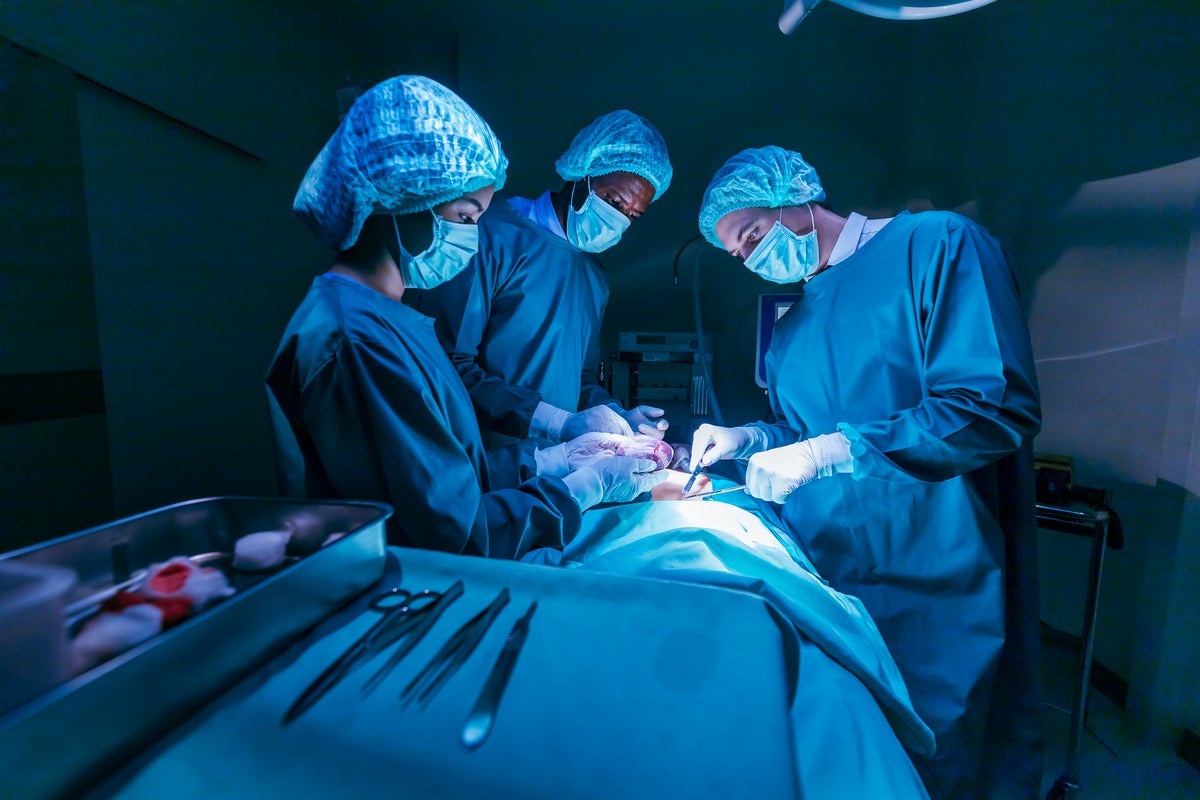
A groundbreaking new procedure, designed to preserve donor livers within the body, is set to significantly increase the number of life-saving transplants, health officials have announced.
This innovative technique keeps the liver supplied with oxygen inside the deceased donor for approximately two hours before its removal.
The National Institute for Health and Care Excellence (Nice) explained that this crucial period allows the organ to recover from any damage while still in situ, simultaneously providing doctors with vital time to conduct tests and confirm its viability.
Currently, donated livers are immediately flushed with cold fluid and packed in ice for transport, a method that frequently leads to organ damage.
Nice data reveals that in 2024/25, out of 727 livers donated after circulatory death in the UK, only 309 were successfully transplanted.
This staggering statistic means over half (58 per cent) of donated livers went unused, primarily due to concerns over damage caused by interrupted blood flow, a problem the new procedure aims to mitigate.
Known as an in-situ abdominal normothermic regional perfusion (NRP), this procedure can be used as an option to preserve donor livers during retrieval after the donor’s heart has stopped, according to new draft guidance from Nice.
Meanwhile separate draft guidance recommends specialist liver preservation machines that preserve donated livers outside the human body using specially formulated solution to help protect the liver from deteriorating.
Dr Anastasia Chalkidou, health tech programme director at Nice, said: “Too many donated livers are currently going unused, and too many people are dying while waiting for a transplant.
“The evidence shows this procedure works as well as, or better than, existing methods and has a good safety record. This is the first time Nice has evaluated this procedure for any organ, and our draft guidance gives the NHS a clear, evidence-based foundation to make it available consistently and fairly across the country.”
NHS Blood and Transplant estimates that wider use of NRP could enable around 150 additional liver transplants each year.
Vanessa Hebditch, from the the British Liver Trust, said: “Too many people with advanced liver disease spend months living with uncertainty while waiting for a suitable donor liver, and sadly every year people die whilst waiting for a life-saving transplant.
“This is encouraging because it supports an innovative approach that could help make more donated livers be viable and available for transplantation.
“We know that every additional transplant represents a life saved and a family given hope for the future. We welcome the opportunity to see innovations like this benefiting more patients across the UK.”