

This article first appeared on our partner site, Independent Arabia
Farmer Enad approaches the yellow line in Gaza with caution. He stops at the point closest to his cultivated land, focusing his gaze in the hope of catching sight of some green grass that would put his mind at ease about his crops. He interlaces his fingers and fidgets nervously, afraid that he will not be able to return to farming. While Israeli planes bombed Gaza and tanks swept through its cities during the war, Enad was busy cultivating his eight dunams of land (a dunam is around 1,000 square metres), planting mallow, peppers, onions and aubergines. He was conscious that the fruits of his labour would feed the hungry people trapped in the territory.
His hands were covered in mud when the Israeli army reached the town of Beit Lahia in northern Gaza, forcing him to flee the tank fire. Like other farmers, Enad has been unable to return to his land since then, as the yellow line has swallowed it up.
According to the ‘Peace to Prosperity’ plan, the Israeli army must withdraw from the centres of Gaza’s cities to an imaginary border called the yellow line and redeploy its soldiers along 53 per cent of the Strip’s territory. However, as the ceasefire took effect, Tel Aviv began marking the truce line by placing hundreds of yellow-painted concrete blocks, preventing Palestinians from returning to these areas. This new positioning of the army made it almost impossible for farmers and other locals to access their agricultural lands, which lie behind the yellow line, as Israel controls a 65-kilometre (approximately 40-mile) stretch from Rafah in the south to Beit Hanoun in the north, varying in width from 300 to 1,000 metres, and sometimes extending up to 1,500 metres.
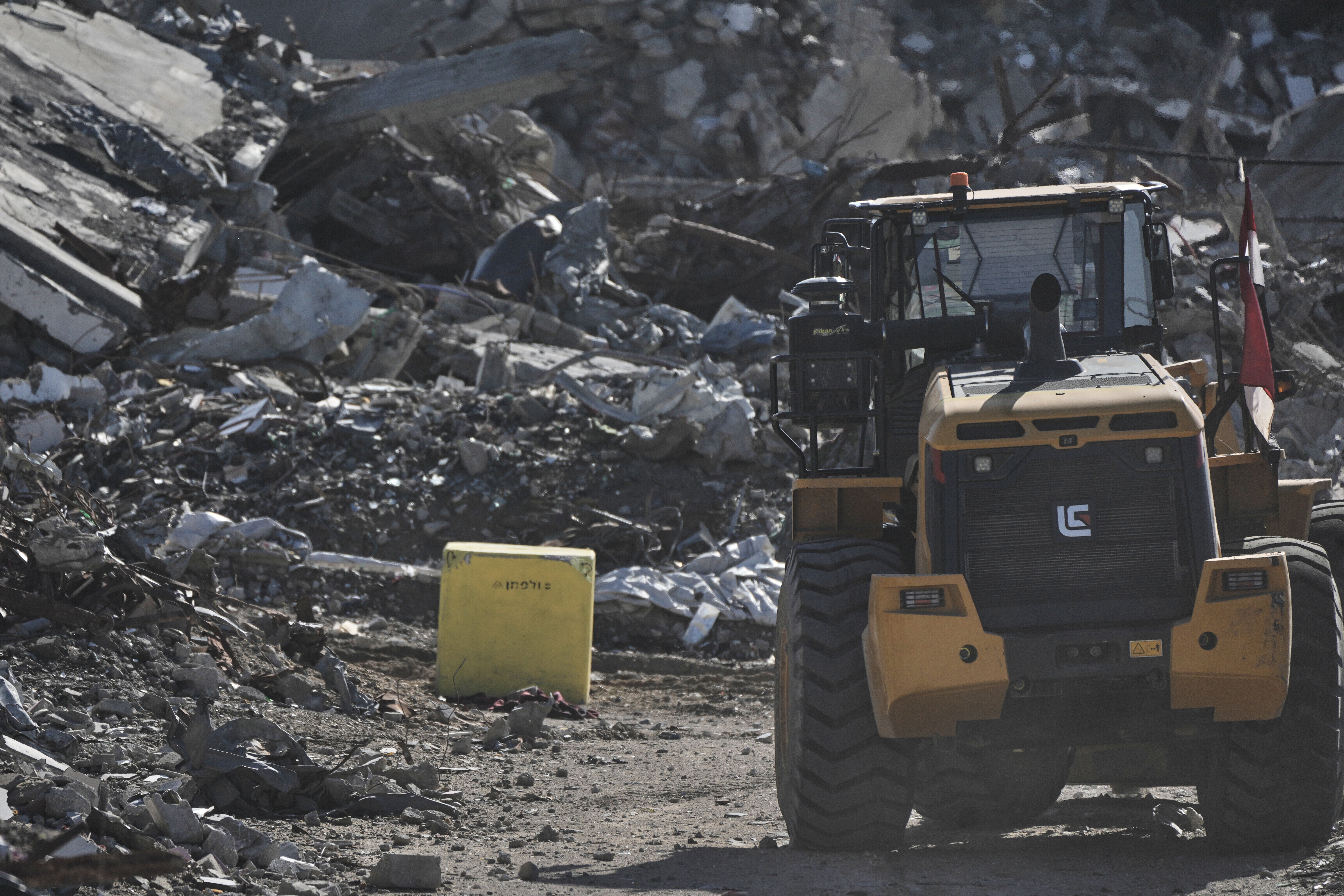
Behind the yellow line, in areas controlled by the Israeli army, lies about 60 per cent of the fertile agricultural land that used to be the breadbasket of the Gaza Strip. However, as Tel Aviv continues to control this area and refuses to withdraw despite entering the second phase of US President Donald Trump’s plan, hopes of returning to farm the land are beginning to fade.
All hopes for farming dashed
One kilometre from the actual border of the Gaza Strip with Israel, as it was before 7 October 2023, lies the land of Yassin. Speaking to Independent Arabia, the farmer shared: “I own 17 dunams of agricultural land that is still under Israeli control inside the yellow line.”
This land was an important source of food for Gazans, providing vegetables, grains and ripe fruit. It was also a source of livelihood for Yassin and the farm’s workers, but it has been turned into a military zone that he is allowed neither to access nor to cultivate.
Yassin left his land and abandoned farming, and today he fears that Israel will seize his land and put it across the new borders of Gaza, as Tel Aviv plans to turn the yellow line into a new border for the devastated land. “The army destroyed my house, and bulldozers and tanks razed the land. For two years, I have been unable to access [my land] to plant, farm and tend to it, and I don’t think it will be possible for me to farm it after this. We are used to Israel turning ‘temporary measures’ into permanent ones,” he added.
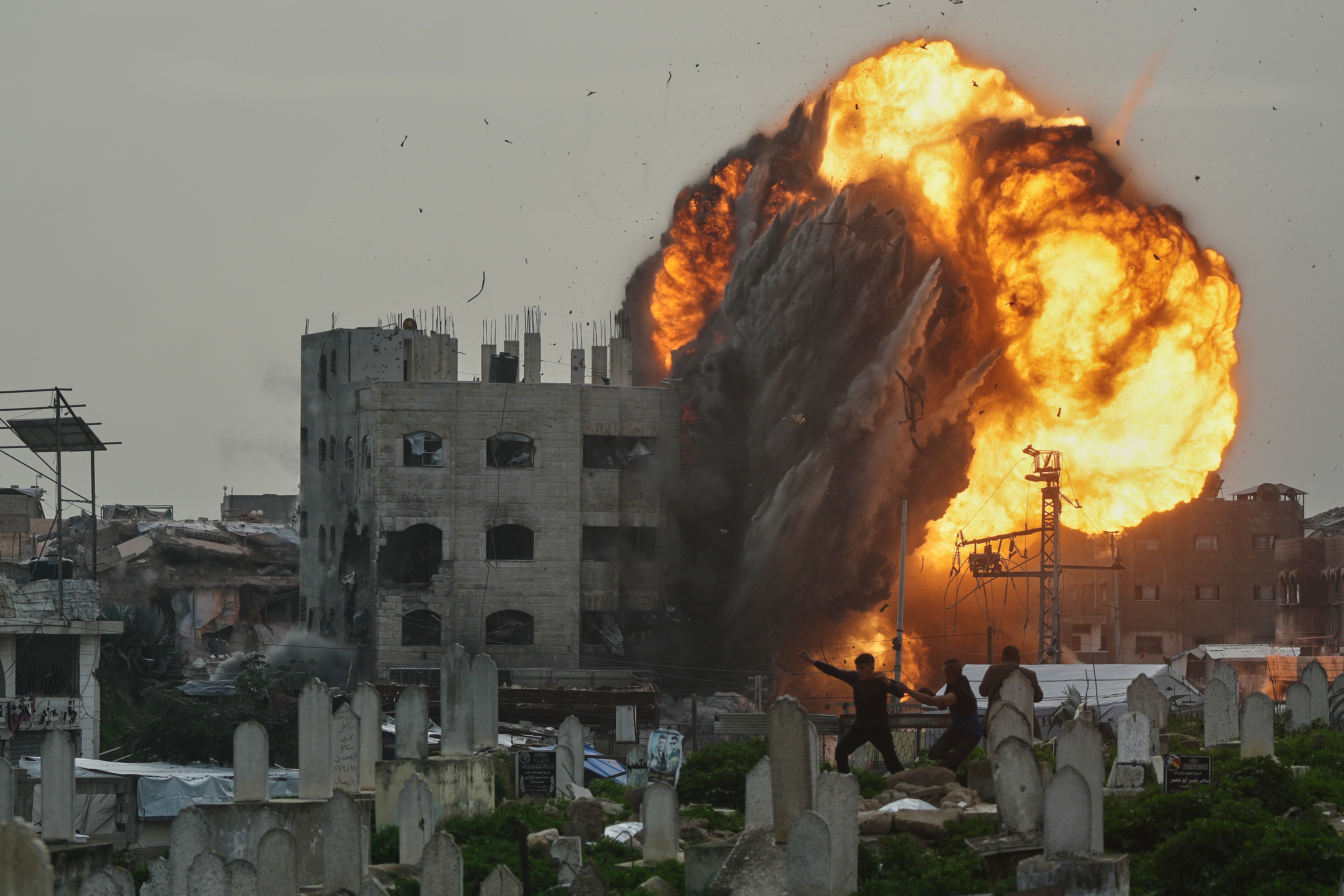
Yassin grieves the razed trees more than the ruins of his own home, as farming is all he knows: “The house can be rebuilt in a few months, but the lemon, olive and grape trees need 20 years to bear fruit that is suitable for consumption.” He said that the army’s continued presence within the yellow line means the death of Gaza and the continuation of starvation and dependence on imports.
A new de facto border
Farmers in Gaza fear that they will not be able to return to tend their land, as they believe Israel does not intend to withdraw from the yellow line. The reason for this is not only to do with the surrender of weapons by Hamas, but Israel’s own stated plans to annex part of the Gaza Strip.
IDF chief of staff Lt Gen Eyal Zamir openly declared: “The yellow line separating the areas under army control from the western areas of Gaza represents the new border line between Israel and the Strip. It is a forward defensive line for the communities and an offensive line.”
Israel has therefore turned the yellow line into a de facto border and refuses to withdraw to the red line marked on the maps included in Trump’s plan for Gaza. This means that the prospects for the revival of agriculture are effectively over. Farmers will not be able to cultivate their lands again, and Gaza will never again be self-sufficient in vegetables. It will remain dependent on imports from abroad, if Israel permits their entry in the first place.
Agricultural data
Before the war in Gaza, agricultural land covered 195,000 dunams of the Strip’s territory. Just under half of this land was planted with some 55 varieties of vegetables, while grains and fruit trees populated the rest. However, tanks, bulldozers and warplanes have completely destroyed these fields, directly impacting production.
According to data from the Palestinian Central Bureau of Statistics, the agricultural sector accounted for about 11 per cent of Gaza’s gross domestic product before the war, with a production value of $343 million (approximately £270 million).
Data from the Food and Agriculture Organisation (FAO) shows that 560,000 people in Gaza were working full-time or part-time in agriculture. However, they are now deprived of their livelihoods and are mostly unemployed. FAO statistics indicate that Israel has rendered about 94 per cent of agricultural land unusable, either because of bombing and bulldozing or because it lies across the yellow line, leaving only six per cent of agricultural land accessible, mostly in western Gaza.
A rare commodity
In this context, Mohammed Abu Odeh, head of the horticulture department at the Ministry of Agriculture, said: “Before the war, Gaza was 115 per cent self-sufficient in vegetables and exported the surplus overseas, whereas today the food gap has exceeded 85 per cent, so prices have skyrocketed and vegetables, which used to be a staple food, have become a rare commodity.
“Large stretches of orchards, planted with olive, citrus and palm trees, have been bulldozed by Israel, leading to significant topographical changes to agricultural land, which has lost its natural fertility. The use of bulldozers and heavy machinery has also killed the microorganisms in the soil.”
Abu Odeh explained that Gazans having access to only six per cent of the agricultural land they previously cultivated has contributed to starvation: “We saw the impact during three famines that struck the Gaza Strip during the war with the siege and the closure of the crossings. The loss of access to land for farming has also led to acute malnutrition, evident on the bodies of Gazans.”
A systematic policy
Since the early days of the war, Israel has targeted agricultural land with aerial bombardment, after which soldiers bulldozed thousands of dunams of green fields, before planes sprayed dangerous chemical pesticides over large swathes of crops.
Nabil Abu Shammala, a consultant on sustainable agricultural development, told Independent Arabia: “The actions on the ground reveal a systematic Israeli policy to target the agricultural sector in Gaza which was one of the pillars of economic and food resilience, destroying the soil and destroying crops.
“Israel has also targeted irrigation networks, greenhouses and water wells, and prevented the entry of seeds and fertilisers. There was a policy to target this vital sector, and the destruction of agriculture was not collateral damage, but the result of systematic targeting.”
When Independent Arabia reached out to IDF spokesperson Ella Waweya and asked why farmers were being prevented from accessing their fields and why they were being fired upon if they approached their agricultural land near the yellow line, she stated: “This is due to the regulations established by Israel for dealing with incursions across the yellow line.”
When the Israeli army redeployed in Gaza and began marking the yellow line, Israeli Defence Minister Israel Katz said: “This [line] represents the boundary of Israeli military deployment, and any attempt to cross it will be met with direct gunfire. The purpose of this measure is to warn Gaza residents and Hamas terrorists against approaching this area. The army will deal forcefully with any individual or party that crosses this line. The response will be immediate and without prior warning.”
What about the land behind the yellow line?
What exactly happened to the agricultural land behind the yellow line? Aerial maps show that the vegetation in these areas no longer exists and that the area has been turned into a desert of scattered rubble and military sites.
The yellow line cuts through half of Gaza, including the town of Beit Hanoun and parts of Jabalia and Beit Lahia, the eastern part of Gaza City, the eastern part of Khan Yunis, and the city of Rafah. Israel refers to the areas behind the truce line as ‘Eastern Gaza’. Eastern Gaza encompasses approximately 130,000 dunams of agricultural land.
According to the head of the horticulture department at Gaza’s Ministry of Agriculture, “Approximately 30,000 dunams extend along the eastern border areas, 35,000 in the towns of Beit Lahia, Beit Hanoun and eastern Jabalia, at least 25,000 in the Rafah governorate in the south of the Strip, and 40,000 in Khan Yunis.”
He explained that the Israeli army either destroyed or bulldozed all agricultural land along the eastern and northern fences of the territory, noting that “acts of vandalism targeted hundreds of farms and agricultural and livestock production facilities that were the backbone of the local food supply.”
Abu Odeh confirmed that Gaza farmers are prohibited from accessing the land behind the yellow line, which has therefore become barren. As the Israeli army continues to station there, “the hopes of farming have begun to fade, but there is hope of returning to those areas when Tel Aviv withdraws as part of the second phase of Trump’s plan.”
Farming alongside the yellow line
Although most farmers in Gaza have lost hope, Nofal is waiting for the second phase of the ceasefire agreement to come into effect so that he can return to his land and recultivate it. “I haven’t set foot on my land for two years,” he said. “The army prevents us from even approaching our fields, but despite that, I feel that I will soon be planting onions and potatoes in the fertile land behind the yellow line once the army withdraws from it.”
Nofal longs to return to his land behind the yellow line and tries to reach it, but the army fires at him whenever he approaches the area. “It is true that my land is no longer mine, after the entire area was turned into a closed military zone under Israeli control, but I watch it from afar, because I understand that approaching it means death.”
Khaled did not give in to the yellow line. He began planting his crops just 50 metres away from it. “Despite the danger of approaching the yellow line, I preferred to stay and work and plant. We plant and see the tanks in front of us, but we are not afraid of them. I planted olives, wheat and onions. The land deserves blood, not just sweat.”
Khaled uses old tools to cultivate the land, watering with cans and digging by hand. “There are no materials or equipment. Israel wants to kill us and prevent us from farming, but we will not give up, even if we plant only one tree on one metre of land.”
Translated by Mirane Abou Zaki; Reviewed by Tooba Khokhar and Celine Assaf