



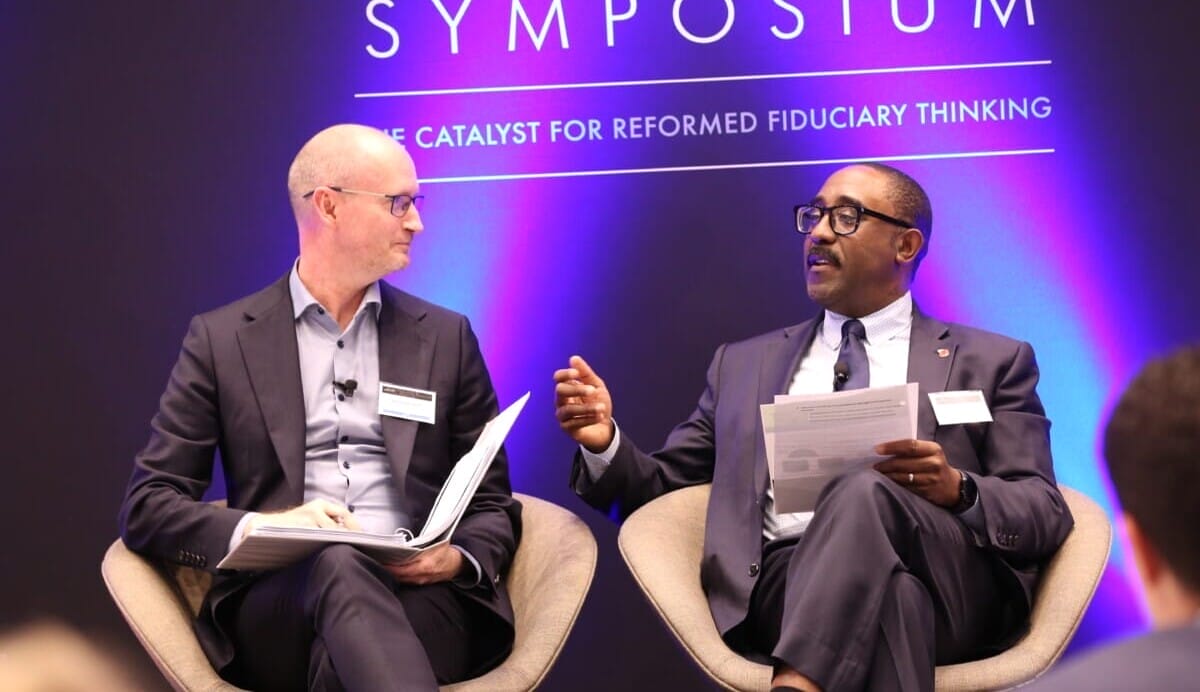
L-R: Brendan Swift (Conexus Financial) and Michael Davis. Photo: Jack Smith
President Trump’s executive order that America’s 401(k) plans invest more in private markets will take five to ten years to have an impact. Although private assets are a significant part of America’s defined benefit pension fund assets, the ability of defined contribution funds to invest in private markets is a little more complex, explained seasoned investor Michael Davis, head of global retirement strategy at T. Rowe Price, speaking at the Fiduciary Investors Symposium at Oxford University.
“I think, at the end of the day, it’s going to be a long road for private assets in defined contribution plans,” he told an audience comprising 68 asset owners from 17 countries gathered alongside global asset managers for the three-day conference.
“When I was in government, I learnt that you can kind of tilt [policy] in a direction, and eventually, it picks up speed, but it takes a while. I think the executive order will help, but I wouldn’t expect there to be a change overnight,” he said, recalling his time helping craft pension fund policy while serving under the Obama administration.
Enduring litigation issues will continue to dent plan sponsors’ enthusiasm to invest in private markets, he said. Investing in private assets incurs higher fees and will therefore attract lawsuits that particularly target fees, costs and performance.
“I experienced this myself in terms of some anxiety, because I am the head of the investment committee for our own T. Rowe Price plan. So I live some of the same anxieties that many of our clients experience,” said Davis.
Other barriers to change include low financial literacy. Although the US has higher levels of financial awareness than in other countries, he flagged that public knowledge of private assets is poor. “Even things like public assets, people struggle with.”
Liquidity is also an issue since DC investors “like daily liquidity.” However, he noted the continued evolution of liquidity-supporting private market structures and vehicles.
“We expect to see more of that innovation and I do think that this is an area that we can learn a lot from our colleagues around the world who have deployed these assets into defined contribution plans for a much longer time than the US has.”
He said private assets are unlikely to be offered as a separate option in a defined contribution plan. Instead, investors will most likely tap into alternatives via a diversified portfolio in a target date fund.
The pros and cons of legislation
America has a successful history of policy makers successfully steering the $37 trillion retirement industry in new directions.
The passage of the 1974 Employee Retirement Income Security Act (ERISA) laid the foundations for capital formation, and has gone on to fuel an industry of private asset managers characterised by hedge funds, private equity and private credit.
Davis noted that other countries are now starting to think about how to use their retirement assets as a lever to spur capital formation and local investment.
But he warned that governments need to tread a fine line between pushing for the productive use of capital and maintaining the fiduciary duty enshrined in ERISA law, which ensures plan sponsors act solely in the interest of beneficiaries. It’s a line that has got blurred in the US at times – like when unions pressured to direct assets towards creating jobs. Something that he believes has fed directly into the politicisation of ESG in the US.
Davis also talked about the importance of staying invested in an inflationary market and avoiding non-productive investments.
“If you’re in a bank account earning next to nothing, you are losing money every day.”
He suggested countries integrate a national default policy whereby beneficiaries default into a diversified pool of assets that includes growth and fixed income assets.
“Again, in a world where inflation is a bigger problem, the idea that you have big pools of people that are still investing in cash, I think is a tragedy. And the government can do something about that. In the United States, prior to 2006/ 2007 a lot of people were invested in either the stock of the company they worked for, which is not a diversified place to be, or cash. And the department did a thorough analysis to say this is not where people should be.”
Davis also argued the case for active management in today’s concentrated market.
Still, legislation in the US retirement industry has also created barriers to change and a disincentive to innovate in contrast to newer pension systems like Australia. Australia’s super funds have been able to hone in on the best concepts like automatic enrolment and centralisation, for example.
“One of the big issues in the United States is portability. So if [people] change employers, [they] have to individually take those assets. It’s a whole process to roll those assets over,” he concluded.
