


President Donald Trump and the House Republican caucus have been increasingly at odds over the past few months, ever since a discharge petition over the Jeffrey Epstein investigation files threatened to spark a rebellion among the GOP with Speaker Mike Johnson helplessly caught in the middle.
Now, one Democratic senator is trying to drive another wedge in between Johnson and Trump over one of the president’s key campaign promises for younger families.
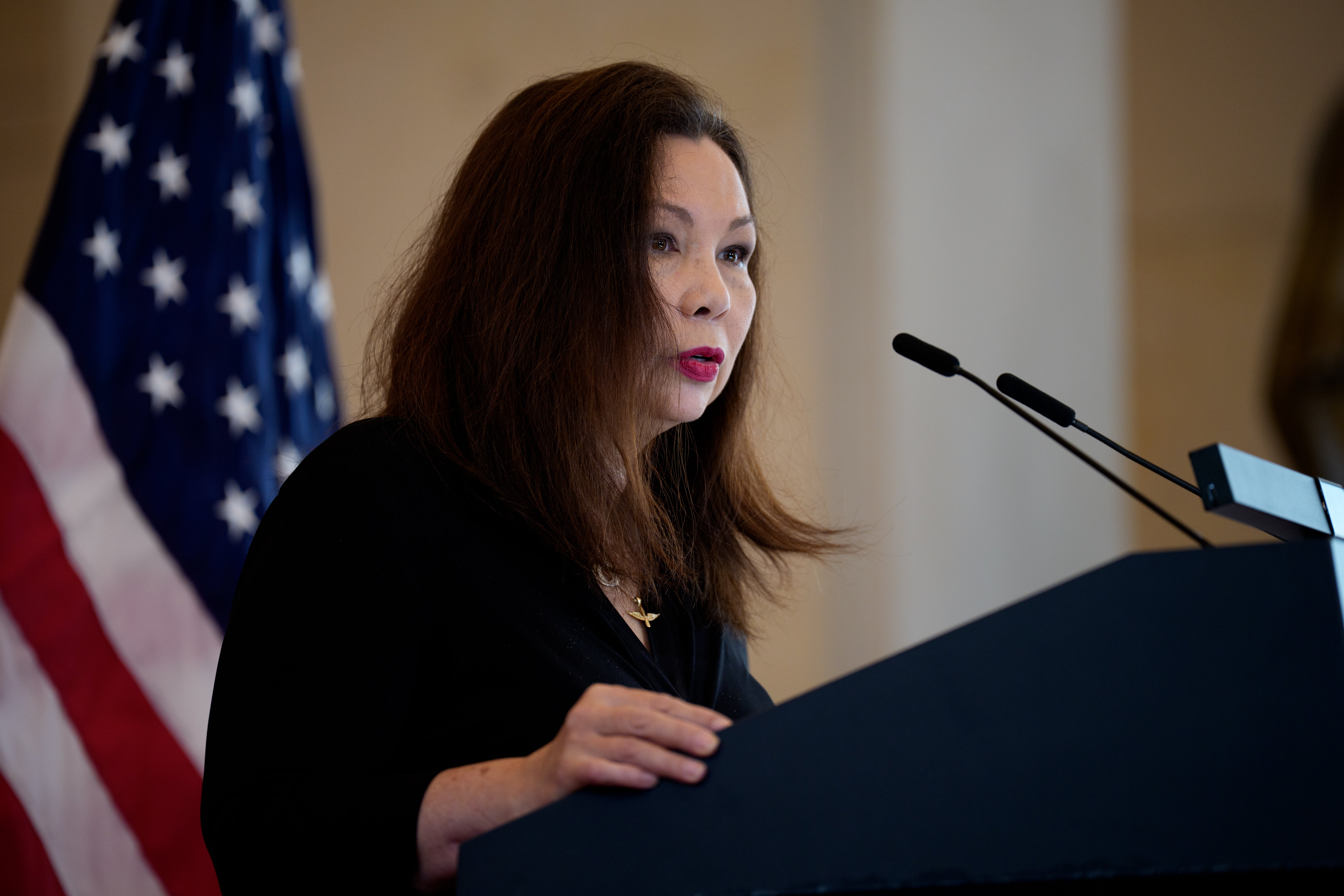
On Sunday, Sen. Tammy Duckworth said that Johnson should be added to the list of Republicans whom Trump frequently identifies as responsible for undermining his agenda. The Illinois Democrat was on CNN’s State of the Union and argued that Johnson was attempting to block a prominent part of that 2024 campaign agenda: Support for making in vitro fertilization (IVF) treatments affordable or free for American families.
She spoke to anchor Dana Bash about a letter she wrote to the president annotated with the Trump-style caption, “WARNING: Speaker Johnson wants YOU to become the DEADBEAT DAD of IVF.”
“It’s…personal to me because I saw so many of my comrades who were at Walter Reed and other military medical centers who lost their fertility as a result of their military service,” said Duckworth, noting that veterans still suffer much higher rates of infertility than do civilians.
Her comments come on the heels of a Military.com report detailing the congressional discussions over the National Defense Authorization Act, better known as the NDAA. The annual bill funds America’s armed services. Johnson, according to Military.com, is leading efforts to strip language aimed at expanding IVF coverage for service members from the legislation.
Right now, IVF coverage is only covered for service members if infertility is judged to have been caused by “a serious or severe illness or injury while on active duty,” according to the news outlet. New provisions in this year’s NDAA would expand that coverage to all service members, regardless of the reasons for infertility struggles.
The senator pointed out one reason why this plan is often insufficient during her interview on Sunday: Many military women, she argued, want financial support to freeze their eggs before entering into combat zones rather than seeking treatment or therapies after the fact.
On Sunday evening as Washington headed into the second week of the holiday month, lawmakers in the House released the text of the 2026 NDAA. The massive piece of legislation, more than 3,000 pages in total, did not include the language expanding IVF access for service members — indicating Johnson’s success.
The policy is one of Trump’s most unique campaign positions stemming from his 2024 bid for office. While all three of his presidential runs leaned on support from the Christian conservative right, including opponents of abortion, the president’s stance on IVF runs contrary to views held by many hardline opponents of abortion given how human embryos are created, stored and sometimes destroyed as a part of the IVF treatment process.
In October, the president announced at a White House event that his administration had negotiated with some pharmacies and a drug manufacturer to lower costs on one commonly-used IVF medication.
Duckworth suggested during her interview that it was Johnson and the House GOP’s own ties to the religious right blocking further progress on the president’s plan, not Democrats. Trump acknowledged some of that backlash from conservatives at his event in October, and quipped that his plan was “pro-life”.

“There’s nobody opposing this other than Speaker Johnson and his religious views,” said Duckworth. “Because if you believe that a fertilized egg is a human being, has personhood, then some of the processes within IVF are considered murder.”
It’s also one Trump has struggled to implement via legislation. The expansion of IVF benefits to all servicemembers would mark his greatest success in this endeavor; Republicans in Congress have not moved to implement the broader policy call of his campaign, which would involve passing legislation to mandate health insurance plans cover IVF in some fashion, making it a more affordable option for families. $50,000 is typically cited as the average cost for a successful pregnancy via IVF, which includes the cost of medications and often multiple treatment cycles.
Johnson, meanwhile, is dealing with lingering resentment and rebellious attitudes in the House of Representatives. Prominent women in his caucus including rogues like Reps. Marjorie Taylor Greene and Nancy Mace, as well as loyalists like Rep. Elise Stefanik, are growing increasingly publicly critical of his leadership, while others have predicted in anonymous comments to reporters that Johnson’s tenure as speaker will not last through 2026.
The House GOP holds a tenuous majority in the chamber, which is set to shrink in January with the resignation of Greene and, potentially, Mace as well. Other members are reportedly considering the same.
Democrats are poised to take control of the chamber next year if current trends continue. Republicans remain mired in an affordability crisis, the same one that doomed Joe Biden’s presidency and Kamala Harris’s 2024 campaign; Trump continues to dismiss it as a “Democrat hoax”.
Congress is facing a deadline on that topic in the coming weeks as federal subsidies for plans on the Affordable Care Act’s public health exchanges are set to expire at the end of the year, which if not extended or dealt with are set to result in annual premiums skyrocketing for millions.