


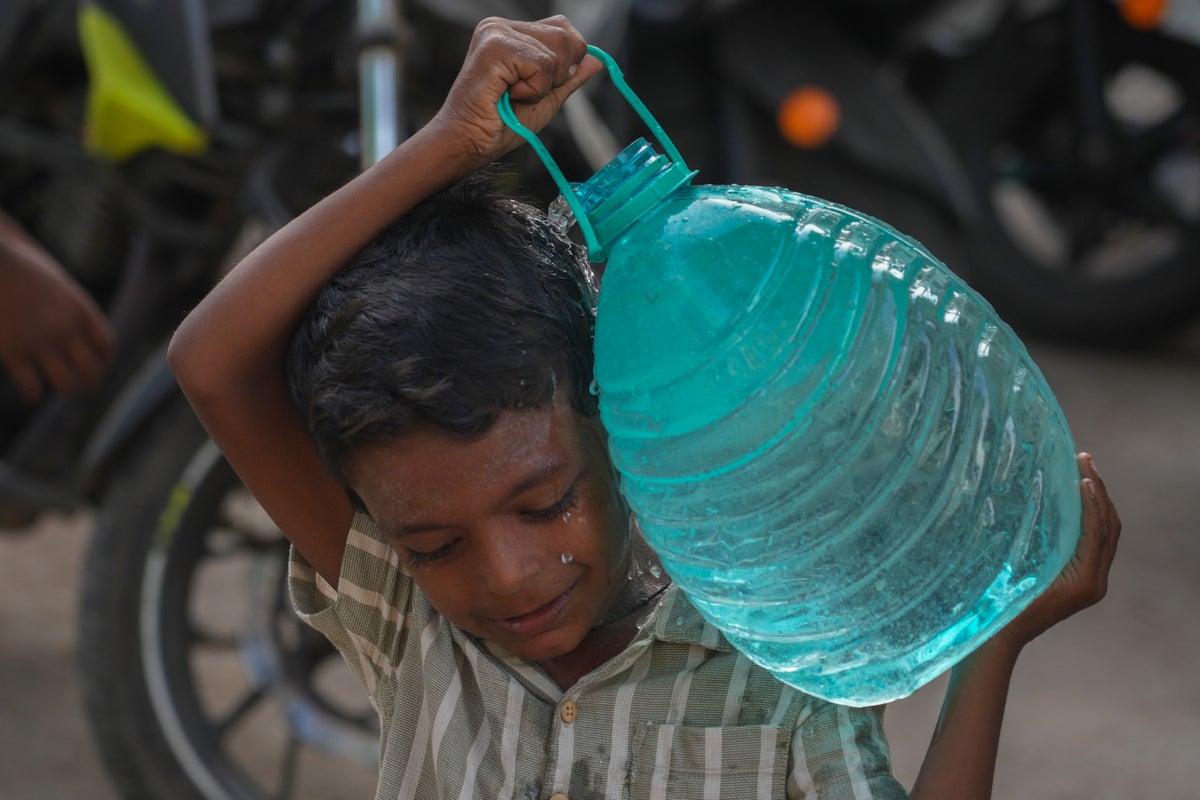
The late arrival of India’s monsoon season and below-average rainfall have caused problems ranging from planting delays for farmers to water restrictions for construction sites in its largest business hub, Mumbai.
Water shortages have been reported around the country due to the late start of the rainy season, which typically begins in June but has grown erratic in recent years. Climate experts said the El Nino, a warming of the Pacific that affects weather around the globe, combined with an already heating planet, will likely result in weak, scattered rainfall across the country.
While monsoon rains reached Mumbai earlier this week, about two weeks later than normal, water restrictions are in place to bolster the city’s dwindling reservoirs. Forecasters said it will likely take more than this week’s rains to replenish them. The local government has stopped municipal water supplies to swimming pools and construction sites, where it can be used to mix concrete, so there is more available for essential needs.
Lines are stretching for hours at public water distribution sites due to the shortage.
“To collect just 10 liters (2.6 gallons) of water, I have to wait for two hours. I have to go to work, take care of my children and make sure there is water at home,” said Aishah Khan, a 33-year-old domestic worker in Mumbai.
Many farmers in India’s northern, rural regions are delaying the sowing of their seeds as rains have still not arrived. They fear that poor rains this year will drive them into further debt.
“We are unable to plant our seeds without the rains coming. Already, we’re suffering losses. I think it’s worse this year than previous years,” said Suresh Kumar, a millet farmer in India’s Uttar Pradesh state.
In the neighboring Madhya Pradesh state, soybean and wheat farmer Kedar Sirohi said he is praying for good rains to arrive.
“I’m very worried but we have no choice but to wait and see now,” he said.
June and July are the most important sowing months for millions of Indian farmers who depend on the rainy season to irrigate their fields. Farmers said poor rains are adding to existing challenges, including uncertainty over fertilizer supplies interrupted by the Iran war and a trade agreement with the United States that they think gives them a poor deal.
How climate change is impacting monsoon seasons
Traditionally, people in India and neighboring countries excitedly awaited the monsoon rains, which would finally mean the end of summer heat. However, extreme weather including erratic rain and high heat are becoming more frequent in India and elsewhere as the planet warms.
The South Asian region has traditionally had two monsoon seasons. One typically lasts from June to September, with rains moving southwest to northeast. The other, from roughly October to December, moves in the opposite direction.
But with more planet-warming gases in the air — caused by burning oil, coal and gas — the rain now only loosely follows this pattern. This is because the warmer air can hold more moisture from the Indian Ocean, and that rain then tends to get dumped all at once. It means the monsoon is punctuated with intense flooding and dry spells, rather than sustained rain throughout.
“The Indian monsoon is becoming more variable as a result of global warming,” said Akshay Deoras, a meteorologist at the University of Reading, in the United Kingdom, who has tracked Indian weather systems for more than a decade. He added: “We are seeing wet spells becoming more extreme and dry spells are more prolonged.”
Deoras said the current rainfall deficit is too large to be entirely wiped out by even a few weeks of good rainfall in the areas where monsoon season has arrived. And some regions of India may receive little rain in the coming weeks.
India’s weather agency, the India Meteorological Department, said conditions including El Nino and dry winds from northwest India have stalled the monsoon’s advance, resulting in a countrywide rainfall deficit of 42%. The weather agency said it expects rainfall from June to September to be below average.
According to local government data, Mumbai has only 40 days of water left. Deoras said erratic rainfall will not be enough to improve this situation.
“I think in the next 10 days, the region will get rain and the reservoir area will also get some rain, but that is not that good enough for levels to improve substantially,” he said.
Improving water storage capacity is key
Given the increasingly unpredictable weather, improving the country’s capacity to handle climate shocks is key, climate experts said. India is among the top 10 countries worst affected by climate change, according to a report released last year by the European nonprofit Germanwatch.
Home to more than 90 million farmers, most of whom own less than 2.5 acres (1 hectare) of land, India is the world’s largest extractor of groundwater, pumping out more than the United States and China combined, according to a 2022 United Nations report. According to India’s Central Ground Water Board, about 70% of the water used in the country is from groundwater sources.
Extraction for farming, construction and other needs, exacerbated by erratic rainfall and extreme heat, is resulting in water tables dropping drastically across the country.
Poor rainfall does not have to translate into water stress if planning and governance systems are strengthened, said Abhiyant Tiwari, climate and health expert at New Delhi-based NRDC India.
“Investing in water conservation, restoring urban water bodies and protecting smaller village ponds should be high priorities at both national and local levels,” he said.
Farmers with access to groundwater will be able to save their crops even during weak rains, but those who depend on the rains won’t, said Vivek Grewal, hydrogeologist at Bengaluru-based WELL Labs.
“Every year there are bad rains, it exhausts the groundwater buffer,” he said. “In the cities, authorities expect reservoirs to get filled with a good monsoon but when that doesn’t happen there is an immediate impact.”
___
Associated Press journalist Rafiq Maqbool in Mumbai and Rajesh Kumar Singh in Lucknow, contributed to this report.
Follow Sibi Arasu on X at @sibi123. Reach him at [email protected].
___
The Associated Press’ climate and environmental coverage receives financial support from multiple private foundations. AP is solely responsible for all content. Find AP’s standards for working with philanthropies, a list of supporters and funded coverage areas at AP.org.
