It was 49 years ago that I first interviewed David Hockney. I still have the 1977 handwritten letter he sent me at school inviting me to his studio in Powys Terrace, Notting Hill. I was 16 and starstruck. At the top floor of several flights of stairs was a transformative oasis of light and, waiting at the door, was the peroxide blonde bombshell that was David Hockney. Smoking and beyond charming and funny and irreverent, his Yorkshire accent and charisma were as palpable as his art. His gripe then was not restrictions on smoking but the restrictive opening hours of English pubs and bars compared to 24 hour freedom in America. Ever the radical libertarian.
His autobiography had recently come out and he was very much art’s ultimate rock star. His paintings and drawings dazzled as he infectiously explained to me his lifelong simple doctrine of art depicting beauty. His then boyfriend Gregory Evans was an Adonis-like presence as David talked and talked. His garrulous open charm concealed steely ambition and focus.
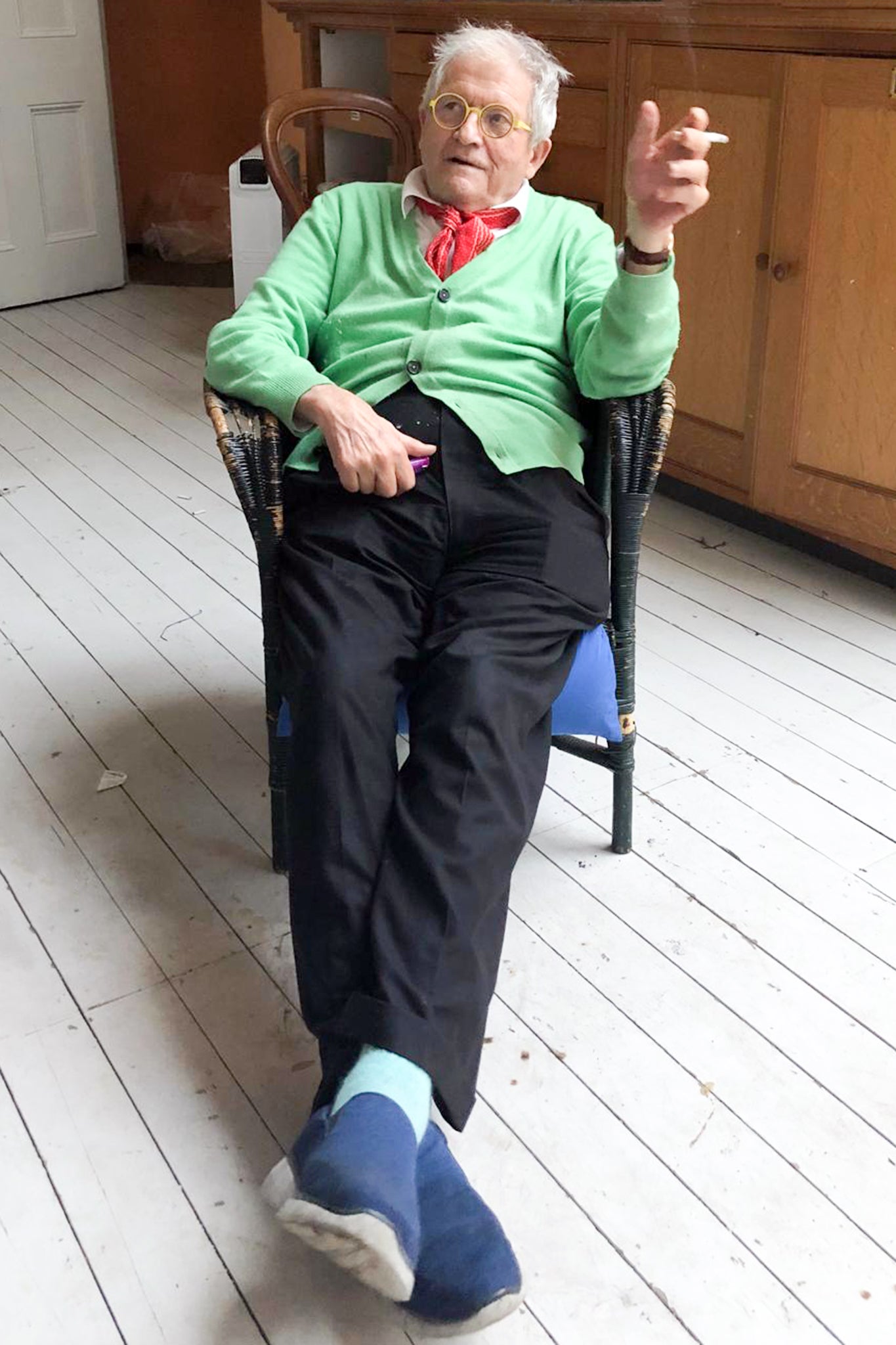
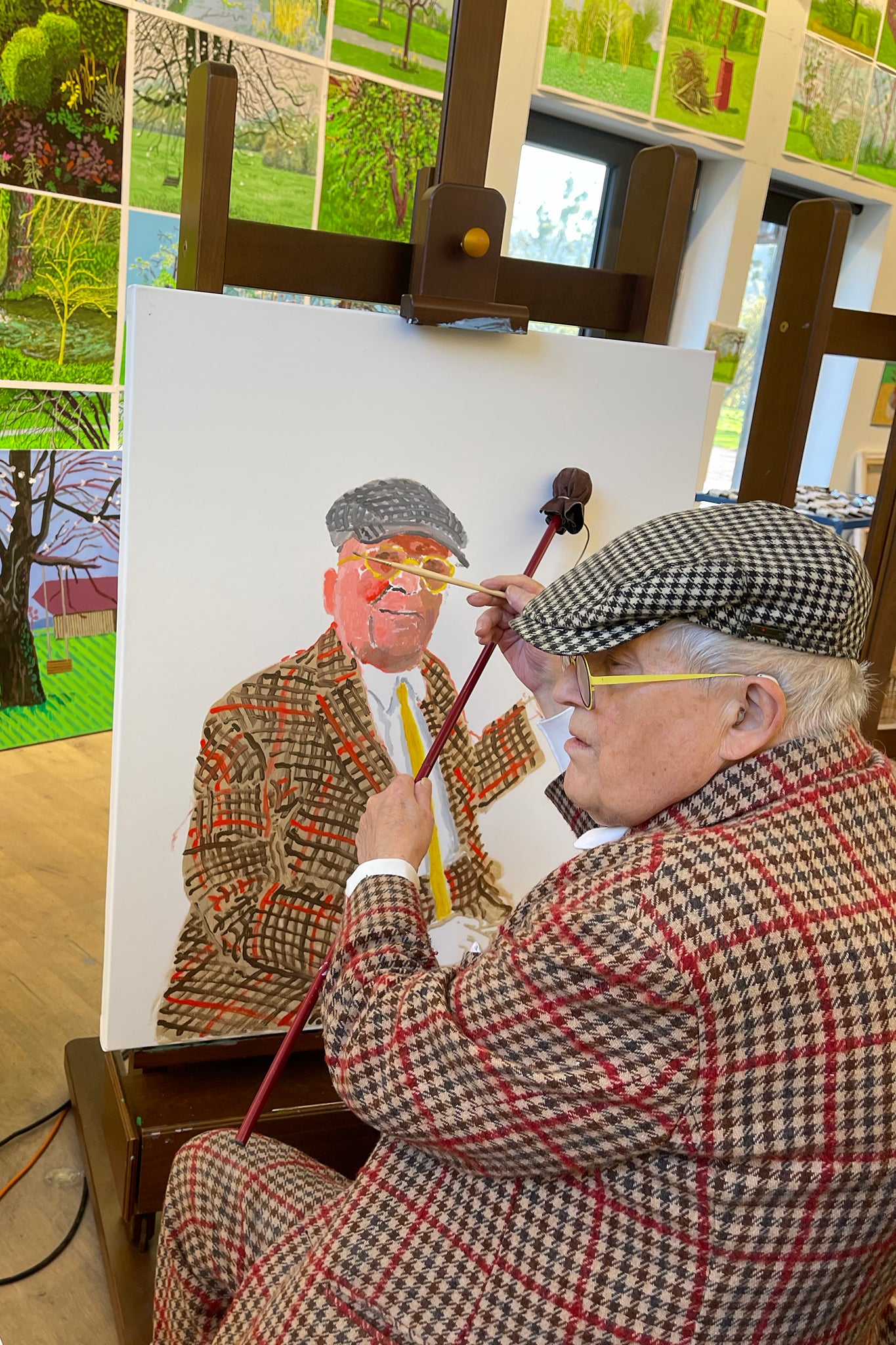
“People are dismissive of the word pretty. I like pretty and I think most people do too,” he explained. It was a simple mantra that art should celebrate but it hid a complex and deeply sophisticated profundity of an artist who was to progress over the next half century to become the world’s biggest art star since Picasso. Almost every year for the next 50 years I interviewed David – from his beach house in Malibu to his home in the Hollywood Hills. I stayed with him in Bridlington and saw him in Chicago as he opened Turandot and at Glyndebourne for his magical sets for the Magic Flute. Wherever he was he transformed his life into great art, he was also forever a subtle and beguiling peacock in his chic and dandified spectacles and stylish clothes. Only recently he had six tweed suits made by his Normandy tailor which was his dining out and painting clothes. He painted right to the end. He was always amused and amusing. He shared his vision and it became a defining and new language of art.
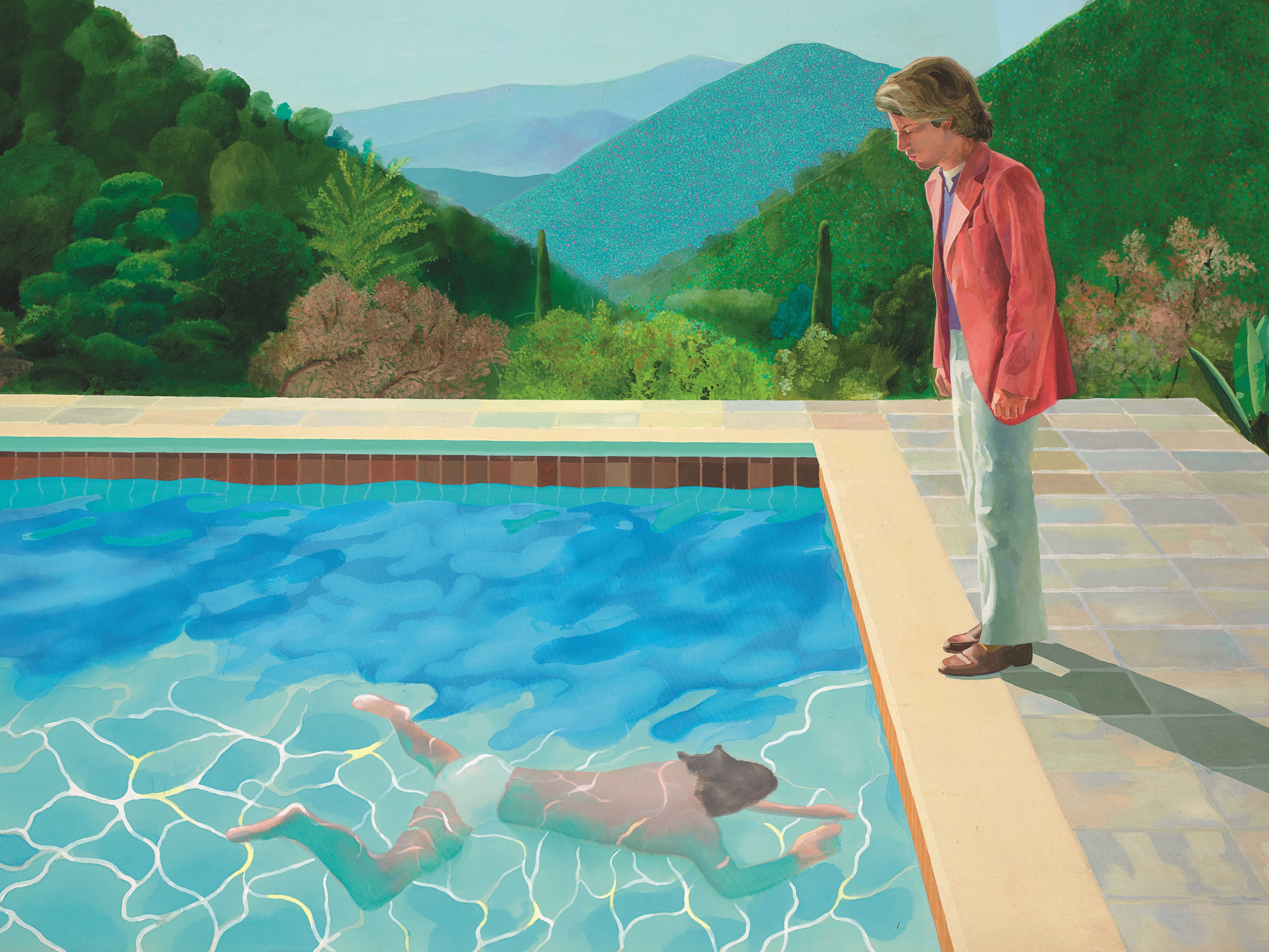
Ever the proud Yorkshireman he adventurously set off in the 1970s to depict Californian pools – a fabulous escape from hidebound Bradford. He was a sunshine artist who sought the light and the limelight. He conquered California and Yorkshire and Normandy as places which were redefined through his vision. But he also never stood still – the Fjords in Norway, off to China with Stephen Spender, in the South of France with Tony Richardson. He lived at different times in Paris, Los Angeles, London and Normandy. He created his vision of people and places: a Hockney world which was instantly recognisable. His sublime line, genius with colours, adventurous with form and always reflecting where he was, who was with him and an unlocking of a language of art which seduced the world. He gave an identity to formless Los Angeles with his pools, palm trees and boys. His portraits created a world and circle of his own which defined late 20th century urban living.
His death at the age of 88 is a huge loss but he has given a vision which touched everyone, with tens of thousands of images which will go on being seen round the world as the major 20th and 21st century interpreter of modern living. A vast Tate Modern show is scheduled for his 90th birthday which will be a celebration of a true British genius.
David never did anything he did not want to do. He most definitely did not want the Bayeux Tapestry to be transported from France to the British Museum. When he wrote a piece for me on that subject in The Independent aged 87 it created headlines around the world. He was not afraid to disrupt. He raged against the anti-smoking lobby. He was devastated by the Aids crisis during which he lost so many friends. I sat with him and Stephen Spender in 1991 as they signed a limited edition of his Alphabet book – he drew each letter wittily and memorably – to raise money to research and combat the disease. Yet he was always tightly focused, almost solely, on his art. He rarely got involved in politics. He just wanted to draw and paint. He would always say it was his whole existence. He had devoted lovers and friends and married his one time assistant JP quietly a couple of years ago. But his abiding passion over more than 80 years was making paintings. His whole life is reflected on canvas and paper.
Sitting for David was to see up close the process of creation in a spellbinding way. The eyebrows knotted closer, his eyes, blue and clear, sharpened. And his attention was ironclad. He was also so free to do whatever came into his mind. His view from his bedroom in Bridlington, Yorkshire, became a series of iPhone art images. His hat and clothes were still lives. No artist made so much of what was in plain sight and elevated it to art since Van Gogh with his chairs and fields. He would put up on his studio wall early versions of drawings which were clearly not the best or even ready to be displayed, but he has such supreme confidence in all he did that he cared not a jot if the process of making his art was seen. Drawings and oil and watercolour or photo collage were all things I saw him turn his eye to when I sat for him.
He did several portraits. He was infectious in his enthusiasm. He was professorial in his knowledge. He was dogmatic in his likes and dislikes. He was obstinate in his habits such as smoking. Actually he was messianic just as his father had been against smoking. One of the last gifts I had was a china ashtray he made partly as protest and partly as merchandise. And commercial David always was – or maybe popular is a more accurate word. He was also a brilliant friend, funny, original, surprising and generous with time and space and conversation. FaceTime calls at unpredictable times were how he kept in touch with so many. He was considered a national treasure as part sage and raconteur and an Everyman of art. He wanted to share. His gallery’s catalogues were sumptuous. T-shirts at his RA show became a sellout and collectors’ items.
So often there was a court around David, close confidants, some of whom had known him since the 1960s: like the model and muse Celia. He outlived so many, and in his final years it got smaller and smaller. Central was JP (or to give him his full name Jean-Pierre Gonçalves de Lima), who is the subject of many a portrait, an enigmatic Portuguese musician and photographer who was with David for more than 30 years. His great nephew Richard was also a wonderful companion.
I remember being at a show opening in Paris and when David entered the room it was as if a light had been lit. His charisma was physical, as was his voice, a Bradford via LA burr which never ceased to explore what art meant and how it was made. His book Secret Knowledge upturned the narrative of how artists had used instruments to create perspective in their pictures. The camera obscura was brought central stage to explain how old masters were made. He outshone art professors with better insight, knowledge and eloquence. He was funny and self-aware. He would regale how his contemporary Patrick Procktor would say the only thing worse than homosexual art was heterosexual art. He just wanted art and not for any horizons to be limited.
In Los Angeles I saw him fax his art to Mexico for a show. He loved all technologies. He was the eternal experimenter from printing to digital to Polaroid to watercolours. He never allowed curiosity or imagination to falter. Sitting with him and his friend Henry Geldzahler in David’s house on the beach in Malibu, a fire roaring in the grate, a joint being passed round, he was at ease as he rolled up his trousers to take me for a walk in the Pacific Ocean.
He never stopped working but when with friends he loved to laugh, gossip, and always to read. He was beyond encyclopaedic with film and theatre and classical music. He was never dull. He loved to argue and carve truths in conversations and art and to seek knowledge. He took no pleasure in pop or rock. He loved opera and made historic set designs which were witty and pretty. His deafness he even turned into a sort of art with different coloured aids and then the highest tech possible. He was an intellectual merging sensuality with seriousness. Get in, he told me in Los Angeles as I boarded his open top sports car with him at the wheel to speed through the Hollywood Hills music blaring, a Wagner operas tape he made to echo the speed and curve of the road and structure of the hills. A road trip was made into art and friendship.
David signed off his emails with ‘love life’. And he did just that. He was a friend I will miss deeply. As godfather to my daughter Monica he was kind and generous. His portrait of her with the words ‘My friend Monica looking serious’ was David as he always was to everyone he met: optimistic and always making art his opportunity and a vision for the world. I mourn him and now celebrate him and his life and his warmth and his work.