

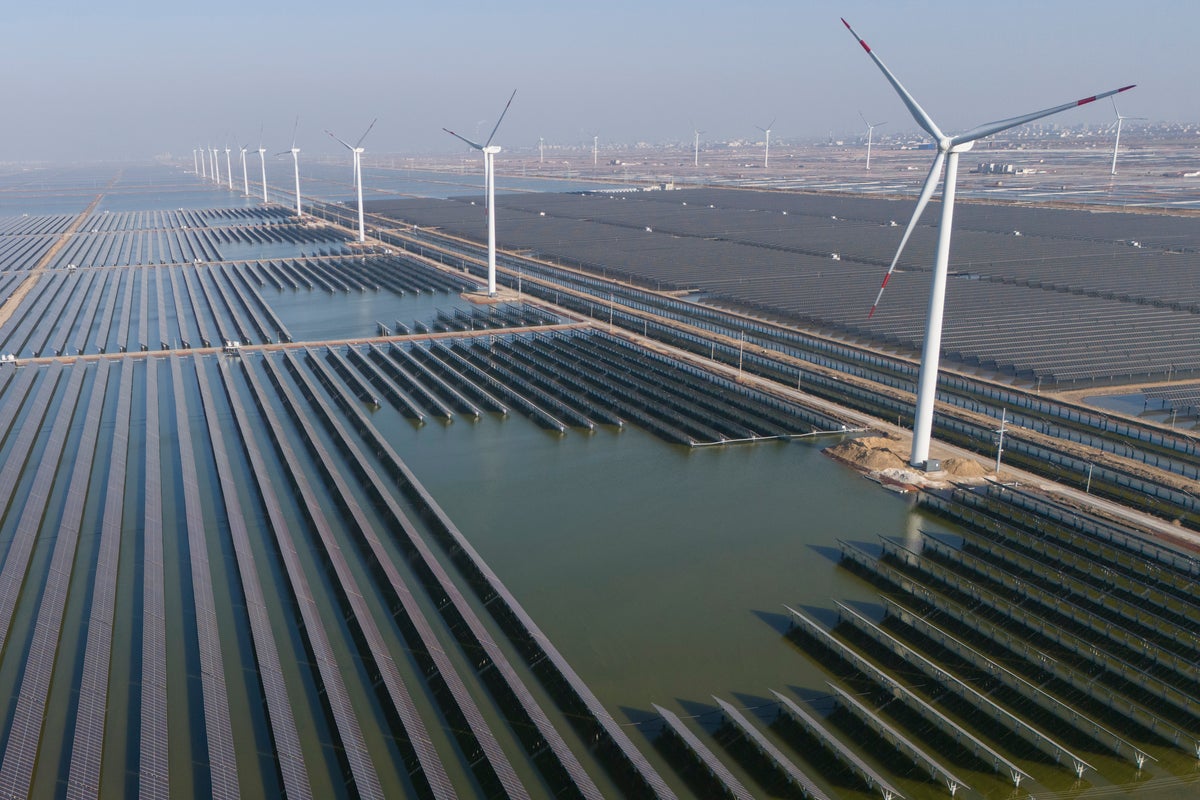
China is set to have more solar power capacity than coal for the first time this year, marking a “historic” milestone in the country’s energy transition.
Data released on Monday by a nonprofit shows installed solar capacity is expected to overtake coal in 2026, following years of rapid expansion that have made China the world’s largest solar market. This is despite the country continuing to rely on coal for energy security.
By the end of the year, wind and solar energy combined are projected to account for about half of China’s total installed power capacity, while coal’s share falls to around one-third, according to the China Electricity Council.
The crossover does not mean China will immediately generate more electricity from solar than from coal. Installed capacity describes how much power could be produced under ideal conditions. While coal plants can operate continuously, solar output fluctuates with daylight and weather. However, the scale and direction of new capacity additions show China’s power buildout is now led by wind and solar rather than fossil fuels.
Andreas Sieber, head of political strategy at green group 350.org, called the shift a “historic inflection point”. He said it’s “proof that clean energy has won on cost, scale, and air quality”, but the continued addition of coal makes its energy politics “impressive but schizophrenic”.
Others caution against reading the capacity crossover as a sign that coal is getting displaced in practice.
“This is entirely symbolic, while it can of course be seen as symbolically important,” said Lauri Myllyvirta, energy analyst at the independent research organisation Centre for Research on Energy and Clean Air.
“The average capacity factor for solar in China is about 14 per cent and for coal 50 per cent, so coal power plants still generate about 3.5 times as much electricity as solar power.
“The really important stat in terms of power generation from solar and other clean sources is that their growth is now faster than the growth in total power demand, which has started to push down emissions from fossil fuels,” he said.
Solar capacity stood at about 1,200 gigawatts at the end of 2025 in the country, after growing at an average rate of roughly 270GW a year over the past three years. Coal capacity, by contrast, is expected to reach about 1,333GW by the end of 2026. Total generating capacity across all sources is forecast to increase by more than 400GW this year, broadly in line with rising electricity demand.
The expansion of clean energy in developing countries like China and India is already beginning to affect how electricity is produced. Analysis published last month found coal-fired power generation fell in both China and India in 2025 – the first simultaneous decline in half a century – after record additions of renewable capacity were sufficient to meet demand growth.
Together, the two countries have accounted for the vast majority of global emissions growth over the past decade, making changes in their power sectors consequential to global climate goals.
However, despite rapid expansion of clean energy, China continues to add coal capacity at a pace that sits uneasily alongside the surge in renewables. In 2025, the country brought 78GW of new coal power capacity online, following a wave of permits issued after power shortages and rolling blackouts in 2021 and 2022 intensified concerns about supply reliability.
However, Biqing Yang, energy analyst for Asia at global energy think tank Ember, says what recent growth of renewables shows is that despite expansion of coal, its role in China’s electricity systems has started to change.
“Coal’s role in China’s power system is shifting from a baseload electricity provider towards a source of flexibility and system regulation,” she said, adding that China is also leading globally in the deployment of battery energy storage as it reforms its power market to accommodate the transition.
Further coal projects remain under construction or have already been approved, reflecting a policy approach that treats coal as a form of insurance when wind, solar, or hydropower output dips during heatwaves, droughts, or winter cold snaps.
However, critics say the risk is that coal plants built as back-up end up running more often than planned, delaying reductions in emissions even as cleaner capacity expands.
“With nearly 290GW of coal already permitted or under construction, far beyond what is needed under China’s 2030 climate commitments, China’s coal expansion neither serves energy security or economic interests,” Mr Sieber said. “It serves only the coal industry racing to lock in assets before the window closes.”
Official projections nonetheless show coal’s share of China’s power fleet continuing to decline. Total installed capacity is expected to reach around 4.3 billion kilowatts by the end of 2026, with non-fossil sources accounting for roughly 63 per cent of the total, while coal falls to about 31 per cent.
“Beijing now faces a clear choice: close in the coal pipeline and manage an orderly transition, or entrench costly, unnecessary assets that will complicate the clean-energy shift it has already won,” Mr Sieber said.