

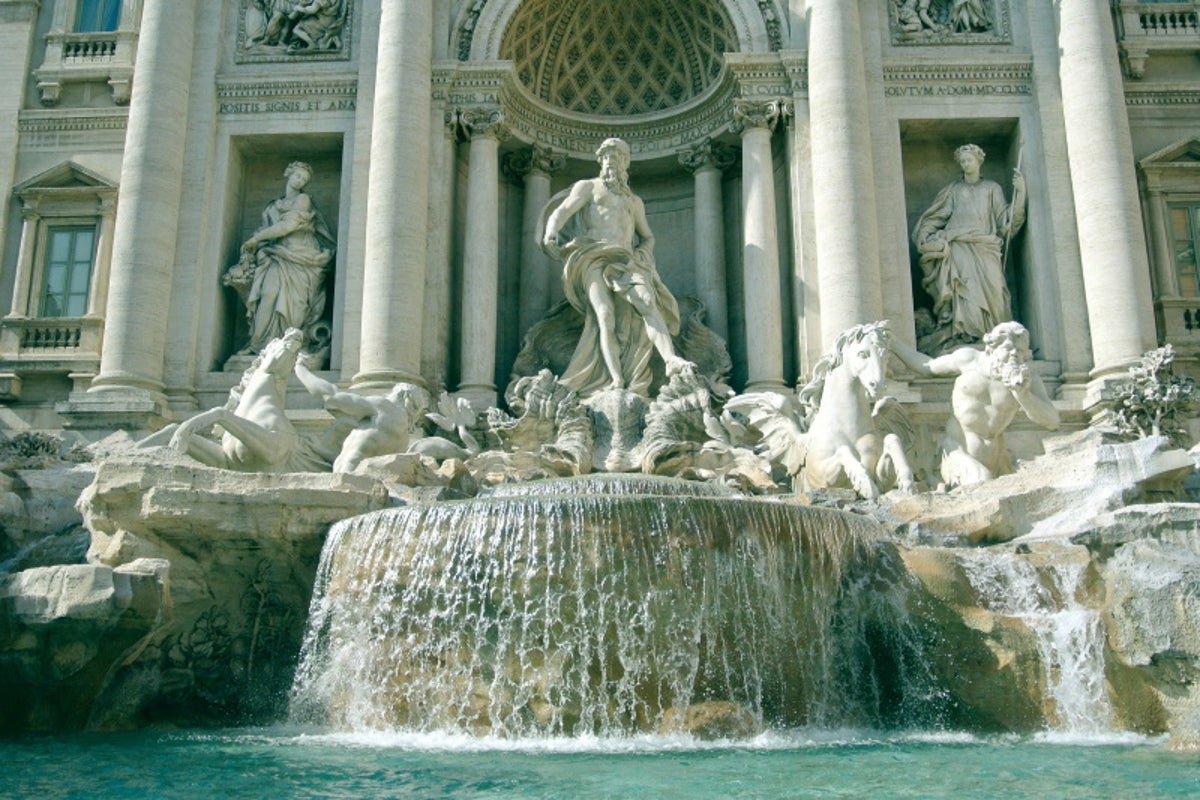
“To enter the basin of the Trevi Fountain, tourists and non-residents must pay a ticket costing €2.” So instructs the Major Events, Sport, Tourism and Fashion Department of the City of Rome. This week the authorities in the Italian capital brought in a fee to try to tackle humanity’s collective desire to view humanity’s magnificent creations.
“It’s a beautiful work of art,” says cultural guide and Roman resident James Hill. “An 18th-century celebration of the delivery of a fairly significant public utility to the city of Rome.”
In 1732 Pope Clement XII wanted a monument to recognise the provision of fresh water to the masses. He chose Nicola Salvi to sculpt the fountain, which backs on to an impressive palazzo. The vast sculpture is full of drama: a stretch of rocky shore has been imported into the very heart of Rome, as the stage for a drama frozen in marble. The god Ocean bursts out of the palazzo wall driving a chariot pulled by two horses, while figures signifying Health and Abundance watch on from niches on either side.
All roads in Rome seem to lead travellers to the Trevi Fountain, where they follow the touristic tradition of throwing coins to guarantee a return to the Italian capital.
Mr Hill says: “The origin of the Trevi story goes back to the ancient Romans. Departing Roman soldiers would drink the waters of Rome to guarantee their return to the city – they would survive campaigning, they would see their families again.
“So even in the 18th century, it was actually the drinking of the Trevi Fountain water that would guarantee your return to Rome, not so much throwing a coin in the fountain. But you certainly wouldn’t want to drink the Trevi Fountain water these days.”
The charge has been brought in to restore some order in the tourist hub of Rome. The admission fee is intended to improve the overall experience for visitors – and bring in useful funds or cultural conservation. Everyone’s a winner, is the official line.
Will the new charge succeed in dampening demand? Mr Hill predicts “everyone will pay” to visit the touristic and geographical heart of Rome.
In what is already an expensive city to visit, most tourists will not notice the odd €2. If you apply in advance for a ticket, though, you will certainly notice how cumbersome the system is – and spend longer organising the permit than you do marvelling at the monumental sculpture.
First you need to track down the official ticketing website, fontanaditrevi.vivaticket.it, amid a confusion of paid results. Next hurdle: an online security check that requires you to click on all the boxes of a picture that contain motorcycles. (Disappointingly, the photo was taken at some random location rather than depicting Lambrettas whizzing through the streets of Rome.)
A few more clicks, plus the application of a code texted from your credit-card issuer to make such an ambitious purchase (about £1.70) and you, too, can be the proud possessor of a barcode that will allow you to witness the wonder.
Mr Hill says he hopes “this isn’t a harbinger of future projects to charge you for walking through what is essentially a public square”.
Yet whatever the moral balance between restricting access and tackling overtourism, I believe the Trevi charge will be deemed a success. The pressure on the monument will ease because tourists in Rome will be deterred from making repeat visits to the fountain.
Today the Trevi Fountain – tomorrow the Piazza Navona or even Trafalgar Square? Probably not. Charging for admission to a public space is cumbersome, as is demanding residents prove their status to avoid the fee. But bigger visitor deterrents are spreading. Scottish cities are imposing tourist taxes. The Netherlands has just put up VAT on hotel stays. And the top US national parks now apply a $100 per person surcharge for foreign visitors.
Cash for access is spreading. Expect higher financial barriers to entry around the world.
For now, many other fine fountains are available free of charge, with Geneva, Singapore and Las Vegas leading the spray spectaculars.
Back in Rome, the city invites visitors to the Trevi Fountain to leave a bit more cash behind. The tourism authorities say: “Before leaving, do not forget to throw a coin into the fountain, you will definitely return to Rome, as the custom says. If, on the other hand, you are looking for a bit of romance, perhaps even an Italian love, you will have to toss a second and a third coin to make sure that the wedding bells will ring soon.”
Alternatively, go somewhere new.
Simon Calder, also known as The Man Who Pays His Way, has been writing about travel for The Independent since 1994. In his weekly opinion column, he explores a key travel issue – and what it means for you.
Hear more: James Hill talks to Simon Calder for The Independent’s daily travel podcast