


Your questions about robot lawnmowers answered
What is the best robot lawn mower?
Overall, the Gardena smart sileno free came out on top during testing. Not only was the cut quality very good, this model has excellent smart-home integration and is quiet in operation. It also won’t deplete your bank account quite as much as some other premium models.
If you’re shopping on a tighter budget, the Flymo easilife 250 go is an excellent, simpler alternative that focuses on reliability and ease of use rather than endless smart features.
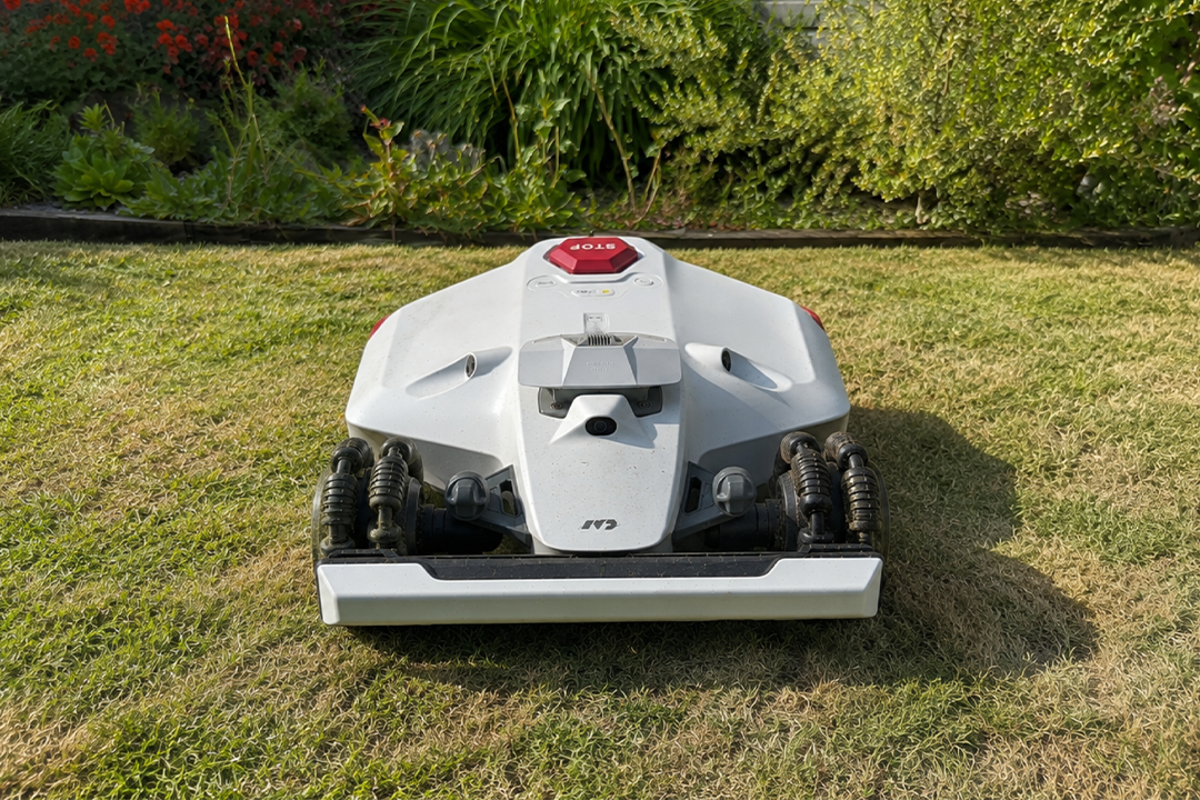
Meanwhile, if money is no object and you want one of the smartest robot lawnmowers currently available, the Mammotion luba 3 AWD combines genuinely impressive navigation, excellent terrain handling, strong multi-zone support, and one of the smoothest overall user experiences I’ve tested.
Do robot lawnmowers work on uneven lawns?
Yes, although some are dramatically better at it than others. Premium models with all-wheel drive systems and advanced navigation, such as the Mammotion Luba range, cope exceptionally well with slopes, bumps, and rough terrain.
Cheaper robot mowers generally prefer flatter lawns and can struggle more in wet conditions or on uneven ground.
Are robot lawnmowers safe around pets and children?
Modern robot lawnmowers are packed with safety systems. Most immediately stop their blades if lifted or tilted, while camera and sensor systems help detect obstacles and avoid collisions.
That said, I still wouldn’t recommend letting children treat one like a remote-control toy. They’re safer than traditional mowers, but there are still spinning blades underneath.
Are boundary wire robot lawnmowers still worth buying?
It depends. Wire-free RTK and camera-based systems have improved rapidly over the past few years and are now just as good as boundary wire mowers but without the extra set-up fuss.
That said, mowers with boundary wires can still be extremely reliable and often cost considerably less. They’re usually best suited to smaller or simpler gardens where one-off installation isn’t a major issue.
How I tested robot lawnmowers
Most of the robot lawnmowers here were tested in the same fairly square garden, which gave me a good baseline for comparing navigation, cut quality, app performance, obstacle avoidance, and overall reliability. I deliberately tested them in mixed conditions too, including wet grass, uneven patches, and areas with partial signal obstruction.
The Mammotion luba 2 AWD and Yarbo were tested separately at my in-laws’ garden, which is roughly three times larger and split into multiple lawn sections with gravel paths between them. That environment proved particularly useful for seeing how well these larger, more advanced machines coped with transitions, zone management, and rougher terrain.
For every mower, I looked closely at set-up difficulty, navigation accuracy, app usability, cutting consistency, obstacle avoidance, battery performance, and whether the thing actually made my life easier. Because ultimately, that’s the whole point of buying one of these in the first place. My testing criteria included:
- Ease of setup: I assessed how simple each mower was to install, whether that involved laying boundary wires, positioning RTK antennas, or mapping virtual boundaries.
- Navigation and obstacle avoidance: I tested how accurately each mower navigated around garden furniture, toys, narrow pathways, gravel crossings, trees, and uneven terrain.
- App experience and smart features: I compared how intuitive the apps were, how reliable connectivity proved during testing, and whether features like zoning, scheduling, and remote control genuinely improved the experience.
- Cutting quality: I closely monitored how neat and consistent the final finish looked, whether edges were left messy, and how well each mower coped with longer or damp grass.
- Reliability: I paid attention to how often each mower became stuck, lost signal, required manual intervention, or simply behaved unpredictably during day-to-day use.
Why you can trust IndyBest reviews
Connor Jewiss has been writing and editing about consumer technology for more than a decade, with bylines across titles including The Independent, Stuff, CNET, TechRadar, iMore and Trusted Reviews. He has tested everything from smartphones and smart-home kit to EVs and outdoor tech, with a particular focus on products that promise to make everyday life easier.
For this guide, Connor tested each robot lawnmower hands-on across real gardens rather than relying on spec sheets. That meant setting them up, mapping lawns, checking app controls, monitoring navigation, comparing cut quality, and seeing how each mower handled the awkward bits most gardens actually have, from gravel paths and uneven patches to slopes, edges, and unpredictable British weather.
Want more recommendations? Check out our guide to the best hedge trimmers