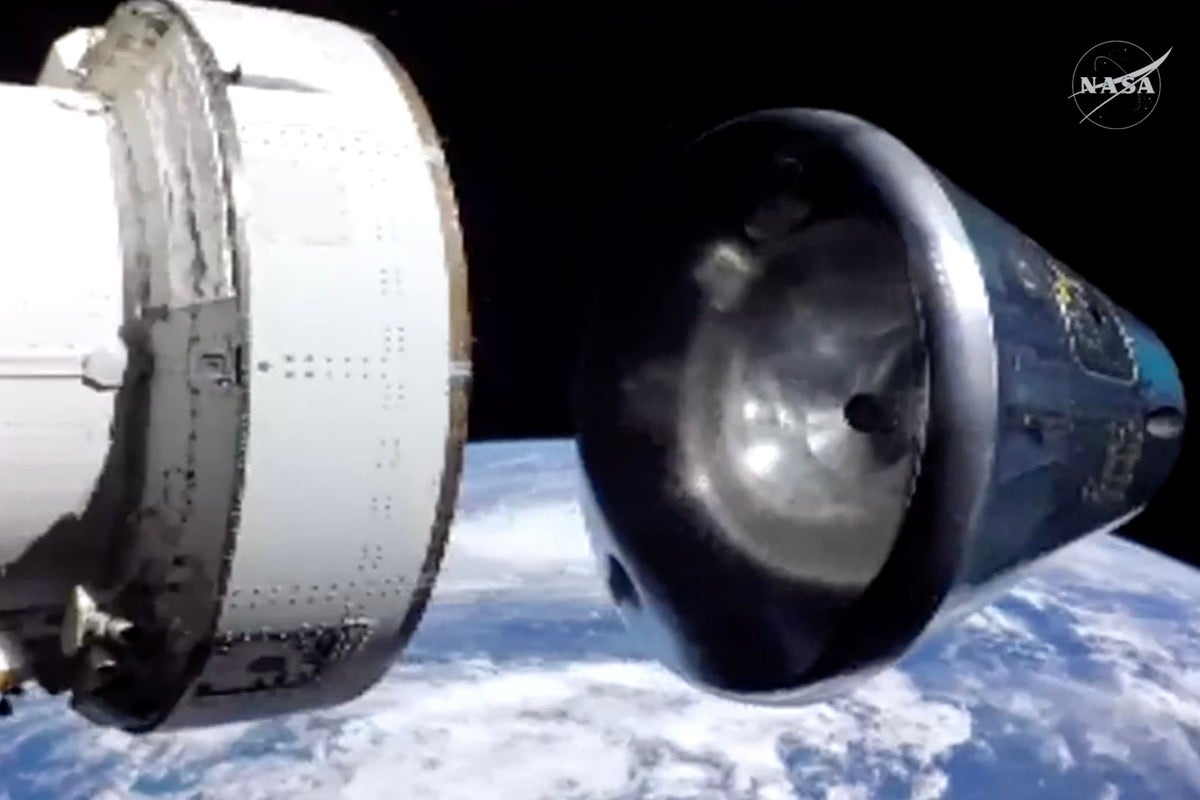

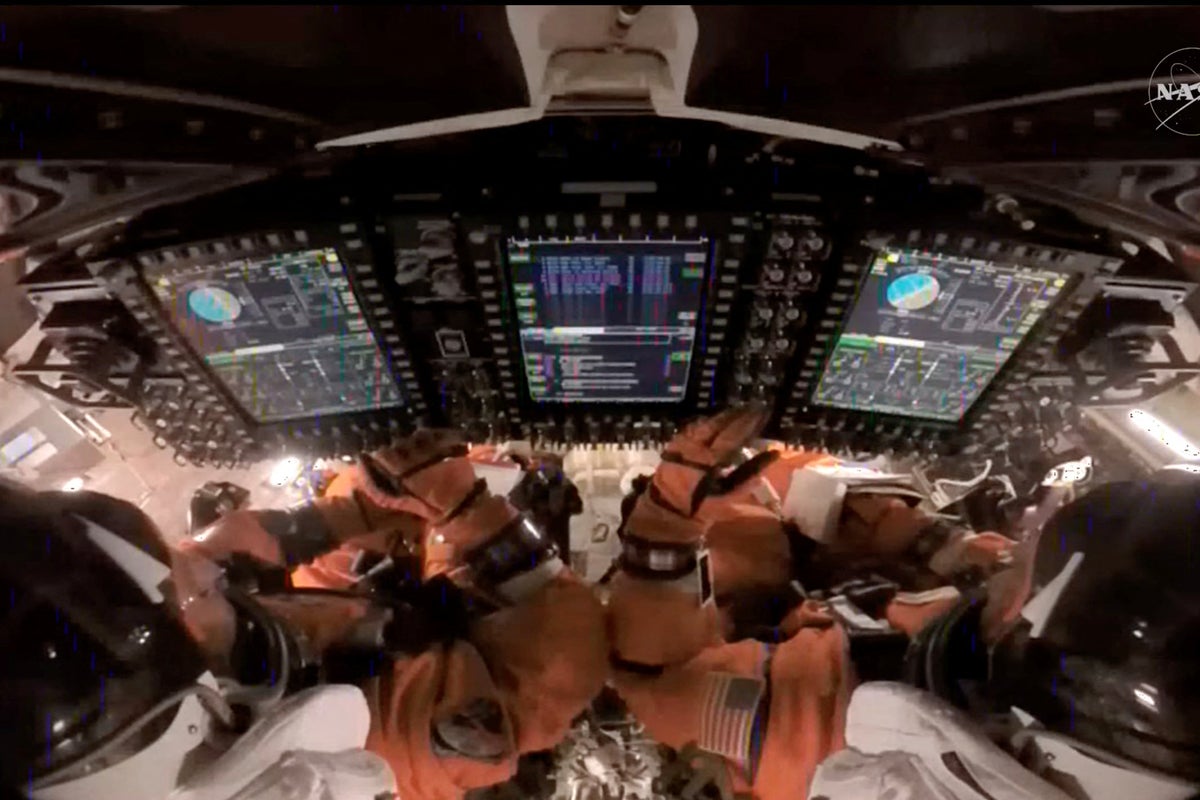
The Artemis II mission astronauts are minutes away from splashing down in the Pacific Ocean after returning from the Moon. It will be a fiery descent lasting about 15 minutes, finishing around 8.07pm ET today.
NASA expressed “high confidence” in the Artemis II crew spacecraft’s heat shield ahead of Friday’s historic return.
The shield is a critical part of the Orion capsule, protecting the crew from exposure to lethal temperatures – reaching up to 5,000 degrees Fahrenheit – during their high-speed descent, which is expected to last less than 15 seconds.
“It’s 13 minutes of things that have to go right,” Jeff Radigan, NASA’s Artemis II flight director, said yesterday.
There were problems with the heat shield on the first Artemis flight, which had no human passengers. Gases that were generated inside the shield’s outer material were not able to vent as expected, causing cracks.
Since then, the shield has undergone extensive testing and Amit Kshatriya, the space agency’s associate administrator, says his confidence in the tech is backed up by engineering and flight data.
The astronauts — NASA’s Christina Koch, Victor Glover, Reid Wiseman and the Canadian Space Agency’s Jeremy Hansen — were said to be in “high spirits” as they started their journey to Earth following a record-breaking slingshot around the Moon.
Artemis II astronauts could very well hurl after splashdown
After splashing down in the Pacific Ocean, the Artemis II astronauts will be extracted by Navy recovery teams using a life raft. The crew will be put in harnesses and hoisted into two helicopters overhead.
Then, the astronauts will be flown to the USS John P. Murtha amphibious transport dock ship for between 10-15 minutes. The crew will be taken into a medical bay for comprehensive examinations before they are flown to the San Diego Naval Air Station – and eventually to NASA’s Johnson Space Center in Houston, Texas.
In an interview with NASA, Dr. Rich Scheuring, NASA flight surgeon, said that the astronauts had gone over medical protocol earlier Friday, including that they may need nausea medication and fluids to replace the fluid and electrolytes they’ve lost in space.
“One of the most common responses they get is just some stomach awareness to some nausea – even to some vomiting,” he said.
“We don’t expect any injuries,” Scheuring added, noting that reducing speed can feel “kind of like a car crash.”
Julia Musto11 April 2026 00:19
Key milestones of Artemis II return
We’re less than an hour away from splashdown for the Artemis II crew, and there are several key mission milestones coming up.
Here, from Nasa, is the rundown of the timings for the re-entry. (They’re in eastern time, so add five hours if you’re watching from the UK.)
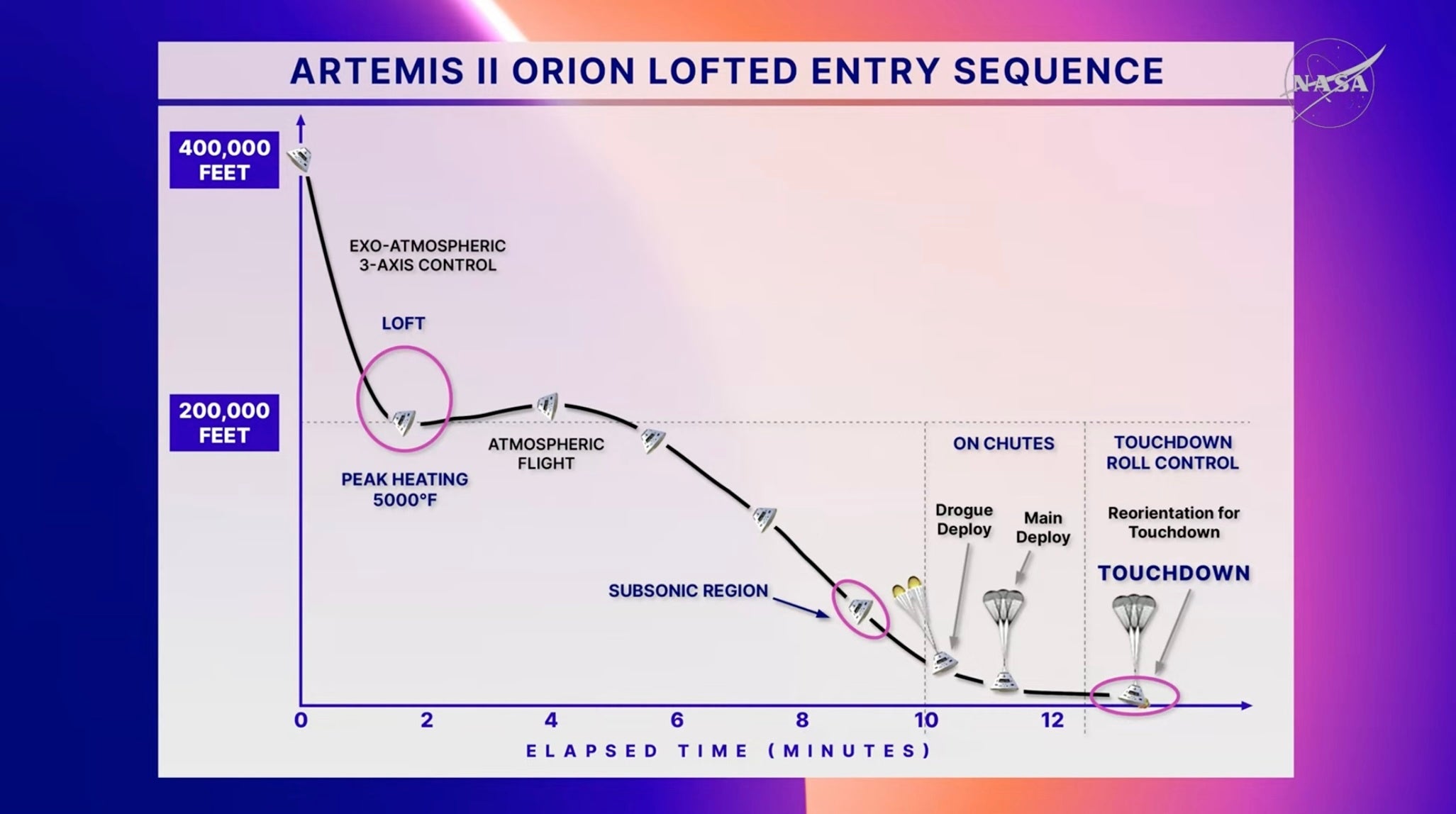
- 7:33 p.m.: Orion’s crew module will separate from the service module, exposing its heat shield for the spacecraft’s return through Earth’s atmosphere, where it will encounter temperatures of about 3,000 degrees Fahrenheit.
- 7:37 p.m.: Following separation, Orion will perform an 18 second crew module raise burn beginning to set the proper entry angle and align the heat shield for atmospheric interface.
- 7:53 p.m.: When Orion reaches 400,000 feet above Earth’s surface while traveling nearly 35 times the speed of sound. The crew is expected to experience up to 3.9 Gs in the planned entry profile. This moment marks the spacecraft’s first contact with the upper atmosphere and the start of a planned six-minute communications blackout as plasma builds around the capsule.
- 8:03 p.m.: Around 22,000 feet in altitude, the drogue parachutes will deploy, slowing and stabilizing the capsule as Orion nears splashdown.
- 8:04 p.m.: At around 6,000 feet, the drogues will release, and the three main parachutes will deploy, reducing Orion’s speed to less than 136 mph.
- 8:07 p.m.: Slowing to 20 mph, Orion will splash down in the Pacific Ocean off the coast of San Diego, completing the Artemis II crew’s return to Earth and a 694,481-mile journey.
- From there, teams from NASA and the U.S. military will extract the crew from Orion and fly them via helicopter to the USS John P. Murtha.
- Within two hours after splashdown, the crew will be extracted from Orion and flown to the USS Murtha. Recovery teams will retrieve the crew, assist them onto an inflatable raft, and then use helicopters to deliver them to the ship. Once aboard, the astronauts will undergo post‑mission medical evaluations before returning to shore where awaiting aircraft will take them to NASA’s Johnson Space Center in Houston.
Anthony Cuthbertson11 April 2026 00:13
The splashdown sequence
With just over an hour to go until the Orion spacecraft splashes down in the Pacific Ocean, the crew members of the Artemis II mission are making the final preparations for their safe return.
Here’s how the whole sequence should play out:
Anthony Cuthbertson10 April 2026 23:59
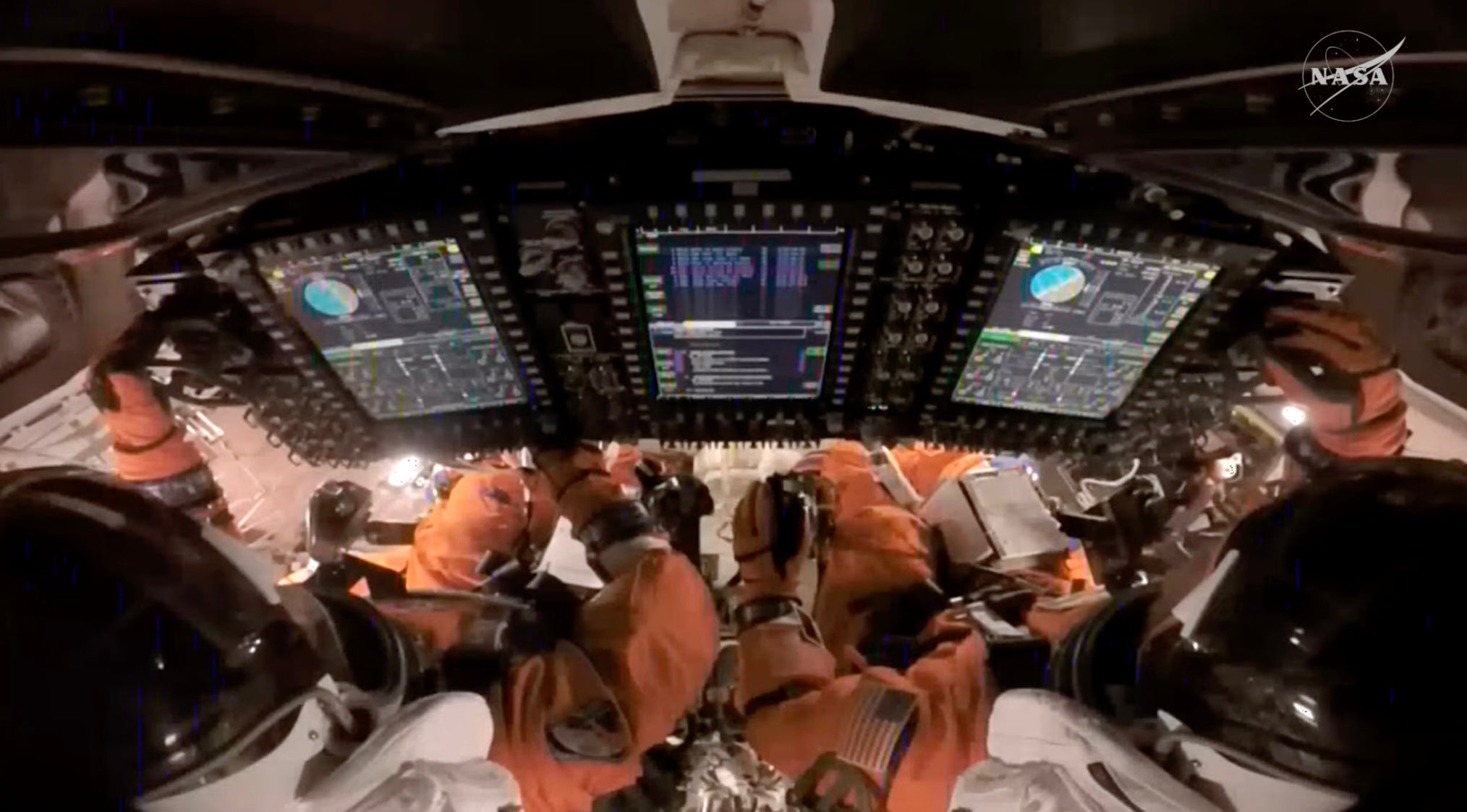
What do the Artemis II astronauts do when they’re not in space?
Christina Koch is a rock climber, surfer, runner and yogi. She’s been seen climbing ice walls in Montana. Reid Wiseman enjoys a round of golf and go-carting racing, according to Baltimore. Jeremy Hansen rides sail boats and mountain bikes. He also enjoys rock climbing. Victor Glover works out and is a former Division 1 athlete. He’s been seen using a rowing machine during the Artemis II mission.
Julia Musto10 April 2026 23:52
The terrifying stakes of reentering Earth’s atmosphere
In the history of our species, 19 people have died during spaceflights. Nine of them were killed during reentry.
In April 1967, Soviet cosmonaut Vladimir Komarov perished when his Soyuz 1 spacecraft slammed into the ground at high velocity because its parachute failed to open.
Seven months later, NASA test pilot Michael J. Adams lost, regained, and lost control of his X-15 spaceplane during reentry, causing it to break apart at 65,000 ft.
But the largest incident came on February 1, 2003, as the Space Shuttle Columbia was returning from a 15-day scientific mission. Two days in, NASA analysts had learned that the shuttle’s heat shield was damaged during launch, but ultimately concluded there was no danger.
As Columbia screamed across the California coast at Mach 23, hot air forced its way in through the breach in the heat shield and began melting the shuttle’s skeleton. Over the next 15 minutes, gradually and then extremely quickly, the spacecraft slipped out of control and was torn apart.
Astronauts Rick Husband, William C. McCool, Michael P. Anderson, Kalpana Chawla, David M. Brown, Laurel Clark, and Ilan Ramon had enough time to know that something was wrong, but not enough to correct it. They may have been conscious up to 90 seconds of wrenching impacts, horrific heat, and terror.
The disaster delayed the completion of the International Space Station and froze Shuttle flights for two years, ultimately causing the its retirement in 2011. Today there is a memorial to the crew at the Arlington National Cemetery, and an asteroid named after each member.

Io Dodds10 April 2026 23:46
Astronaut portraits projected onto US embassy
The Artemis II mission is being celebrated throughout the US and beyond – from high schools, to highway overpasses.

The US embassy in Ottawa shared an image showing the portraits of the four crew members projected onto their walls, where they will remain throughout the month of April.
Anthony Cuthbertson10 April 2026 23:38
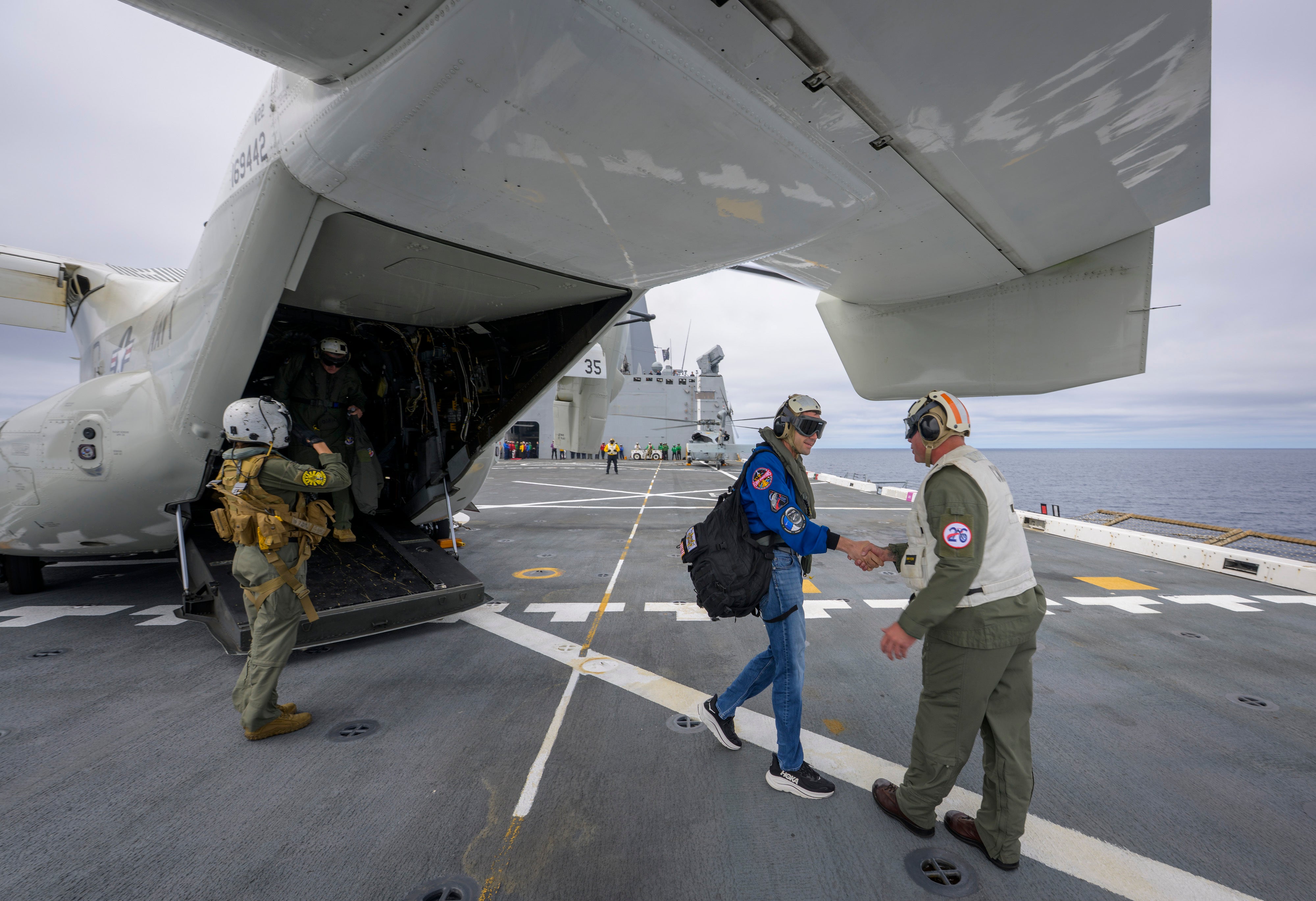
Nasa Administrator Jared Isaacman arrives at splashdown site
Jared Isaacman, former space tourist and now the administrator of Nasa, has arrived onboard the USS John P. Murtha ahead of the splashdown.
Helicopters will pick up the Artemis II astronauts from the Orion spacecraft and return them to the navy vessel. The crew will then undergo medical assessments before finally being able to return to solid ground.
Anthony Cuthbertson10 April 2026 23:26
Sonic boom over California
People in southern California may hear and feel a sonic boom as the Orion spacecraft shoots down into the Pacific Ocean, just off the coast of San Diego.
The United States Geological Survey said the sonic boom is expected between 5-5:15pm local time.
Anthony Cuthbertson10 April 2026 23:06
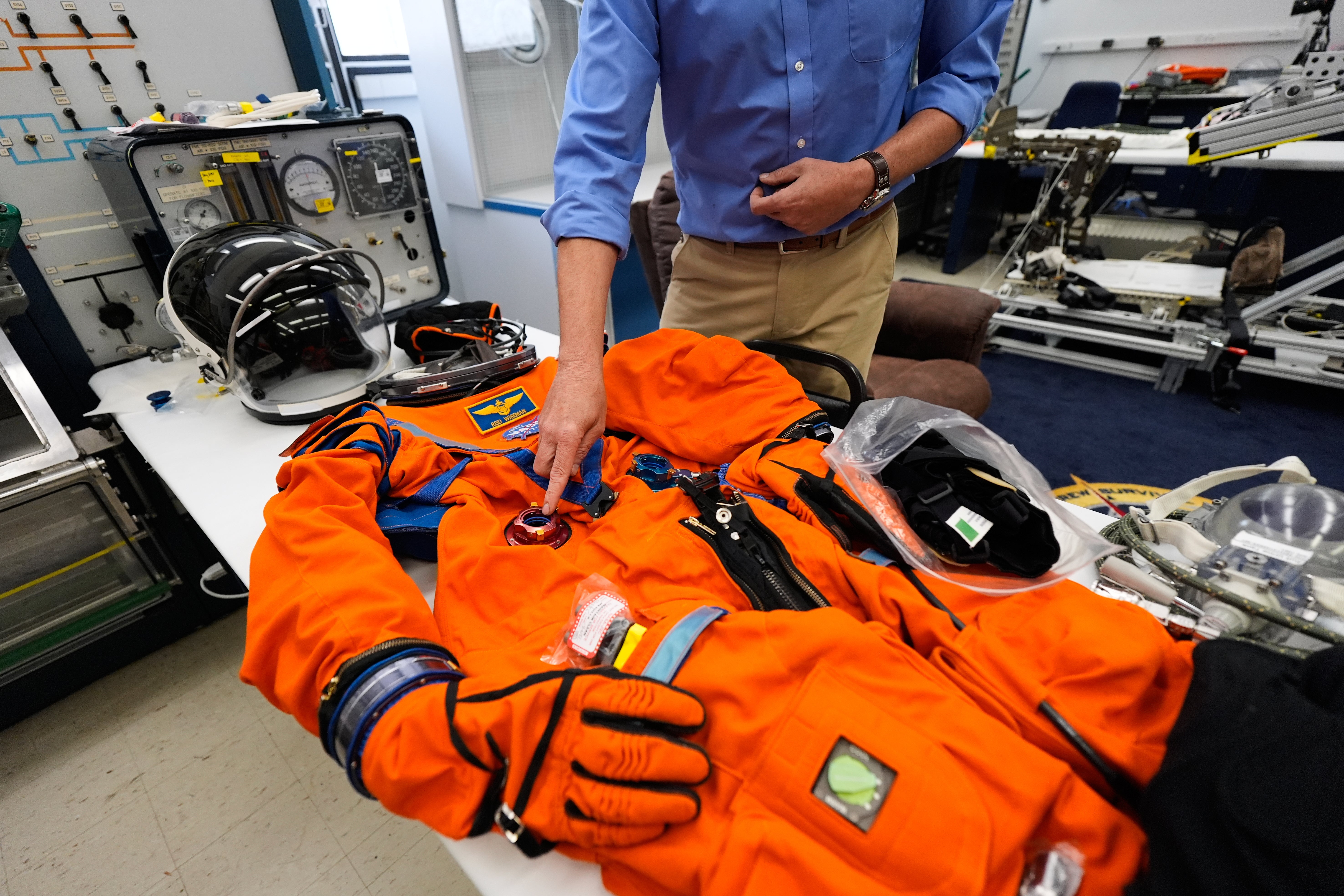
Astronauts don ‘survival suits’
The Artemis II crew members are putting on their “survival suits” ahead of reentry. All four suits have passed the leak check, so everything continues to move forward as planned.
“We are in good shape here for reentry and splashdown,” Nasa says.
There will be a communications blackout of 6 minutes as the spacecraft plummets back into the Earth’s atmosphere at a peak speed of 24,661 mph – just 130 mph short of the velocity record set in 1969 by the Apollo 10 crew on return from orbiting the Moon.
Anthony Cuthbertson10 April 2026 22:40
Astronaut’s high school hosts ‘splashdown party’
The former high school of Artemis II crew member Reid Wiseman is hosting a “splashdown party” to celebrate his return to Earth.

“While Reid will be splashing down in the Pacific Ocean, we are planning to mark the occasion here in Reid’s hometown,” Dulaney High School wrote in a post to Instagram.
Anthony Cuthbertson10 April 2026 22:31