
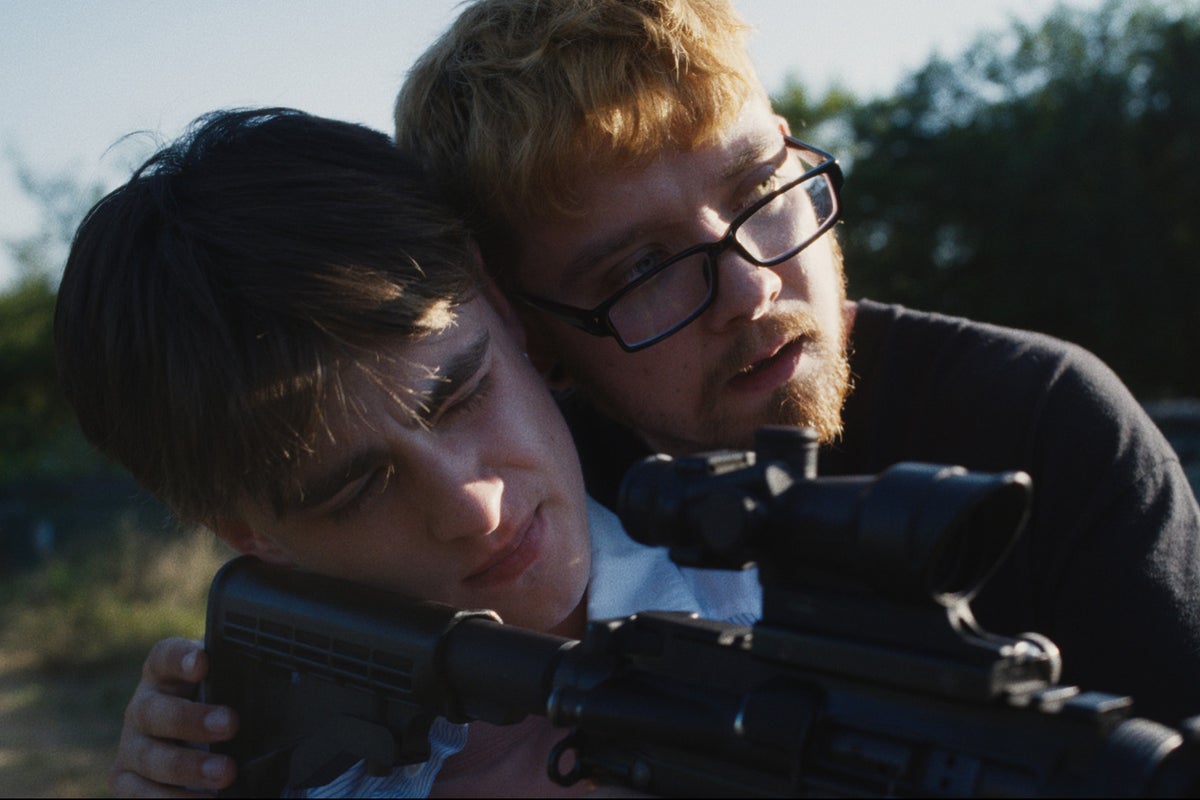
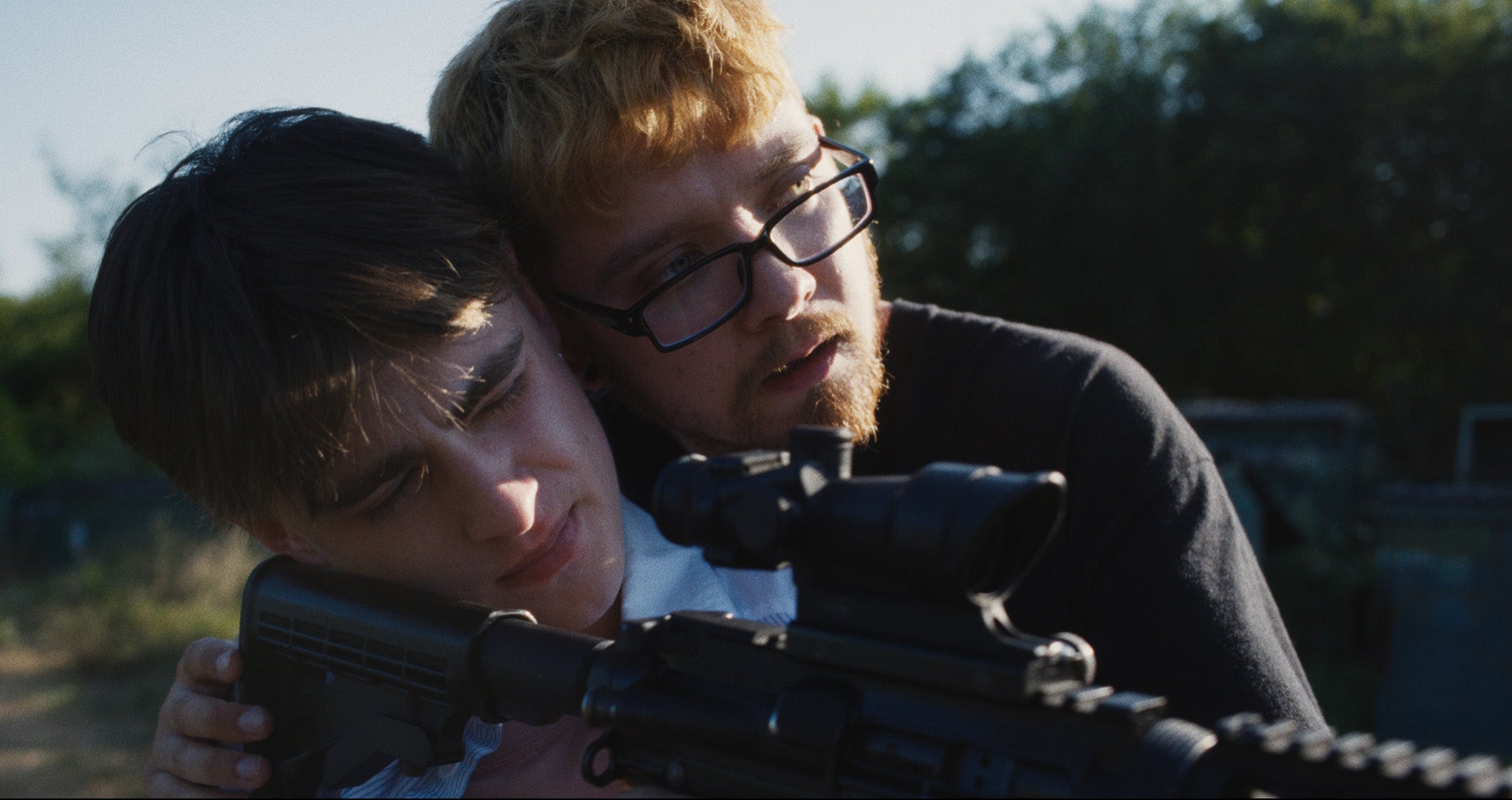
A masked man stalks the halls of a high school corridor, a semi-automatic rifle raised in front of him. But when the gunman finally reaches a classroom, the children inside do nothing but stare at him blankly, unmoved and unscared. The illusion shatters: this particular gunman is part of an active-shooter training drill. Rather than stopping school shootings, America has built a lucrative private industry devoted to preparing children for the next one.
This is the opening scene of Our Hero, Balthazar, a provocative dark comedy from first-time director Oscar Boyson that finds humour in deeply uncomfortable places. What initially appears to be a film about school shootings quickly reveals itself as a bleakly funny satire about the way tragedy and online attention have become hopelessly intertwined. Rather than using school shootings for shock value, Boyson uses them as the foundation for an exploration of greed, loneliness and growing up on social media.
The titular Balthazar (Jaeden Martell of the It films) is a snooty, neglected trust fund kid from New York with an uncanny ability to make himself cry on cue, posting tearful videos after every school shooting in pursuit of online validation. When a troll threatens a school shooting beneath one of his performative posts, Balthazar sees a chance to prove his outrage is genuine. Using a fake online profile and deepfakes of his own mother’s voice, he catfishes the troll into meeting him, then travels to rural Texas convinced he can stop the attack before it happens. Asa Butterfield delivers a skin-crawling performance as Solomon, the lonely, trailer-bound teenager at the other end of the screen, whose violent online bravado masks a grim home life.
The seed for the film came in the aftermath of a mass shooting in Uvalde, Texas, in 2022, in which an 18-year-old boy murdered 19 children and two teachers. Before beginning his massacre, the gunman messaged a 15-year-old girl in Germany he’d been speaking to online, and told her of his plans. She replied with a single word: “cool”. Later convicted of failing to report a planned crime, her response lingered with Boyson, who cut his teeth as a producer on films by the Safdie brothers, among them Good Time and Uncut Gems. “It felt like a microcosm of what it’s like to be on the internet today, [and] especially to be a kid on the internet today,” he says. “She was 15 years old and exposed to all these terrible things and then it’s on her to call the cops? It’s her fault that it happened? It’s just ridiculous.”
Our Hero, Balthazar had its world premiere at New York’s Tribeca Film Festival last year, but only after being rejected by both Sundance and SXSW – important launchpads for independent films looking to find distribution. Boyson has speculated in the past that his movie was overlooked because the subject matter is too provocative, especially in the wake of Trump’s reelection. A dark comedy about a school shooting isn’t exactly the easiest sell. Was it difficult to get made? In a word…
“Yes,” Boyson tells me, laughing. “A lot of the people your agents tell you you’re supposed to talk to when you’re doing an indie film, none of them wanted anything to do with it,” he adds. “But I’m the kind of person who, when people say no, especially in the industry, that actually gets me fired up. I don’t have the wildest imagination. For me, it’s hard to come up with something that’s going to stand out, and I knew that if they’re all saying ‘no’, well, then this will stand out.”
Nevertheless, Boyson says he was able to raise more money than he expected through his industry connections and a group of first-time film investors. That support helped him land a star in Butterfield, the British actor best known for playing the angsty sex therapist-in-training Otis in Netflix’s Sex Education. It’s a great role for an actor in the process of shedding the skin of a familiar character; Butterfield is repulsive as the incel-coded Solomon, disappearing beneath a badly dyed blonde mullet, peach fuzz beard, emo piercings and low-slung denim shorts.
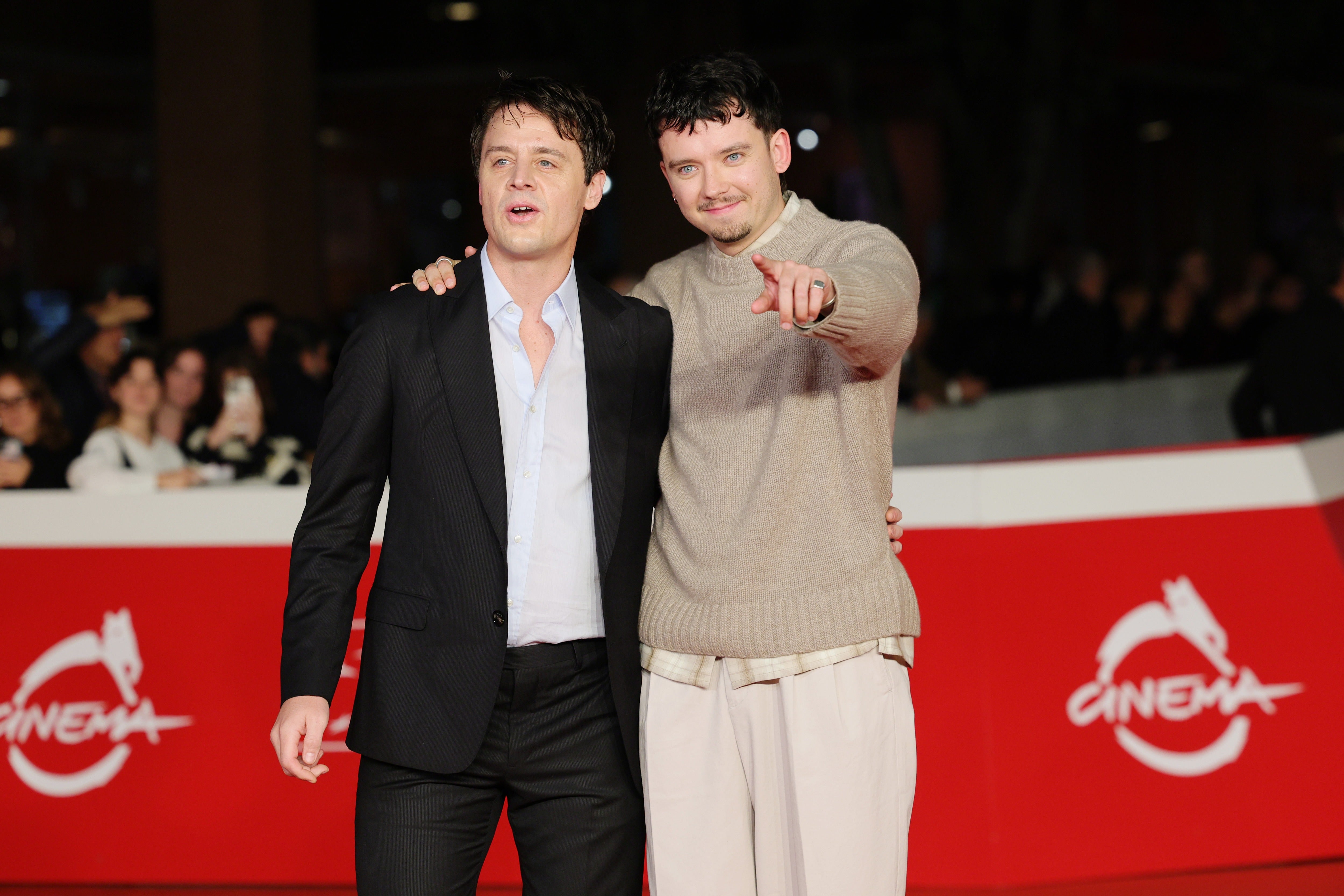
Though school shootings remain a uniquely American epidemic, Butterfield says the film’s deeper themes are universal. “Loneliness in young men is global, which really is the heart of the story,” he tells me, appearing from his London home over Zoom alongside Boyson. “Our movie feels like you’re on the inside of this world and these young men’s minds, and you see what has happened to get them there – their living situations and their sort of shared isolation – despite their massive differences.”

Watch Apple TV+ free for 7 day
New subscribers only. £9.99/mo. after free trial. Plan auto-renews until cancelled.
Try for free
ADVERTISEMENT. If you sign up to this service we will earn commission. This revenue helps to fund journalism across The Independent.
Watch Apple TV+ free for 7 day
New subscribers only. £9.99/mo. after free trial. Plan auto-renews until cancelled.
Try for free
ADVERTISEMENT. If you sign up to this service we will earn commission. This revenue helps to fund journalism across The Independent.
While Solomon and Balthazar might be at different poles of America’s class system, they end up forging a bizarre friendship – one rooted in a mutual desire for connection (the catfishing attempt is quickly forgiven). What transpires is a kind of screw-loose buddy comedy, with the pair cruising round in Balthazar’s car, shooting tubs of supplements that Solomon’s dad has attempted to palm off on him. One of the film’s best running gags is the name of the father’s pyramid scheme testosterone company – Thrush, a portmanteau of “thrill” and “rush”. Wanna buy some Thrush?
Comedy feels like a fine line to tread when it comes to the bleak subject matter here, but Boyson does it elegantly, using satire to expose the contradictions of modern masculinity that breed resentment in young men like Solomon. Not every filmmaker has navigated the topic without controversy. Earlier this year, the Robert Pattinson/Zendaya black comedy The Drama drew criticism for revealing Zendaya’s character had once planned a school shooting, with advocacy groups arguing that the film had turned a real-world trauma into an edgy plot twist. March for Our Lives, the group founded by Parkland survivors, said in a statement: “When something like a school shooting is treated lightly or played for irony, it raises a deeper question: what kind of conversation is this meant to start?”
-2.jpeg)
Boyson wasn’t worried about experiencing a similar backlash. “I think we always knew our hearts were in the right place,” he says. He is more worried that people will be too scared to talk about school shootings at all. “That’s the annihilation mentality,” he says. “Nobody wants to talk about it, because to talk about it is to admit that you can’t change anything. To admit that you can’t change anything is to admit that you don’t live in a functioning democracy. It’s brutal, but we have to talk about this stuff.” Humour, he adds, “increasingly feels like the only way to navigate it as a storyteller”.
Butterfield hopes their film will spark conversations similar to last year’s Adolescence, Netflix’s cultural juggernaut about a teenager’s descent into a world of online misogyny. “What I think our film does differently from Adolescence is that it’s really aimed at young people as a representation of what they’re going through,” he says. “Whereas Adolescence felt like it was more from the perspective of parents on the outside looking in, and not knowing what’s going on. I think this will really speak to all sorts of young people – a lot of Gen Z.”
Without spoiling anything, Our Hero, Balthazar ends on a circular note, suggesting the cycle of gun violence and online outrage will repeat itself indefinitely within the current status quo. Perhaps unsurprisingly, then, the director is similarly pessimistic about whether things will eventually change in the US. He remembers the survivors of the 2018 Parkland shooting – which surpassed Columbine as the deadliest high school shooting in US history – and the massive #NeverAgain movement they created. “They were paraded around the country, and the media made them feel like they could actually change something,” he says. “Then nothing happened. Like, what does that do to your psyche? To be Time’s Person of the Year, and nothing changed at all.” He harks back to his film’s opening sequence with the active shooter training: “You just have to laugh, because instead of doing something nice for kids and making them feel safer… we just turned it into a multi-billion-dollar business.”
‘Our Hero, Balthazar’ is in cinemas from 16 July