


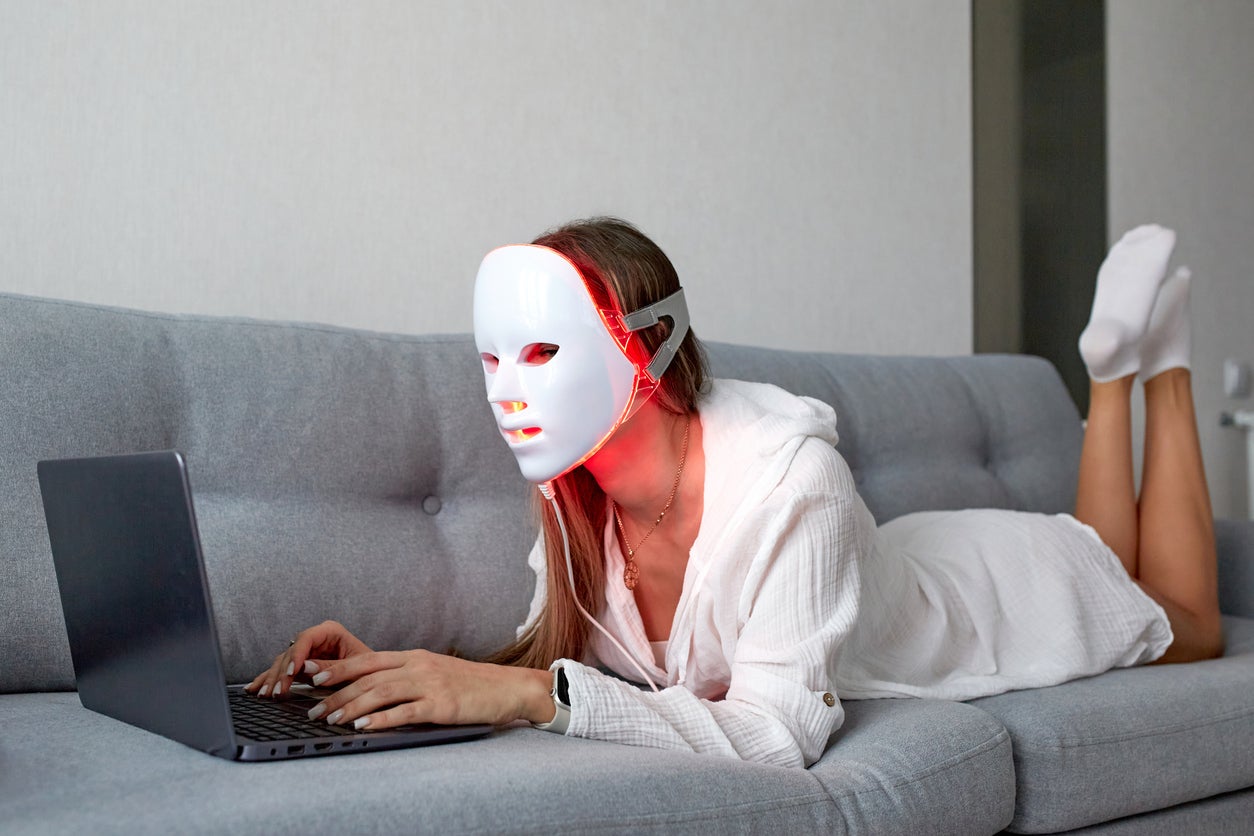
You’ve surely seen the selfies. Celebrities, influencers and bandwagon-jumping civilians sitting in the dark, with a futuristic LED mask obscuring their features with a red glow emanating from beneath. Yes, they look a bit like background extras from a horror movie, or the protagonist of a sci-fi reboot of Phantom of the Opera. But it’s all in pursuit of the perfect complexion.
Over the past few years, at-home light therapy masks have become the ultimate beauty status symbol. You can simply pop it on, sit back and rest smugly in the knowledge that you’re giving your skin a serious boost, smoothing out wrinkles and blitzing blemishes (or so the marketing spiel tells you).
Or, you can multitask and wear it while you’re ticking stuff off your to-do list. I once got a fright when I spotted someone sat in the front seat of a 4×4 with their features obscured by their lit-up mask, like the Terminator on the school run (they were in the passenger seat, but still).
Since the pandemic switched many of us on to at-home beauty options, light therapy devices have boomed in popularity, with LED mask sales reportedly leaping up by 55 per cent in 2020, with the market set to be worth around £600m globally by 2032. A mask can be a serious investment: although prices for some more affordable options start around the £100 mark, there are plenty of high-end offerings that cost anywhere from several hundred to upwards of a thousand pounds.
But for all the social media hype, it’s unclear whether they actually work. Are they worth the staggering price tag? Or are we all just falling for the allure of a few enticing before-and-after photos? “People are drawn in by the promise of easy, tech-based solutions they can use at home while watching TV,” says Dr Sach Mohan, cosmetic doctor and founder of Harley Street’s Revere Clinics. “The downside is that what’s popular online often doesn’t match what’s effective.”
And this week, an advert for Beauty Pie’s LED face mask, which stated that the gadget was “clinically proven to reduce wrinkles in four weeks”, was banned by the Advertising Standards Authority, with the regulator arguing that there was not enough evidence to make such a claim. Beauty Pie argued in response that their trial, conducted on 28 people aged between 30 and 65 over a four week period, demonstrated a “significant reduction in wrinkles”, with 92 per cent of testers either agreeing or strongly agreeing that their “fine lines appear less visible”.
However the ASA said that this sample size was “relatively small” and that there was no placebo group; it also noted that testers were instructed to use an exfoliator and a hydrogel, which were not sold with the mask, so they concluded that “the reported improvements in the appearance of wrinkles could not be attributed to the [mask] alone”.
Dr Mohan points out this is not an isolated incident; the ASA recently had to ban a handful of online adverts for LED masks for claiming that they could clear up acne and rosacea. References to skin conditions like these count as medical claims, which only devices registered with the Medicines and Healthcare products Regulatory Agency (MHRA) can make. “Currently, there are no LED masks that comply with medical device regulations, so these devices are purely cosmetic at best,” Dr Mohan says.
Light therapy, or photobiomodulation (PBM), has been used in clinics for decades. It “works by exposing the layers of the skin to specific light wavelengths”, which can “cause cellular changes”, explains Dr Mohan. Our cells “respond to the different wavelengths, often by increasing energy production, improving circulation, or triggering biological responses like collagen production”.
These different wavelengths, which are measured in nanometres, have different effects, Dr Mohan adds. Blue light, which has a shorter wavelength of between 400 and 495 nanometres, can “target acne-causing bacteria on the skin’s surface to reduce active breakouts”, he says.
Red light, with a wavelength between 630 and 680 nanometres, can “penetrate a little deeper into the dermis” – the middle layer of your skin – and is linked to skin rejuvenation, “stimulating collagen, reducing inflammation and helping with cellular repair and healing”. Back in the Eighties and Nineties, NASA was investigating how red light might impact plant growth in space; the technicians working on the experiments also noticed that bruises and cuts on their hands (which were exposed to the light) were healing quicker than usual.
Near-infrared light, meanwhile, starts at 800 nanometres; it can reach even further to improve circulation, ensuring the cells receive more oxygen and more nutrients.
Professional grade phototherapy devices, Dr Mohan says, are “generally backed up with decades of controlled clinical studies that support improvements in collagen production [and] reduction in inflammation and show measurable changes to fine lines, wrinkles and skin elasticity with regular treatment over several weeks”, or, in the case of blue light, “highlight clinically clearer skin for acne patients with a reduction in acne-causing bacteria”.
That doesn’t mean, though, that the same applies to that futuristic mask you’ve spotted on Instagram. Many of the studies into their benefits have been carried out on a very small sample size, or have been funded by beauty brands. And where they do show positive effects, these tend to be “more subtle, and depend heavily on consistency and correct use”, explains Dr Adam Friedmann, Harley Street dermatologist and founder of ProDerm UK dermatology clinics.
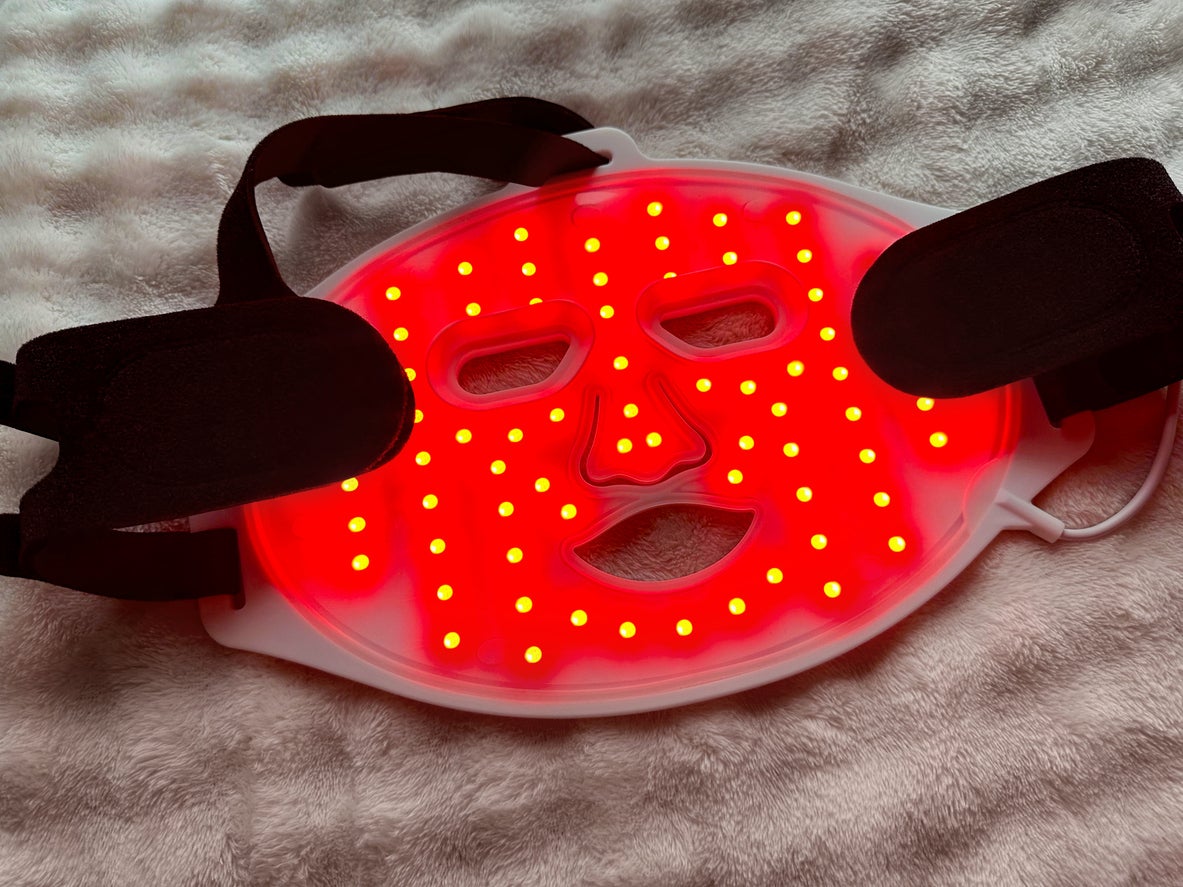
At-home products “emit much lower energy” than their clinical counterparts, Dr Mohan adds; the number of bulbs and the strength of those LEDs will vary considerably from product to product, and they certainly don’t offer “the same grade of LED technology or energy delivery as you will find in a certified medical device used in professional clinics”.
He is not the only expert who is sceptical. Consultant dermatologist Dr Anjali Mahto, founder of Self London, tells me that she is “not a fan” of these devices, because “the evidence behind them remains unclear despite heavy marketing”. In her opinion, “they’re an extremely expensive investment for someone to make considering that the results will likely be largely unpredictable”. And Dr Ross Perry, medical director at Cosmedics skin clinics, reckons that at-home options will have “more of a placebo effect than anything else”.
If you are still intrigued by at-home light therapy, you’ll need to get real about your expectations (that includes taking your favourite influencer’s amazing “glow up” photos with a pinch of salt), commit to using it several times a week and dig deep into the specifications of each product, rather than just opting for whichever one has the best reductions in the post-Christmas sales.
Dr Friedmann recommends checking whether the mask you’re eyeing up offers “clinically relevant wavelengths” and has a sufficient power output, as well as ensuring that the LEDs are distributed uniformly across the face. It also needs a “good facial fit” to actually make a difference. “Price alone doesn’t guarantee effectiveness, but very inexpensive devices often lack the specifications needed to produce meaningful results,” he says.
Your mask should also provide adequate eye protection, and anyone with “photosensitive conditions, those on photosensitising medications or with certain eye disorders” should consult their doctor beforehand, Dr Friedmann adds. Plus, you should be aware that blue light can worsen hyperpigmentation, especially in darker skin tones.
Essentially, we need to be cautious about any big marketing promises suggesting that one £150 mask is going to leave you with a glowing, youthful visage in a matter of days. “At-home devices are designed to be safe rather than powerful, which means results are slower and less dramatic,” Dr Friedmann notes. They can, he adds, “be useful as maintenance tools”, but we need to be wary of claims that suggest they can replicate the results you’d get from a clinical treatment.
So while the red light robot selfies might be intriguing, it’s important to remember that there are no shortcuts to good skin – and any product claiming to offer this is probably too good to be true.