


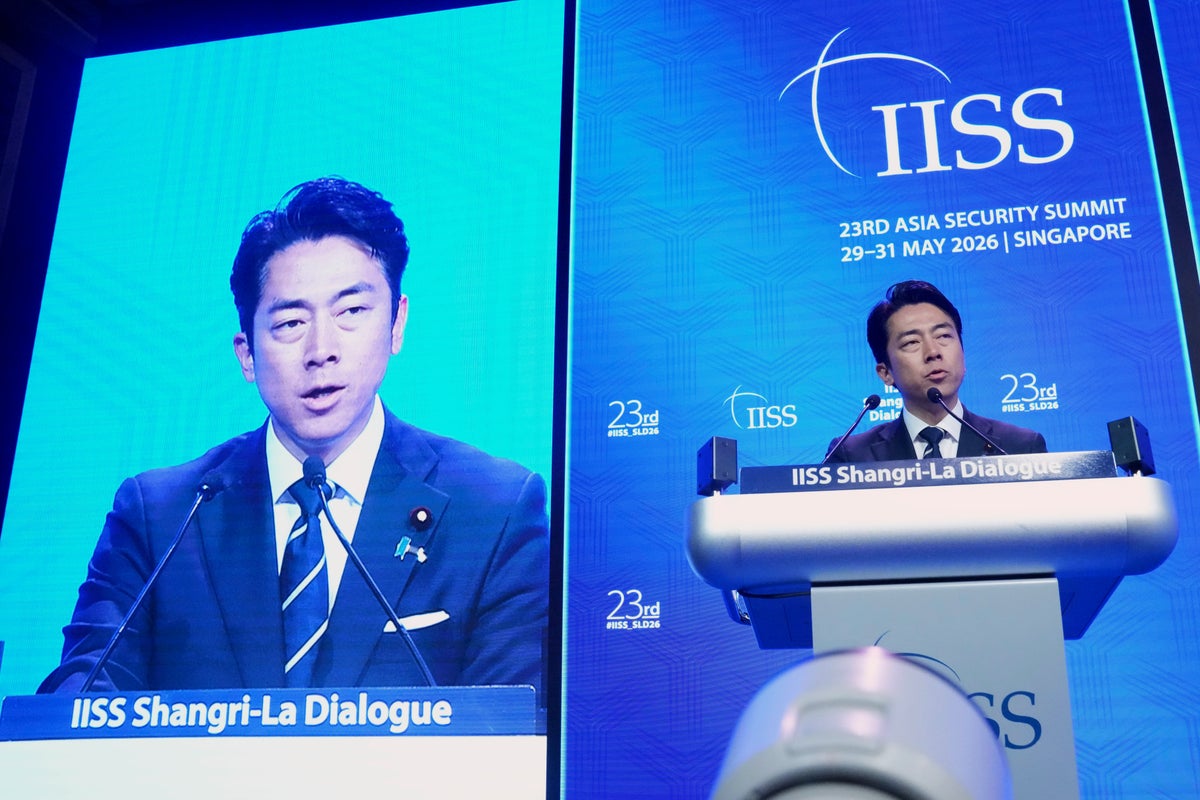
American allies stressed the need for unity at a top defense conference Sunday, saying that as threats increasingly transcend regions cooperation is more important than ever, even as Washington has become more critical of its traditional friends.
U.S. President Donald Trump has been extremely harsh about NATO, and the comments at the Shangri-La conference came the day after U.S. Defense Secretary Pete Hegseth again chided Western European allies at the forum for not devoting enough resources to defense.
Japanese Defense Minister Shinjiro Koizumi praised Hegseth for his commitment to the Indo-Pacific, but at the same time stressed the continued need for strong coalitions globally.
“Division weakens deterrence, unity strengthens deterrence,” he told the conference, hosted by the International Institute for Strategic Studies.
“If gaps emerge among the United States, Europe, and allies and like-minded countries, forces which take it as an opportunity will surely come in,” he said. “We must prevent such as situation. We must keep our cooperation going on. Now is the time to make our cooperation even stronger.”
As China has been rapidly expanding and modernizing its military, Japan has been reshaping its own defense policy. Last month, Prime Minister Sanae Takaichi’s Cabinet scrapped a ban on lethal weapons exports, a major change in its postwar pacifist policy.
China criticized the change, with Foreign Ministry spokesperson Guo Jiakun saying China would “resolutely resist Japan’s reckless moves toward a new type of militarism.”
Koizumi scoffed at that accusation as ironic, coming from China.
“Think about it, there is a country that has a huge arsenal of nuclear weapons and strategic bombers,” he said, speaking in English. “Japan has neither of such weapons, and yet Japan is labeled new militarism. Isn’t it strange?”
He said that transparency comes from “discussion and dialogue” and lamented that China had not sent its defense minister to the conference.
In his speech Saturday, Hegseth applauded many Asian partners for their efforts to step-up defense spending, while reiterating criticism of European allies, who he suggested got “distracted by empty globalist rhetoric about the rules-based international order, while European capitals threw open their borders and hollowed out their militaries.”
“You can have all the rules you want and rules are great,” Hegseth said. “But if you can’t back them up with hard power, the rules are not worth the paper they are written on.”
Speaking to reporters on the sidelines of the conference Sunday, Australian Defense Minister Richard Marles, said he agreed with Hegseth’s point that “the rules based order needs to be underpinned by power,” but at the same time said strong rules were “more important today than they have ever been.”
“We are all committed to a rules based system, because that is actually what gives, middle powers like Australia or smaller countries agency,” he said.
He also said alliances remain critical to the region’s defense.
“This is a collective challenge and it demands a collective response, which is actually what the rules based order is all about,” he said.
Netherlands Defense Minister Dilan Yesilgöz-Zegerius said the current conflicts have global implications and demand a shared response.
“A war in Europe involves drones from Iran, soldiers and ammunition from North Korea and various types of support from China,” she said. “The lesson is clear: regional tensions are no longer regional. Our security is interconnected.”
She said that if middle powers do not work together, they risk becoming spectators or the “subject of conversations,” but with coalitions they can help preserve stability.
“The fact that international rules are being violated does not mean we should abandon them,” she said.
“On the contrary, it means we must defend them more constantly and more courageously. International law may be imperfect, but history teaches us that the alternative is far worse.”