



Blue Origin has suffered a catastrophic setback to its rocket programme in the form of an explosion at its only operational launchpad in Cape Canaveral, Florida, which could add further delays to Nasa’s plans to send astronauts to the moon before China.
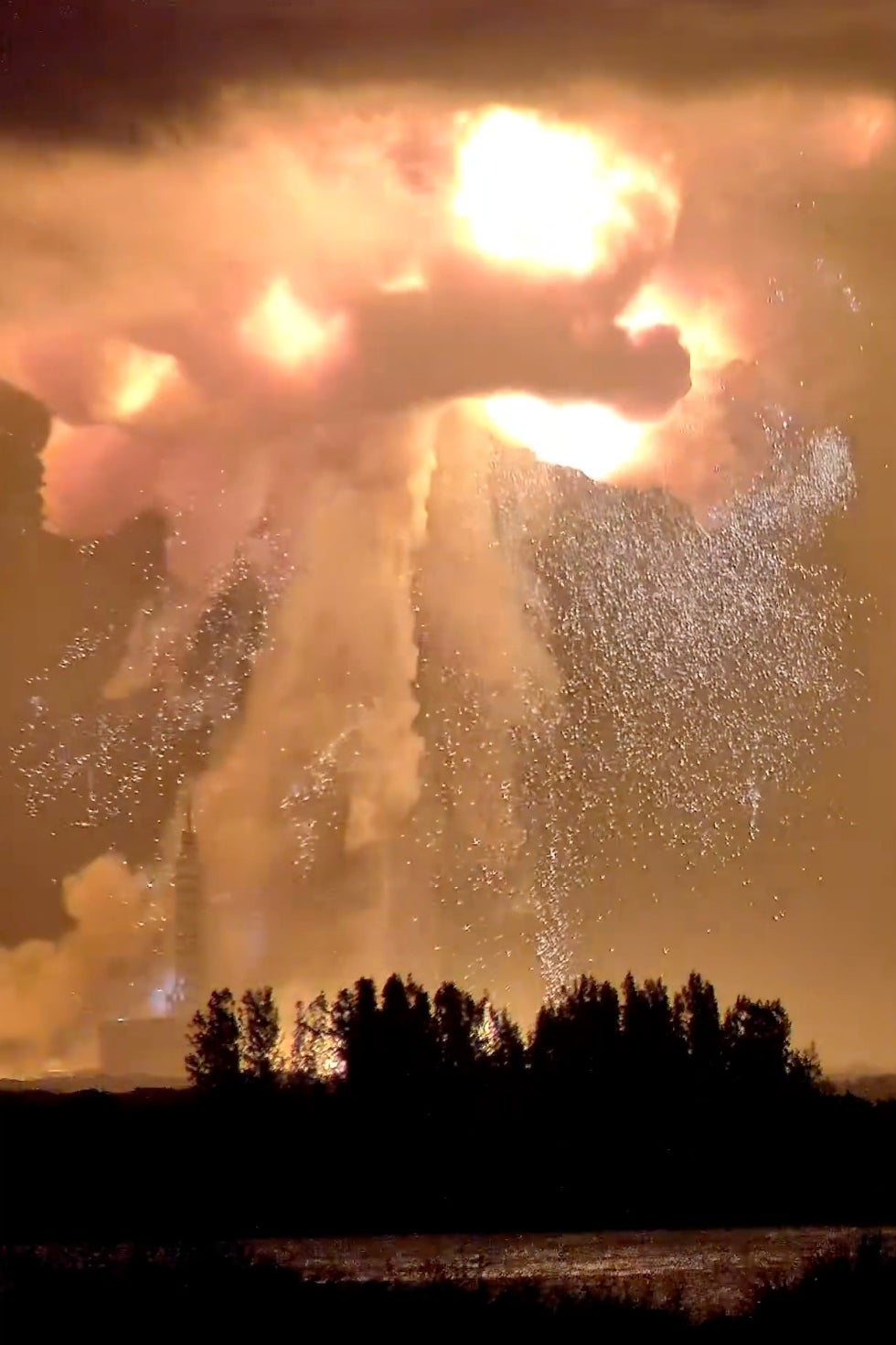
A bright orange fireball, which local residents said looked like a “mini nuke”, completely consumed Launch Complex 36 at around 9pm on Thursday evening during a static fire test of Blue Origin’s New Glenn rocket.
The explosion appears to have completely destroyed the rocket, while the company’s $1bn (£740m) state-of-the-art launch facility will likely require extensive repairs that will ground future launches at the site for a significant period.
The 98-metre-tall New Glenn rocket is being developed for Nasa’s Artemis programme, which is aiming to return astronauts to the surface of the moon by 2028.
Blue Origin is yet to say what impact the explosion will have on these plans, though space commentators said it could set Jeff Bezos’s firm back by up to a year.
“This completely takes Blue Origin out of the Artemis picture for the next 12 months, most likely,” said Eric Berger, a senior space editor at Ars Technica. “All of those Moon Base missions, man, it’s bad.”
The New Glenn rocket is being developed to carry Blue Origin’s Blue Moon lander, which Nasa plans to use as one of its lunar landing systems. The rocket that exploded on the pad has flown three times before, with the static fire test expected to be a routine procedure ahead of another launch next month.
Mr Bezos said it was too early to know the cause of the explosion, and that investigations were underway.
“Very rough day, but we’ll rebuild whatever needs rebuilding and get back to flying,” he wrote in a post on X. “It’s worth it.”
The latest incident means both of Nasa’s main commercial partners for Artemis currently have grounded rockets, with Elon Musk’s SpaceX forced this week to halt any further launches of its Starship rocket.
The US Federal Aviation Administration (FAA) said an investigation must first be conducted into a “mishap” that occurred during its most recent test flight.
During the flight on 22 May, the rocket’s Super Heavy booster crashed into the Gulf of Mexico after only one of its engines lit up during the splashdown procedure.
The FAA said that SpaceX would not be able to fly the rocket again until the regulator could be sure that “any system, process, or procedure related to the mishap does not affect public safety”.
The development of Starship and New Glenn is already behind schedule, with the first crewed missions to the lunar surface originally set to take place in 2024. Nasa has set a new timeline for the Artemis IV mission, which is currently scheduled to lift off in 2028.
China announced in 2023 that it planned to send Chinese astronauts, known as taikonauts, to the moon before 2030. There is no indication from the country’s space agency that this deadline will not be met.
Both the US and China are eyeing potential mineral resources on the moon, with both countries aiming to establish permanent lunar habitats. These bases could also be used to support future crewed missions to Mars.
Last year, the former head of Nasa said that the US could fall behind China due to issues with its commercial partners.
“Our complicated architecture requires a dozen or more launches in a short time frame, relies on very challenging technologies that have yet to be developed, like cryogenic in-space refuelling, and still needs to be human-rated,” Jim Bridenstine, who served as the administrator for Nasa between 2018 and 2021, told the Senate Committee on Commerce, Science and Transportation in September.
“Unless something changes, it is highly unlikely the United States will beat China’s projected timeline to the moon’s surface.”
Current Nasa administrator Jared Isaacman acknowledged that Blue Origin’s latest incident could have an impact on the Artemis programme, though he said any delays would not be known until the US space agency carries out a full review.
“Spaceflight is unforgiving, and developing new heavy-lift launch capability is extraordinarily difficult,” he said following Thursday’s explosion. “We will work with our partners to support a thorough investigation of this anomaly, assess near-term mission impacts, and get back to launching rockets.”