

The United States military faces a critical three-year timeline to replenish key weapon stockpiles heavily depleted by the Iran war, a new analysis reveals, raising concerns about America’s readiness for any future conflict, particularly with China.
The weapons systems in question include Tomahawk cruise missiles, designed for deep strikes into enemy territory, and Patriot and THAAD interceptors, crucial for defending against incoming missiles and drones.
According to a report released Wednesday by the Center for Strategic and International Studies (CSIS), while the U.S. possesses sufficient munitions for any plausible scenario in the Iran war, the current depleted inventories have created a “window of vulnerability” should a conflict arise in the Western Pacific.
The think tank emphasized that “the time needed to rebuild those inventories has thus become a major concern.”
This vulnerability comes as China has set a goal of being capable of taking Taiwan by force by 2027, a timeline experts view as ambitious rather than a firm deadline.
However, Chinese President Xi Jinping recently warned that mishandling relations with the self-governing island could lead to a clash or even open conflict between the U.S. and China.
Despite the Trump administration’s historic defense budget proposal of $1.5 trillion for 2027, which significantly boosts spending on high-end munitions, the CSIS analysis highlights that production takes time. This acceleration in spending, which began during the Biden administration, enjoys bipartisan support in Congress. Yet, the report states, “the problem today isn’t money; it’s time.”
“It takes time to expand production capacity and to build these complex systems,” the report noted, projecting that this window of vulnerability will persist “for several years until inventories return to their previous levels and another several years before they get to the levels that war planners desire.”
While specific munitions inventories are classified, CSIS asserts that Pentagon budget materials provide enough public information to estimate production timelines.
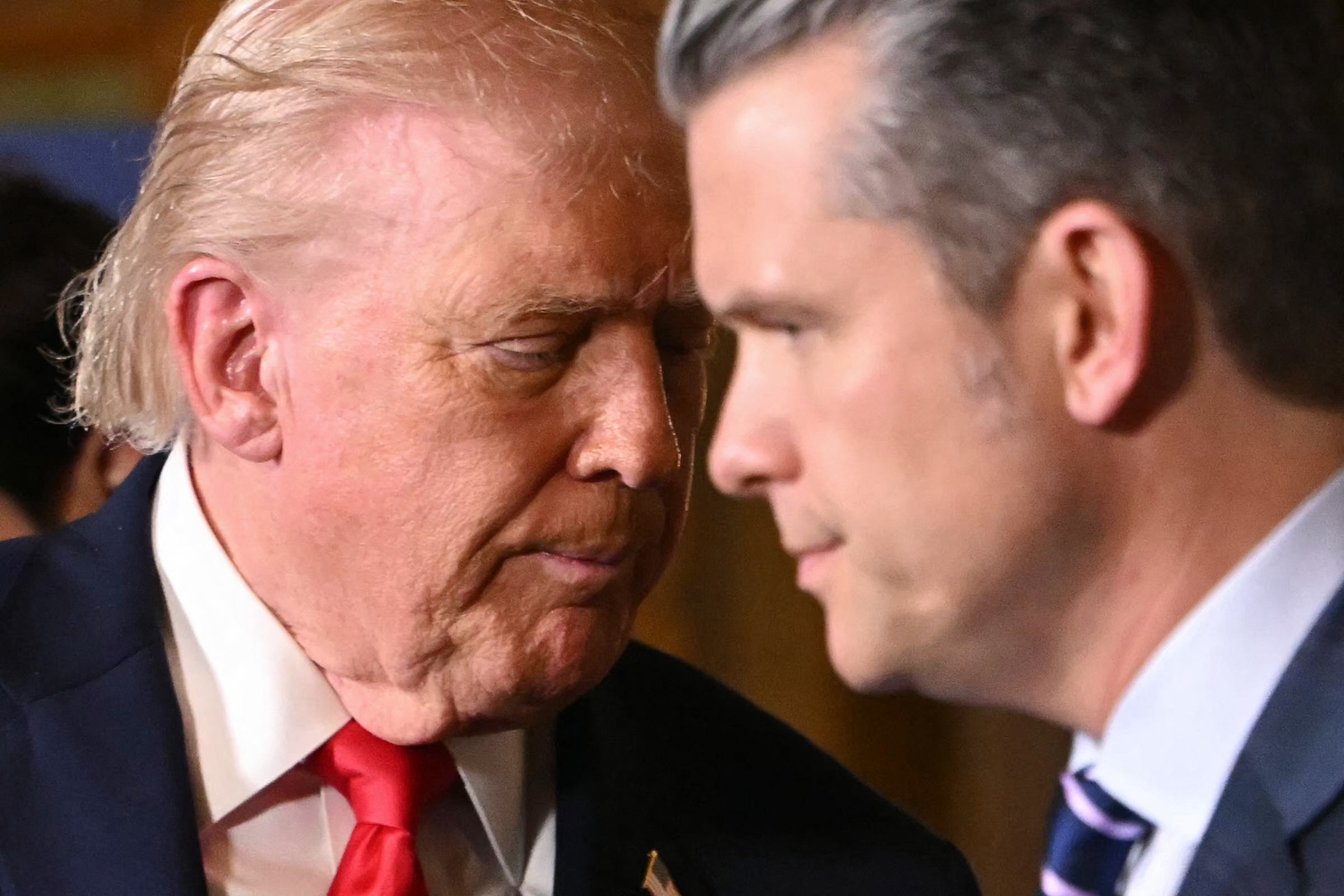
President Donald Trump and Defense Secretary Pete Hegseth have consistently maintained that the U.S. is capable of fighting any war, urging defense contractors to accelerate production. Hegseth told lawmakers last month that military spending under Trump would help manufacturers double or even triple their capacities.
Chief Pentagon spokesman Sean Parnell echoed this sentiment, stating the military “has everything it needs to execute at the time and place of the President’s choosing.” He added, “We have executed multiple successful operations across combatant commands while ensuring the U.S. military possesses a deep arsenal of capabilities to protect our people and our interests.”
However, some military experts express skepticism.
Virginia Burger, a senior defense policy analyst at the Project On Government Oversight and a former Marine officer, suggested that Pentagon officials “knew the reality of our military stockpiles and hopefully told someone, ‘Hey, if we go to this fight, even in the most conservative estimates, we are drawing down our stockpiles to a critical level.’”
Concerns over diminished stockpiles have been a recurring theme in recent congressional hearings. Democrats often cite the munitions supply as a damning metric against the Iran war, which Trump launched without congressional approval.
Some Republicans, conversely, attribute the problem to the U.S. sending Patriot missile defense systems to Ukraine following Russia’s 2022 invasion, despite several American allies also utilizing these systems.
Mark Cancian, a retired Marine colonel and senior adviser at CSIS who co-authored the study, traces the roots of this predicament to the end of the Cold War. After the fall of the Soviet Union in 1991, the U.S. assumed future conflicts would be short and regional, requiring fewer high-end weapons.
This led to low orders and a small manufacturing footprint among military contractors. Russia’s war in Ukraine, however, demonstrated that modern conflicts can be protracted and demand extensive inventories of advanced weaponry.
“The thinking started to change, but it just takes time to build inventories,” Cancian explained, highlighting the challenge of revitalizing a complex web of supply chains and subcontractors for novel components.
He credited the Biden administration for initiating conversations with the defense industry, investing in the industrial base, and ramping up production. “A lot of people in the Trump administration are inclined to say that everything was terrible until they arrived, and that’s not true,” Cancian said, while acknowledging that “it is true that the Trump administration really increased funding.”
The CSIS estimates that fully replenishing the more than 1,000 Tomahawk missiles fired at Iran could take until late 2030. Currently, fewer than 200 Tomahawks are produced annually due to past small orders, though manufacturer Raytheon aims to ramp up capacity to over 1,000 per year.
RTX, Raytheon’s parent company, declined to comment on the CSIS findings directly but pointed to billions in investments to boost production, including facility expansions in Alabama and Arizona.
For air defense systems, replacing the estimated 290 THAAD interceptors used against Iranian drones and missiles could take until the end of 2029, while replenishing over 1,000 Patriot interceptors is projected to conclude by mid-2029. Lockheed Martin is significantly increasing production for both systems, with THAAD deliveries reportedly “re-sequenced to prioritize U.S. needs over those of allies and partners,” according to CSIS.
The report notes that Patriot deliveries present a “dilemma” for the U.S., balancing its own replenishment needs with aid to Ukraine and commitments to 17 other countries using the interceptor. Lockheed Martin stated it is investing $9 billion through 2030, with “tangible results” already emerging, including a new facility in Alabama and over 20 others nationwide.
Despite the challenges, CSIS offers a nuanced perspective, suggesting a potential conflict with China is “not all bleak.”
The U.S. military has recently demonstrated its capabilities against Iran, Venezuela, and Houthi rebels in Yemen. The report concludes, “China is deeply aware that it has no recent combat experience and that it performed poorly in its last war — against Vietnam in 1979. That difference in experience may preserve deterrence until munitions inventories are restored.”
