Whatever comradeship and fraternal fealty remain within Labour, the debate that has suddenly ignited in the party about Britain rejoining the European Union is hardly helping it.
Two men who actually agree on that eventual goal, Wes Streeting and Andy Burnham, have fallen into a tedious briefing war about whether raising this distant prospect right now is a cynical plot by Mr Streeting to undermine Mr Burnham’s chances of winning the Makerfield by-election, and thus the Labour leadership.
Mr Streeting claim that he is simply pointing out the lasting consequences of the “catastrophic mistake” the nation as a whole made in 2016, and that it cannot be ignored.
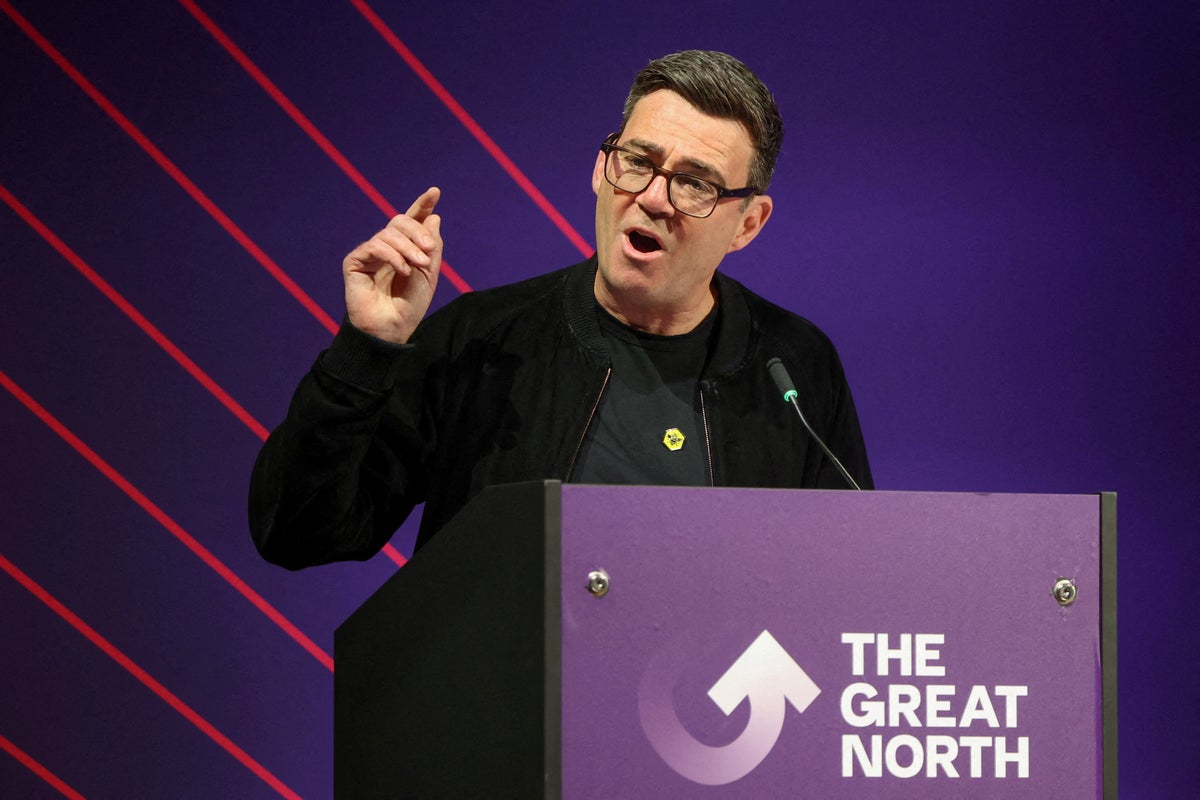
Mr Burnham doesn’t dispute that, but finds it unhelpful to raise it where some 65 per cent of the electorate voted Leave, and where Reform UK will provide formidable resistance to Mr Burnham’s return to Westminster. Speaking at the Great North Investment Summit in Leeds, he said he would not try to “rerun” the Brexit debate, since Britain would be stuck in “a permanent rut if we’re just constantly arguing”.
This chatter has provoked the highly combustible Labour MP for Pendle and Clitheroe, Jonathan Hinder, to comment that “the idea that we can reconnect to our working-class base by reopening this debate is just a staggering level of out of touch”. It is, however, also true that the European cause is extremely popular in Labour’s middle-class membership, and it is they who will be choosing Britain’s next prime minister and influencing their priorities.
The issue is not going to be settled in this leadership campaign because the 2024 Labour manifesto pledged to stay out of the EU and ruled out rejoining the single market, the customs union and the reintroduction of freedom of movement. The debate, though, is going to be relevant for the whole country at the next election and for years afterwards, because Brexit has proved to be at least as big a disaster as the experts warned. As Britain approaches the 10th anniversary of the EU referendum, it is as good a moment as any to revisit the greatest act of self-harm in history.
If nothing else, the experience of the last decade, including the relatively short time since Brexit actually did “get done”, shows that the case for Leave has been proven wrong. It has not made Britain better off. The economic and geopolitical world of 10 years ago was very different to the increasingly protectionist and dangerous one in which Britain now has to make a living.
In 2016, making some heroic assumptions, it was possible to envisage the UK indeed becoming a beacon of free trade able to conclude a range of lucrative free trade deals with dynamic, fast-growing economies – America, China, India and the smaller emerging economies of East Asia. We could even, it was posited, pursue trade opportunities with the benign assistance of the World Trade Organisation’s rulebook.
Such a swashbuckling future has only been partly achieved, it is fair to say, and Donald Trump has displayed only minimal indulgence of British interests. Meanwhile, and again due to the second coming of President Trump, Britain can no longer wholly rely on the transatlantic alliance to defend itself and its partners from Russian aggression, and has been forced to try and build ad hoc, primarily European, defensive alliances.
So, for good or ill, and for reasons that could and could not be foreseen, the 2016 referendum did not settle matters for decades to come in the way the Common Market version did in 1975. The European question that has bedevilled British politics since the late 1950s has not gone away, even if few want to relive the national nightmare that followed the 2016 vote.
The overall European dilemma remains pressing, but the questions have changed and quite dramatically. Should the UK negotiate to rejoin sooner or later? Should the process be subject to a referendum, before or after a bid, or left to a general election and parliamentary decisions? Should Britain join the euro? Is it worth ditching the free trade deals that have been reached with India, America and the trans-Pacific partnership? What would be the impact of European workers arriving again, and British labour taking up opportunities across the Channel? Would it weaken an already enfeebled Nato? Would rejoining help keep Scotland and Northern Ireland inside the UK? Do the Europeans even want to make the effort with this unreliable, indecisive neighbour?
Labour may be doing itself no favours by reviving the European debate – but uncongenial as it is, the whole country will have to face up to it again, sooner or later, and the British know it. It simply cannot be avoided, even in Makerfield.