


California has already overhauled the way it teaches children to read and now a new bill is taking on math education and it may be just as controversial.
Senate Bill 1067 would require schools to screen all kindergartners, first- and second-graders for basic math skills, and give them extra help if they’re behind. The idea is to help children catch up to their peers who might have had much more exposure to math before starting school.
“A student’s early math skills are the most powerful predictor of their later success in school,” said Amy Cooper, a senior advisor at EdVoice, an education nonprofit that’s cosponsoring the bill. “We’re not talking about tracking kids. There’s no labels. It’s just about getting support to students so that they can get up to grade level.”
California students in all grade levels have long struggled in math. Only 37% of students performed at grade level in math last year, with some groups of students faring far worse.
Just 16% of Black 11th-graders, for example, met the state’s grade-level standard. Nationwide, California ranks 43rd in 4th grade math scores, behind Texas, Mississippi, Alabama and dozens of other states.
Experts say one reason for the poor performance is California’s uneven early education landscape. Until transitional kindergarten became available to all 4-year-olds last year, children showed up at kindergarten with a wide array of abilities and skills.
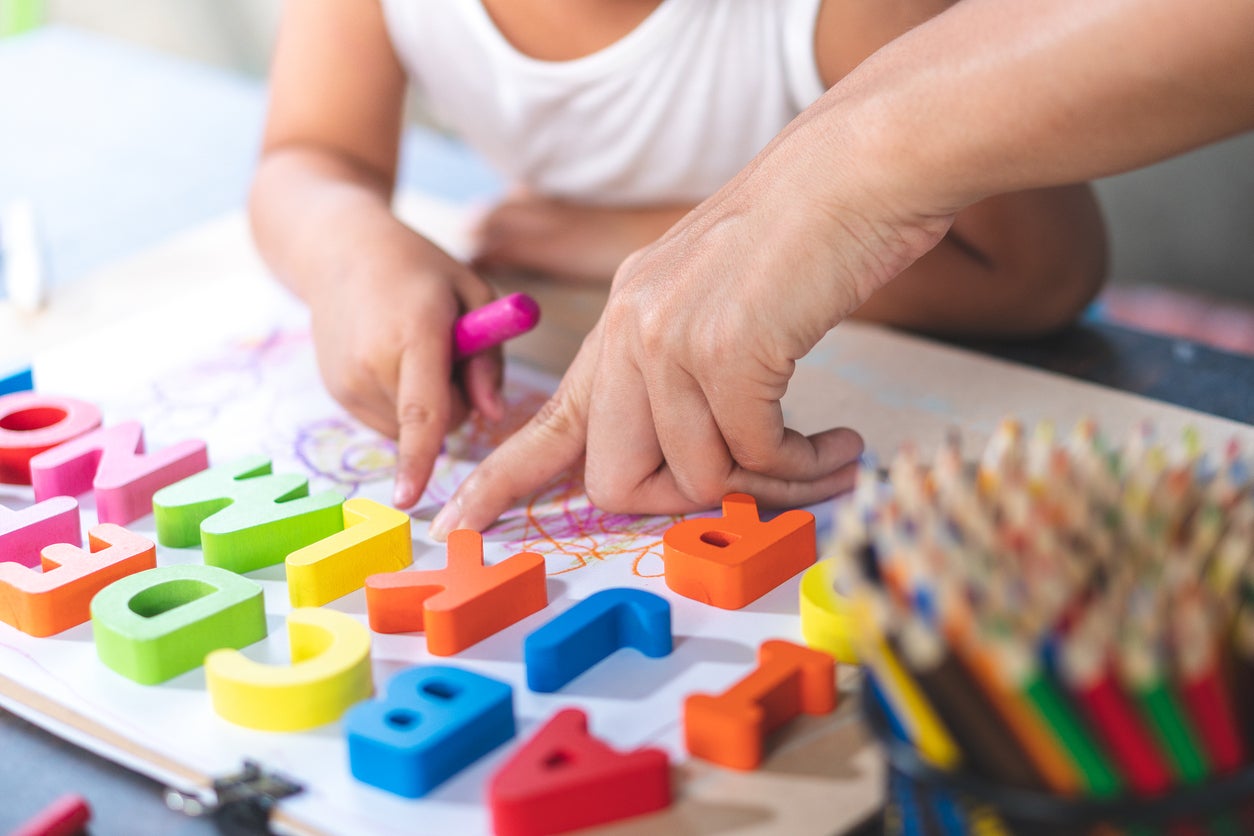
Some had years of exposure to early math — either at preschool or at home — and could count, do basic arithmetic and even read a little. Others, especially low-income children, had no prior exposure to the ABCs and 123s, and lagged far behind. Even now, TK and kindergarten are optional, so some students start first grade with no previous math instruction at all.
‘Critical tipping point’
Some of those children catch up eventually, but many continue to fall further and further behind, research shows. And because math is sequential, catching up becomes harder over time, and the gap widens. Some researchers found that early math skills can even be a predictor of how well students do in high school and college.
It’s still too early to gauge the impact of transitional kindergarten on students’ long-term math performance, but so far there’s still a gap between children who’ve had exposure to math — either through preschool or at home — and those who haven’t. Low-income children are far less likely to get that early exposure, said Alice Klein, a developmental psychologist and research director at the education research firm WestEd.
“It is a critical tipping point,” Klein said. “Unless those students get intervention, the gap will widen. It’ll be harder for them to access higher-level math classes later on, and this will have implications for future job opportunities and the economic future of California. It’s a continual closing of opportunities.”
Klein supports the math screening legislation because she said it’s an effective way to identify students who are struggling and provide them with support. At least 20 other states have math screenings and have seen positive results, she said.
“I’m so happy that California is considering passing this bill,” Klein said. “It’s a great start, and could be the next step” in improving math outcomes in California.
Numbers and objects
Districts would have their choice of several screening tests to choose from, each ranging from 10 to 20 minutes long and testing children’s knowledge of basic math concepts. For example, kindergartners might be asked to look at two groups of dots and decide which group has more. Or they’d be asked to identify certain numbers and show that they understand what the numbers mean — that “three” means three objects, for example. English learners would take the test in their native languages.
The bill is authored by state Sen. Akilah Weber Pierson, a Democrat from San Diego, and last week passed unanimously in the Senate education committee.
Its cosponsor, EdVoice, was behind the push for phonics-based literacy instruction in California public schools. That initiative passed, but only after a long fight with the California Teachers Association, the state’s largest teachers union, and English learner advocates, who argued that it didn’t give teachers enough flexibility and that it wouldn’t be effective for students whose first language isn’t English. The final version of the bill doesn’t require schools to take advantage of state-funded teacher training, but it does require them to use phonics-based classroom materials.
Too many tests?
There might be a fight over the proposed math testing as well. The California Teachers Association opposes it, as well as California County Superintendents, the Association of California School Administrators and the California Mathematics Council.
They argue that the screening is unnecessary because the state already has a comprehensive new math framework and has made other big investments in early math. It’ll take time for those investments to show results. Also, the math framework emphasizes critical thinking and real-world math problems, and the screening might be too narrow and not take into account young children’s developmental differences.
They also argue that the testing will be pointless unless the state funds tutoring to help those students who are identified as needing extra help.
Nick Johnson, an associate professor of teacher education at San Diego State University, questioned whether schools need yet another standardized test. The federal education policy No Child Left Behind, adopted in the early 2000s, focused heavily on testing, and led to few improvements, he said.
“Since No Child Left Behind testing, we’ve assumed that (standardized testing) will improve student learning,” Johnson said. “But the evidence shows that’s rarely true. Is public education in a better place now than it was 25 years ago?”
Magic of math
Rachelle Bacong has been teaching kindergarten and TK for 30 years in National City, near San Diego. She weaves math into every activity the children do. When she sets up an art project, she asks them how many chairs are at the table and how many scissors they’ll need. When she makes smoothies with them, she asks them how much juice or how many chunks of bananas they should add. When the children wash their hands, she asks them how long they spent at the sink.
They also spend a good portion of their day playing with blocks, tiles and tubes, experimenting with shapes and dimensions. Bacong’s goal is to make math fun and easy to grasp, no matter where the child is developmentally.
“Math crosses all cultures, abilities and backgrounds. It’s accessible to everyone. It’s my job to design the learning environment to make it accessible to everyone,” Bacong said. “That’s what’s so magical about it.”
She also spends time every day explicitly teaching them math, although in a way that’s blended with play. She’ll teach them songs about numbers, show them how shapes fit together, and gently guide them when a solution might not be clear. Math instruction needs to come from several angles, she said, because children’s cognitive skills develop at such different rates.
She welcomes extra help for children who need it, but she’s skeptical that a test will reflect how individual children process math concepts. She already knows how her students are faring, and she fears that screening results will be used to stigmatize children, teachers or schools.
“My fear is that it’ll focus on a child’s deficits,” Bacong said. “Math needs to be joyful, fun and developmentally appropriate. We want to set students up for success, so they’ll be prepared for whatever they’re going to be designing or building in the future.”