No other far-flung city has so fired the imagination of English poets over the centuries as much as Samarkand – exotic, magical and mystical, a fairytale architectural citadel in the heart of Central Asia. Uzbekistan has been the playground and battleground of Genghis Khan, Alexander the Great, Emperor Temur and Peter the Great who laid the groundwork for Russian control a century later.
Today this ancient citadel is something of a tourism secret, with Uzbekistan now undergoing a renaissance having freed itself from the Soviet yoke through Gorbachev’s Perestroika revolution in 1991. It is remarkably undersold as a stunningly attractive and safe destination. It is also a flourishing trade hub, its economy turbocharged by copious gas and gold mining, making it a surprisingly alluring ancient and modern tourist hot spot.
It is also one of the few places where every visitor almost immediately becomes a millionaire. It’s not just because Uzbekistan is prosperous, which it is, but because of its currency the Som – £100 of sterling is worth 1,630,000 Som! Even better, these rather eye-watering sums find tremendously good value with accommodation and shopping compared to European prices.
And there are so many shopping opportunities – from sourcing silk dressing gowns, which can be tailor-made in an hour, to scouting the vast emporium of the seventh generation carpet dealer Sabina Burkhanova, whose speciality is a particular silk design and weave specific to the Bukhara region.
Uzbekistan is in so many ways an Aladdin’s Cave of treats and treasures, from amethyst necklaces to fabrics and fashion. Beating the path to shop here are London and Paris interior designers who come for the fabrics. High on their list to see is the Queen of Uzbekistan Embroidery, Madina Kasimbayeva, who has revived the traditional Tashkent school of Suzani hand embroidery. Her signature is coats – she has exhibited in museums and has a couture clientele. During her catwalk show in Tashkent this month the chicness of her designs on 23 sashaying models was matched by that of her high society and fashionista guests who all wore white. Her clothes are considered works of art. “Buy for investment. This is not just a coat,” said a fashion expert from Seattle flown in for the show.
Kasimbayeva is considered the Muccia Prada of Central Asia. She may be high-end but everyday shopping here – from trinkets to silk scarves and souvenirs – is fun but also completely hassle-free. This is one of the most easy and friendly places for a tourist to navigate. Or even wind down with a meal and drink. It is relaxed about alcohol in restaurants: Uzbekistan has a mainly Muslim population but is a secular country.
For many years Uzbekistan, nestled along the legendary Silk Road, has been the chosen territory of adventurous English travel writers, from Robert Byron to Colin Thubron and Wilfred Blunt. They tempted readers through their courageous exploits on horseback, train, camel and foot to discover what were once truly wild and remote tribal territories.
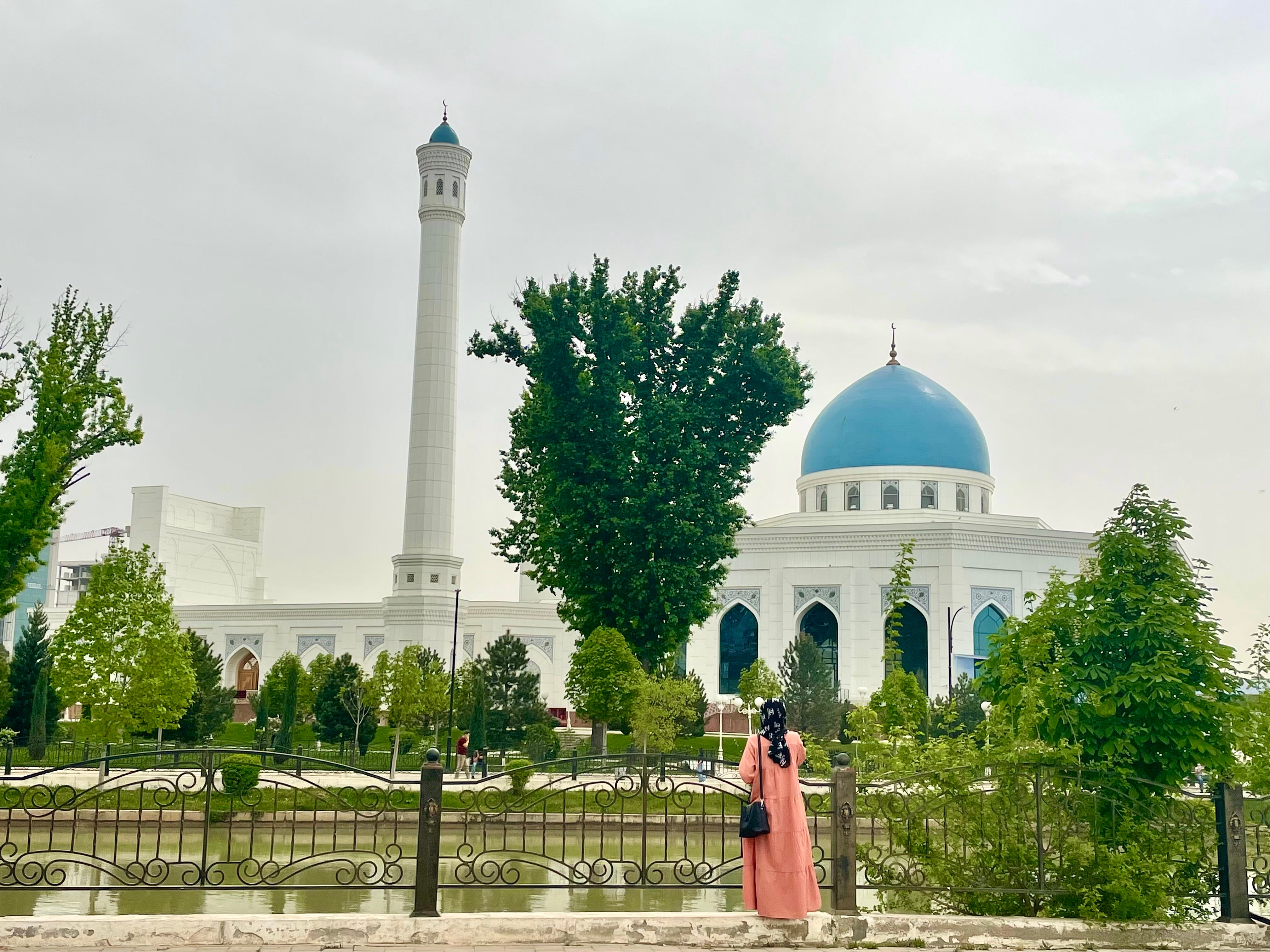
Today Uzbekistan is an easy six hour flight from London to Tashkent. The capital has a flavour of Paris with its wide boulevards, tree-lined avenues and verdant parks. There are many brand new five-star luxury hotels – some with a sushi bar on the penthouse floor – as well as boutique hotels nestling next door to marble monuments and galleries. It seems a haven of peace away from the world’s many trouble spots.
Uzbekistan likes its very local food and customs and has deliberately kept out fast food franchises. That said, the shopping malls in Tashkent compete with Oxford Street in terms of big name brands – and Rolls Royces and Maybachs for sale are displayed in the hallways of the malls.
Samarkand has always been intoxicating as an exotic fantasy and idyll, even for those who never actually visited it like Christopher Marlowe, the Elizabethan dramatist, who had much to say about the romantic and remote city in his play Tamburlaine. Milton was also seduced by the idyll of Samarkand, while Keats described the city as “silken”. Oscar Wilde was won over too:
“The almond groves of Samercand,
Bokhara, where red lilies blow,
And Oxus, by whose yellow sand,
The grave white-turbaned merchants go”
But it was James Elroy Flecker, the late Romantic poet, who surpassed them all in 1913 with his famous poem “The Golden Journey to Samarkand”, where the desert city is presented as a distant and mythical destination. His repeated line “We are the Pilgrims … we shall go, always go a little further” suggests a longing for exploration and the pursuit of an ideal world. Oxford University’s Bodleian Library recently acquired the manuscript of this highpoint romantic poem. The university’s Centre for Islamic Studies is also about to stage an exhibition of key historic artefacts from Uzbekistan.
Milan Fashion Week has just featured Uzbek designs as the most potent source of fashion inspiration with the best interior design magazine Cabana having a pavilion dedicated to Uzbek textiles. The standout influences are the ikat techniques, blurred flame-like patterns, which have covered a million sofas and lampshades in textiles, from Oscar de la Renta to Missoni and Dries Van Notem. On catwalks all over the world designs include ikat prints and Suzani embroidery, whose bold deep blues, saffrons and reds combine exotically with their hand-made clothes. As a savvy marketing slogan might say: “Art, Literature, History & Fashion r UZ!”
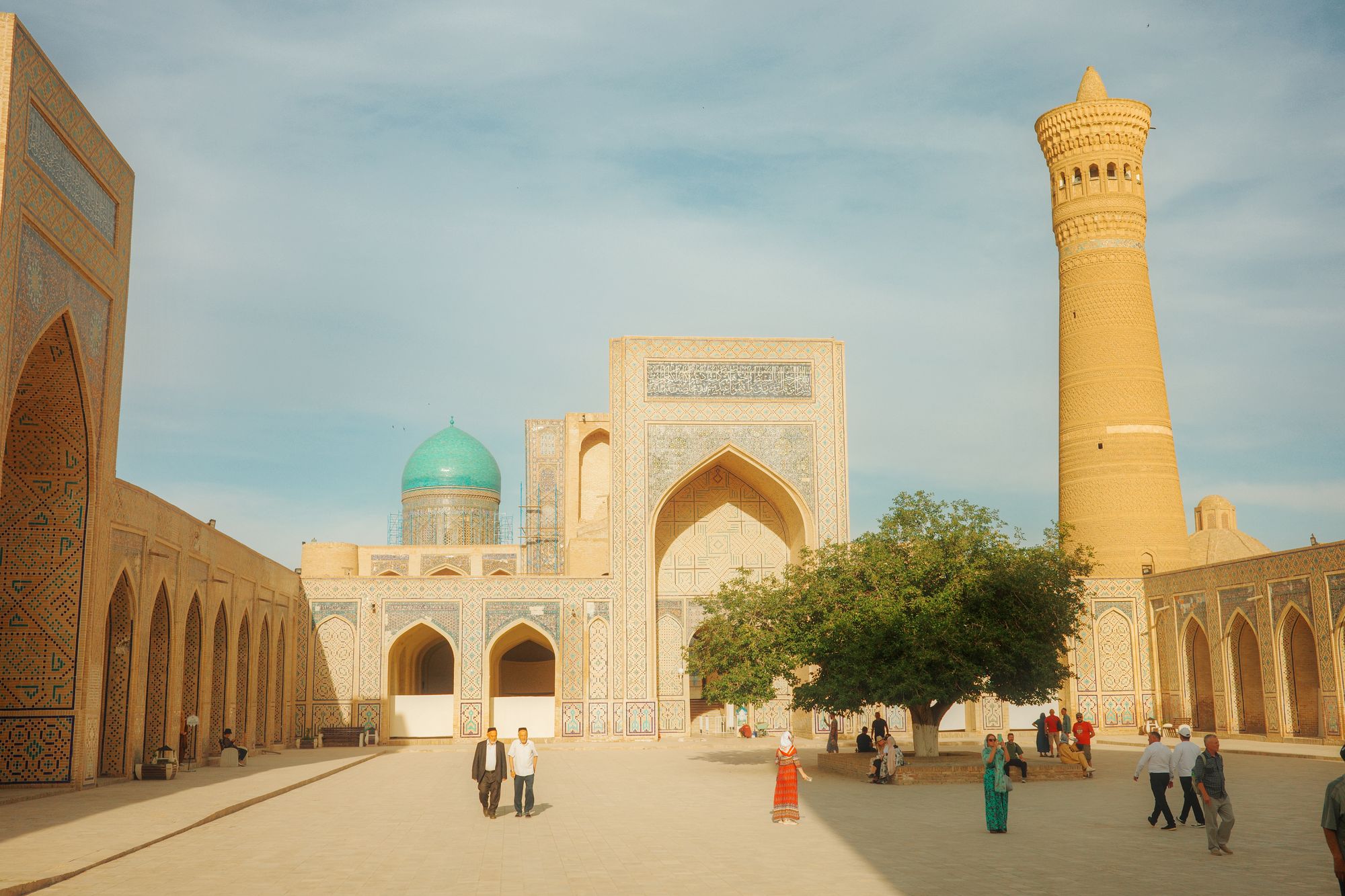
For over 2,700 years, Samarkand has stood at the crossroads of trade, art, religion, battles and scientific invention. The term Silk Road was not used until 1877 by Ferdinand Richthofen, uncle of the Red Baron, to describe the essential trade road from China through to Europe.
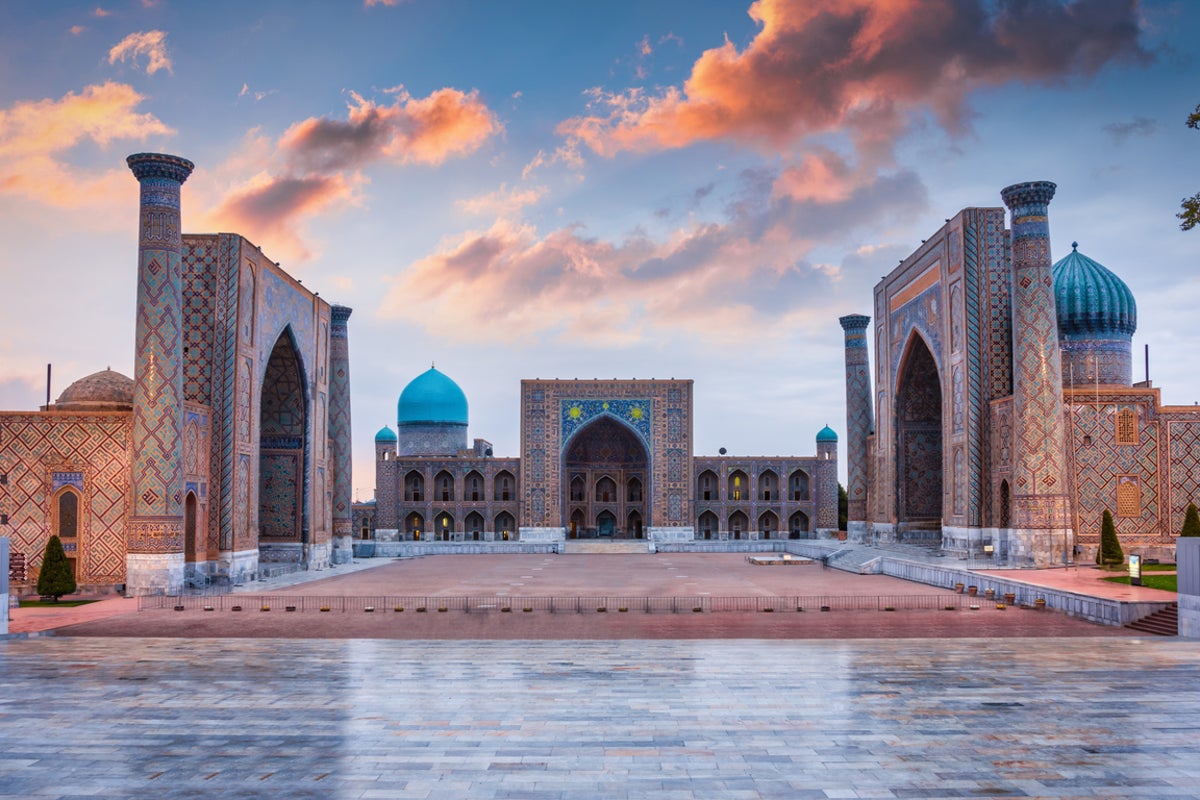
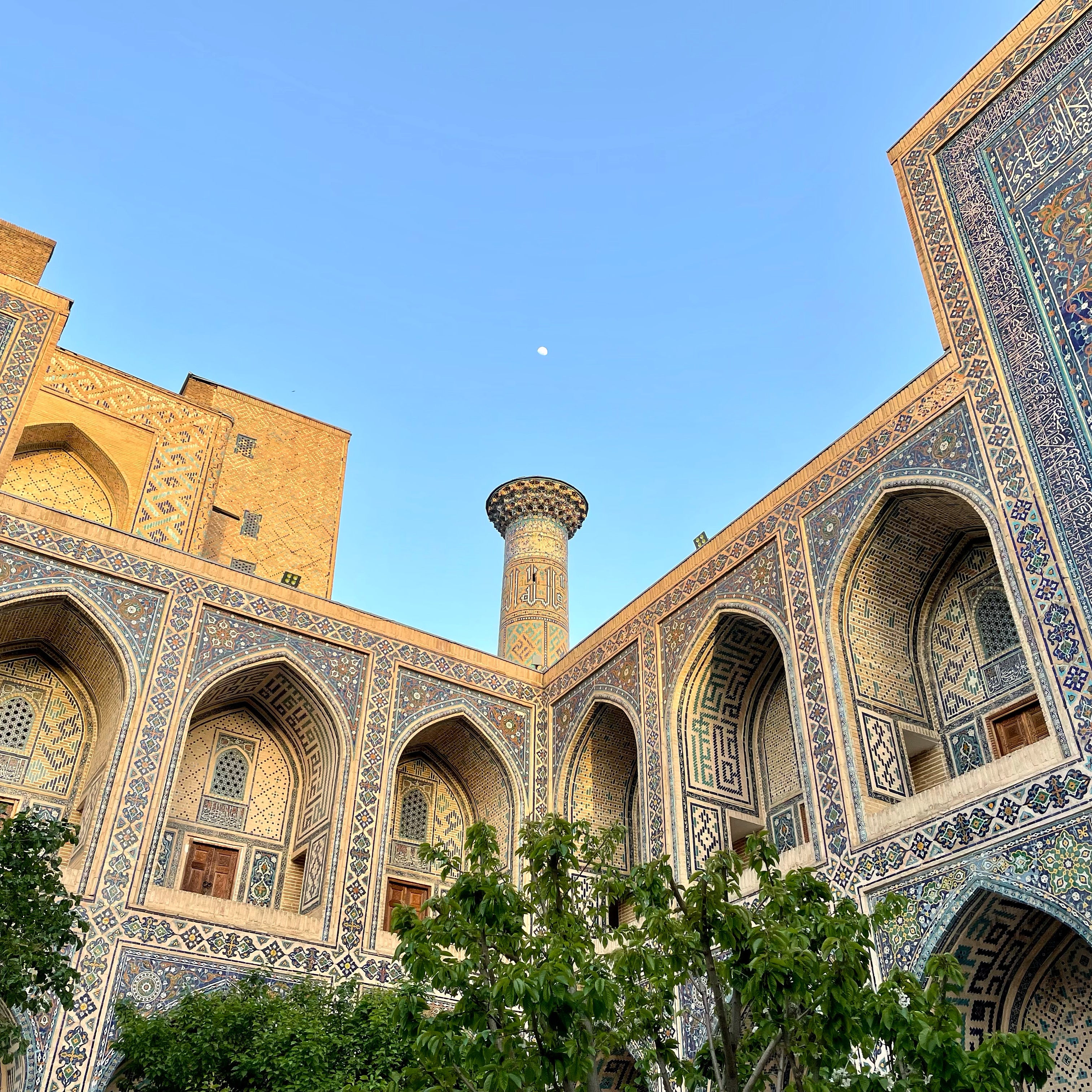
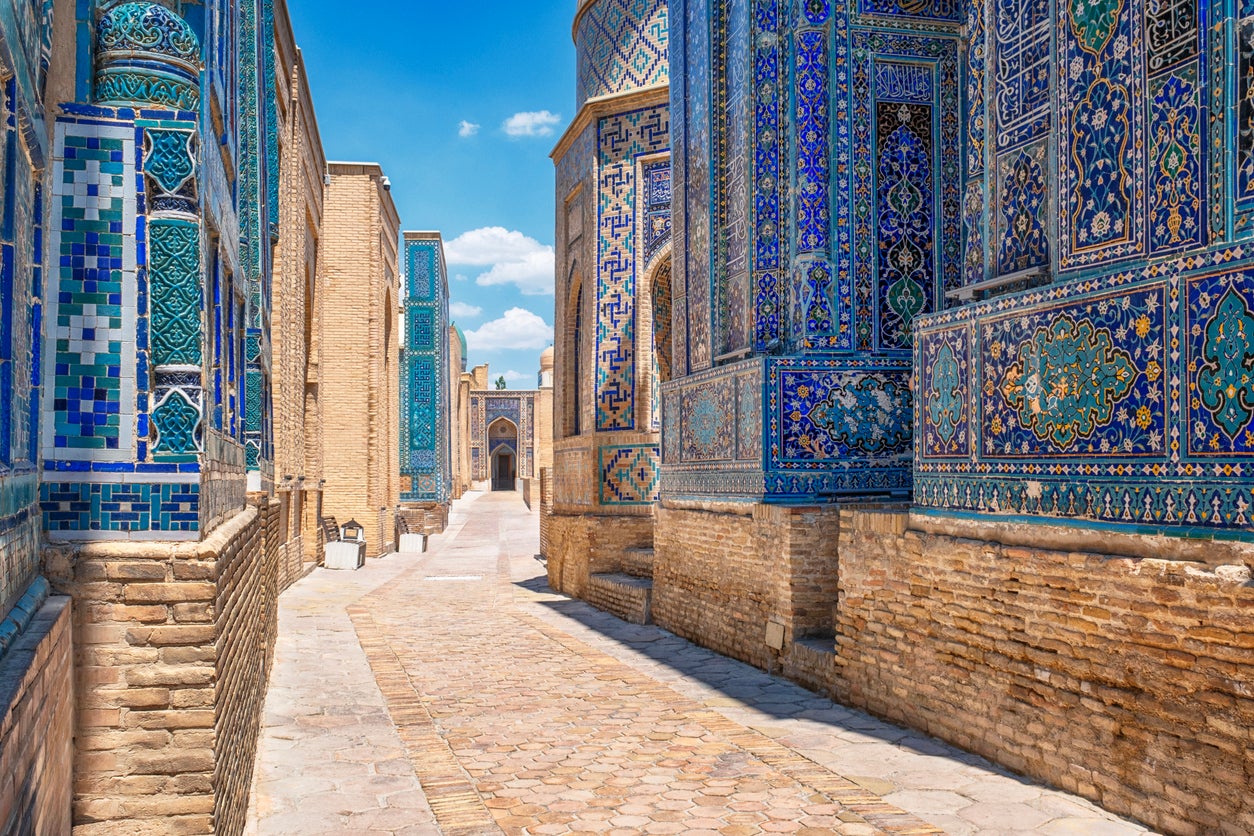
My journey began in Samarkand, which is dominated by the vast Registan. As one of the most iconic architectural public spaces, which anchors the city, its trio of madrasahs glow with intricate tilework in shades of blue and gold. Nearby, the necropolis of Shah-i-Zinda offers a more intimate, spiritual atmosphere, where narrow lanes are lined with exquisitely decorated tombs. Samarkand feels grand and ceremonial, a place where the scale of empire is written into every façade. Intriguingly, the 15th-century mausoleum of Amur Timor – known as Gur-e-Amir – with its ribbed turquoise dome on a cylindrical drum and decorated with deep blue tiles gives off a luminous and almost celestial quality. Maybe we should not be surprised at its connection to the ultimate edifice of magical serenity, India’s Taj Mahal in Agra, which was built by Timor’s great great grandson.
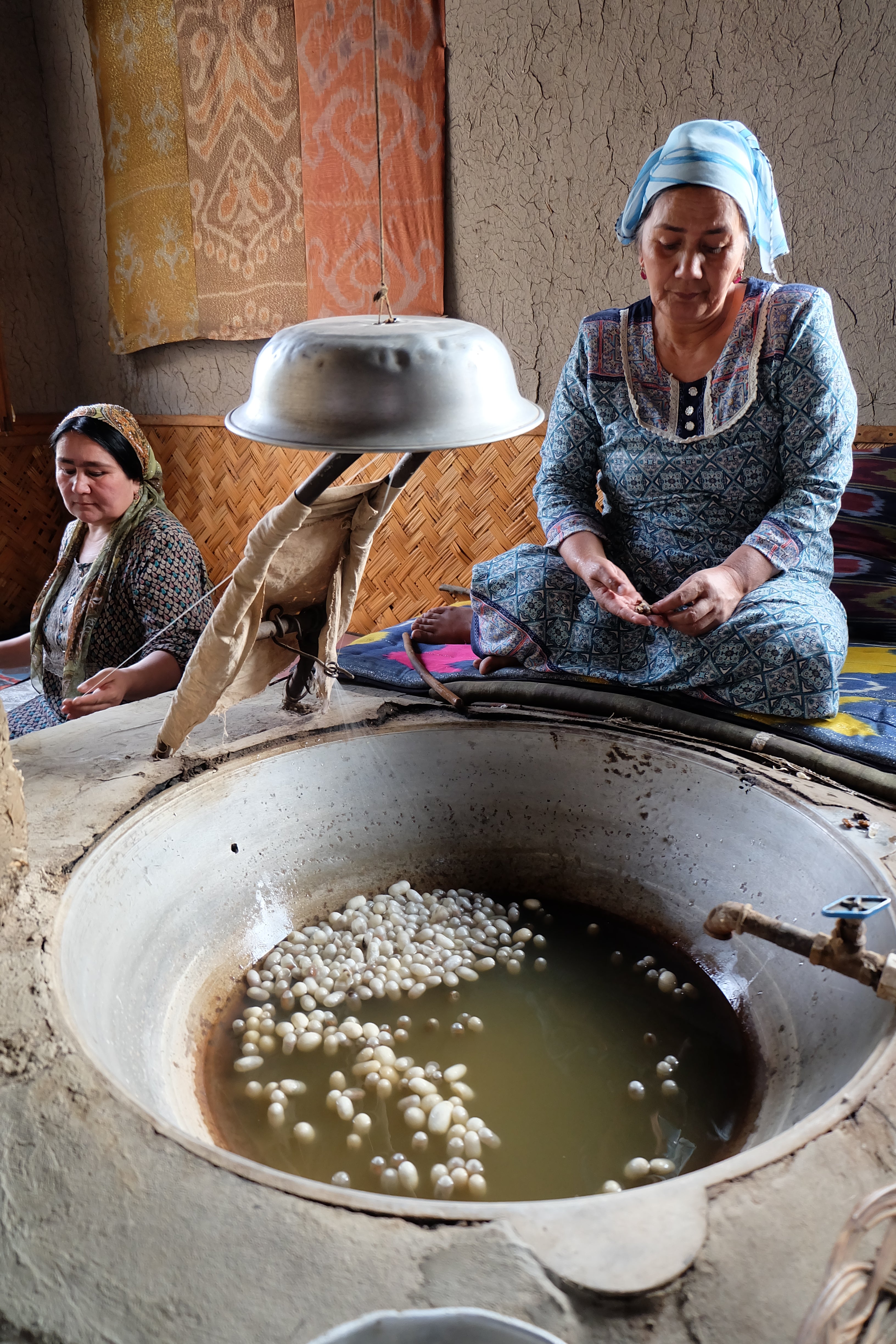
Traveling onward to Bukhara, the mood shifts from imperial spectacle to lived-in history. The city’s Old Town is a maze of narrow streets, trading domes and hidden courtyards that seem largely unchanged for centuries. At its heart stands the Poi Kalyan Complex, where the towering Kalyan Minaret has guided travellers for nearly a millennium. Bukhara invites slower exploration – sipping tea by a pond, browsing artisan workshops, and absorbing the rhythms of a city that once thrived on the Silk Road.
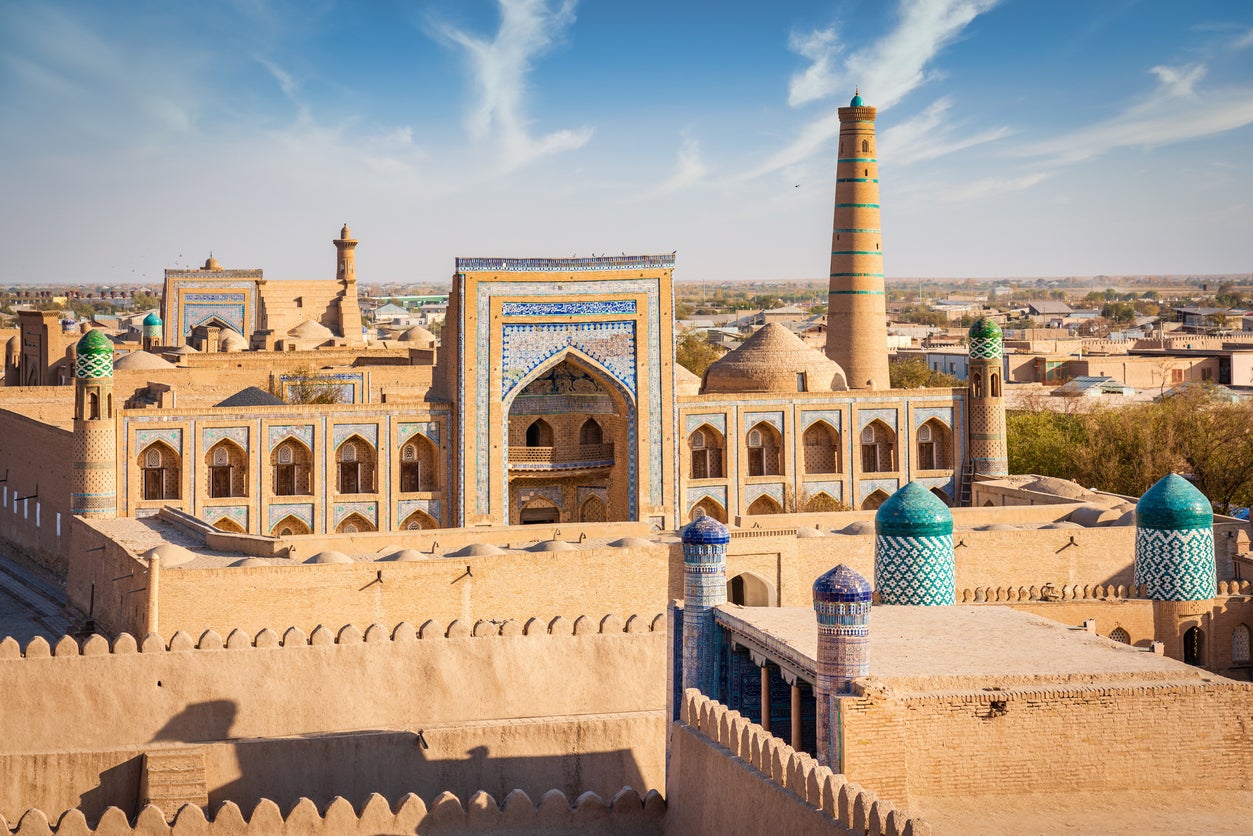
Further west lies Khiva, a destination that feels almost like stepping into a living open-air museum. The walled inner city, Itchan Kala, is compact yet dense with architectural treasures – mosques, madrasahs and palaces rising behind earthen walls. Yet it is also home for many. Children play football in the public spaces, students wear the traditional sheep helmet hats to mark their graduation. Like medieval Italian cities it is full of the noise and heartbeat of its locals. But always history is felt. The unfinished turquoise tower of the Kalta Minor Minaret stands as a striking symbol of Khiva’s distinct character. Unlike Samarkand’s grandeur or Bukhara’s lived-in charm, Khiva offers a sense of immersion, as if history has been carefully sealed within its walls.
Taken together, the route from Samarkand to Bukhara to Khiva reveals a rich progression of experiences along the Silk Road. From monumental ambition to intimate continuity and finally to preserved heritage, each city offers a different lens on Central Asia’s past. The journey is not just geographical but atmospheric, shifting from awe to reflection to a kind of timeless stillness that lingers long after leaving Khiva’s gates.
Each of these cities share a dazzling architectural splendour comparable in drama and aesthetic impact to Jaipur’s Pink City or Delhi’s Red Fort. This is the stuff of dreams for anyone wanting to find a modern day Grand Tour. Samarkand’s central square, Registan, for instance is as defining here as St Mark’s Square is in Venice. Epic and mesmerising, this majestic plaza is surrounded by three grand madrasas – Ulugh Beg, Sher-Dor and Tilya-KorI – each towering and epic, covered in stunning majolica tilework. It is sculptural and splendid, seeming to carve time out of the desert’s open space.
And of course no one forgets Uzbekistan’s food or its endless hospitality, be it from the courtesy of the ticket inspectors on the train, the ubiquitous tourist police or the cafe waitresses. Sit down anywhere in Samarkand or Tashkent and before you can say “just something light,” a table mysteriously fills with bread, salads, tea, and at least three dishes you didn’t order. The star, of course, is plov – a heroic mound of rice, carrots, and meat that arrives looking like it could feed a small cavalry unit. You start bravely, insisting you’ll only have a little, and somehow end up finishing enough for two people while your host watches with quiet satisfaction, as if you’ve passed an unspoken test.
What makes it truly delightful is the warmth wrapped into every bite. Meals stretch out, not because they’re slow, but because no one is in a hurry to leave – tea keeps appearing, bread keeps being broken, and conversation keeps circling back to “just one more taste”. Even something as simple as their delicious “non” bread feels ceremonial. Non, round loaves baked in a clay oven, is sacred in Uzbek culture and should never be served upside down. It is stamped with beautiful patterns and treated with respect (dropping it would feel like a social crime).
Samsa are oven-baked pastries filled with pumpkin or potatoes, and green tea is served wherever you go along with delicious pomegranate and strawberry juices. (Helpfully many restaurants have photographs of their dishes on the menu.) Uzbek food has a way of turning a simple meal into a cheerful negotiation between you and your appetite. By the end, you’re full, slightly overwhelmed, and deeply appreciative – convinced that Uzbek cuisine isn’t just about food, but about generosity disguised as a feast.
.jpg)
The capital Tashkent is emblematic of the entrepreneurial energy of this city, much rebuilt in the last ten years. It is a modernist capital, which has cherrypicked some of the best modern architects from all over the world. It has seen a stampede of glimmering new glass and steel buildings layered on top of Soviet era architecture. A terrible earthquake in 1966 led to major recasting of the city. Care has been taken to make changes to the cityscape with style and elan. A notable landmark is the Soviet art deco Metro with its ornate chandeliers and mosaics: each station as clean as if it had been set ready for a royal visit. Litter is strikingly absent.
This is a country that prides itself on being full of entrepreneurs and small businesses. Boutique stores include Qand, a chocolate factory and shop, which makes the president’s wife’s favourites – luxurious and decadently delicious. Their signature recipe uses pistachios grown wild in the mountains and moulded into truly seductive rich chocolate. Their stylish packaging with multi-coloured foil wraps gives Tiffany a run for its money. They are looking to expand and export to Harrods and Selfridges, positioning themselves as Central Asia’s greatest master chocolatiers. The name Qand, they explain, rhymes with cand with a “y”!
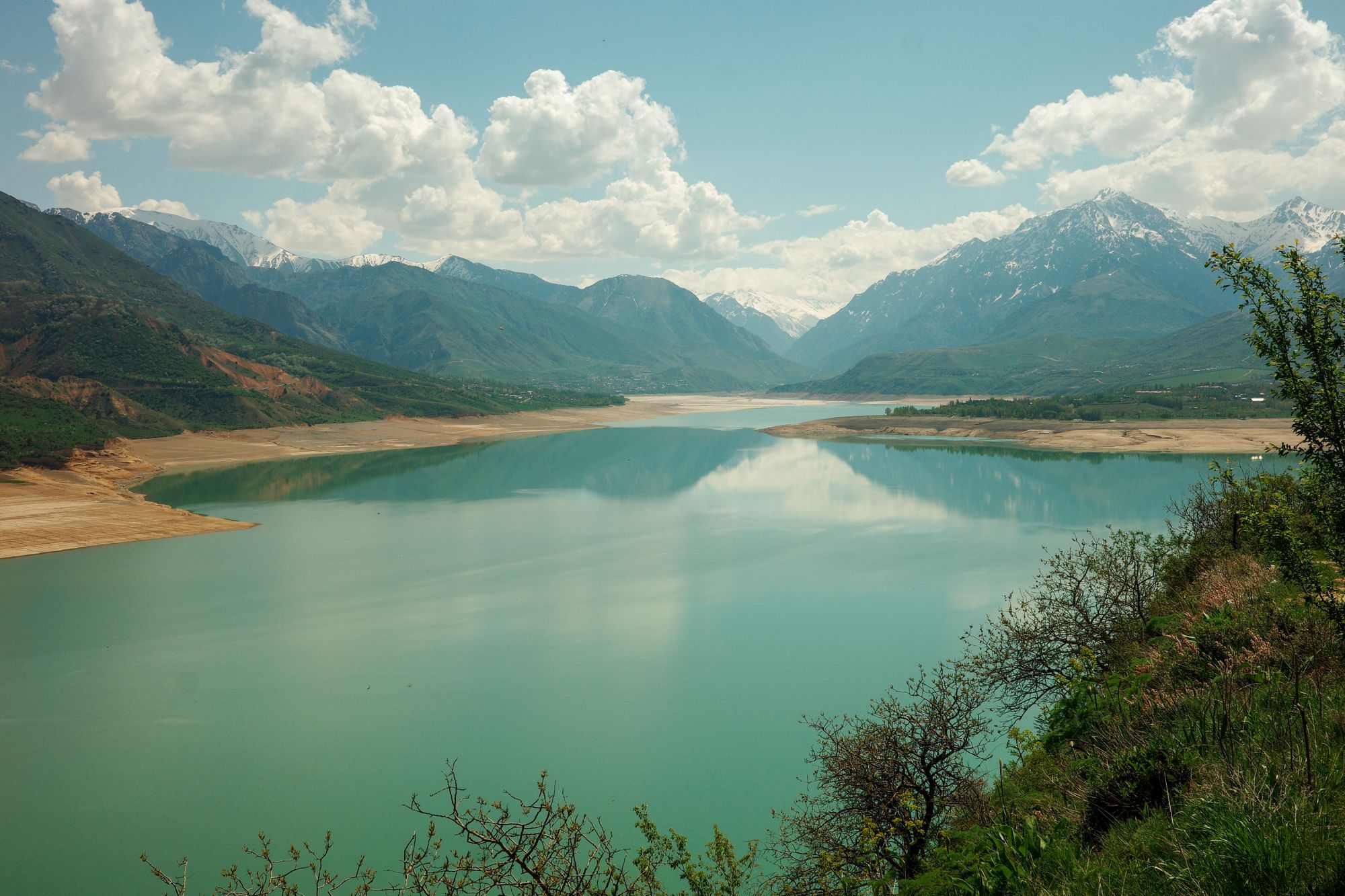
Invest in the best is the mantra of Gayane Umerova, the key cultural figure in the arts, cultural preservation and innovation. This is why the capital’s classical music concerts now have world-class performers like Helene Mercier, the Canadian pianist, playing at the new concert hall, which makes the Wigmore Hall seem like a duty provincial town hall. A new contemporary art gallery, being built by Japanese architects and supported by the Arts and Culture Development Fund, shows how Umerova is serious about putting culture at the heart of Uzbekistan’s development
There are so many surprising cultural treats to discover here. Antony Gormley was commissioned to take over a square in Bukhara with a stunning show of sculptures responding to the ruins of Khoja Kalon mosque, originally built in the 16th century, attracting global attention. There is a clear ambition to combine the arts and entrepreneurship to match and supplement the country’s economic achievements. And in a way this is a return to its romantic roots when it caught the imagination of the greatest writers.
A trip to Uzbekistan demands the lightness of touch of a butterfly to navigate and alight on its many silk dream wonders. Its three major centres of ancient art and architecture each have the capacity to stir the imagination and imprint an indelible picture of beauty and history. The massive turquoise domes and iridescent blue-tiled mosaics have the same resonance and magic they had when they were first created. They are poetry in motion, an intoxicating journey from the past to the present, and a powerful magnet for modern travellers.
How to get there
Uzbekistan Airways flies direct from London Heathrow or Gatwick to Tashkent. Flight time is round six hours.