.jpeg?trim=0,1,0,0&width=1200&height=800&crop=1200:800 "Trump’s DOJ ‘quietly assuring allies’ to expect slush fund payouts – UK Times")


As headlines state that May half-term flights could be cancelled due to a shortage of aviation fuel, and Donald Trump says the US will blockade the Strait of Hormuz, Ben B poses a good question: “What happens to accommodation booked in advance separately to a plane ticket if an airline cancels your flight?” He wonders: “Would travel insurance cover the cost?”
I hope my answer will help to put his mind at rest, and possibly yours.
Buying flights and rooms separately is always riskier than booking the two in a single transaction. The latter case creates a package holiday. The company that puts the two together – known as the tour operator – becomes responsible for delivering the trip as sold. If the outbound flight is cancelled, the firm must either find a suitable alternative departure or provide a full refund for the trip. (Typically, the operator might also invite you to switch dates or destinations, but getting your money back is your prerogative.) That is a strict obligation under the Package Travel Regulations.
Plenty of travellers, though, buy the two components separately. Reasons include saving money (cutting out middlemen can keep costs down) or availing of more flexibility, for example, to choose a property on a platform such as Airbnb.
Fortunately, passengers who book flights separately have some strong consumer protection too, thanks to a different body of legislation: air passengers’ rights rules, known informally as 261. These apply to all flights from UK (or European) airports, and departures from anywhere in the world if a British or EU airline is doing the flying. The most valuable stipulation, in my opinion, is that a carrier that cancels a flight must provide a suitable alternative. “Suitable” is interpreted by the UK Civil Aviation Authority to mean a flight (or, if appropriate, a train) enabling the passenger to reach their destination on the same day.
The obligation applies regardless of whether the cancellation is within the airline’s control. And if the carrier does not have a suitable flight but a rival does have seats available, the cancelling airline must buy a ticket allowing the passenger to complete their journey more or less as intended.
I provide this context because the rules will apply even in the hypothetical case of flight cancellations due to a shortage of aviation fuel.
Last week, I wrote about what might happen if a continued closure of the Strait of Hormuz led to tanks running low at UK airports. On Sunday morning, the American president posted on social media: “Effective immediately, the United States Navy, the Finest in the World, will begin the process of BLOCKADING any and all Ships trying to enter, or leave, the Strait of Hormuz.”
This does not bode well for the imminent restoration of normal tanker traffic in and out of the Gulf.
Airlines UK, representing the main carriers, has responded to the latest round of headlines by saying; “UK airlines are currently not seeing disruption to jet fuel supply, in part due to the UK’s diverse fuel supply, and continue to engage with fuel suppliers and government to monitor the situation.”
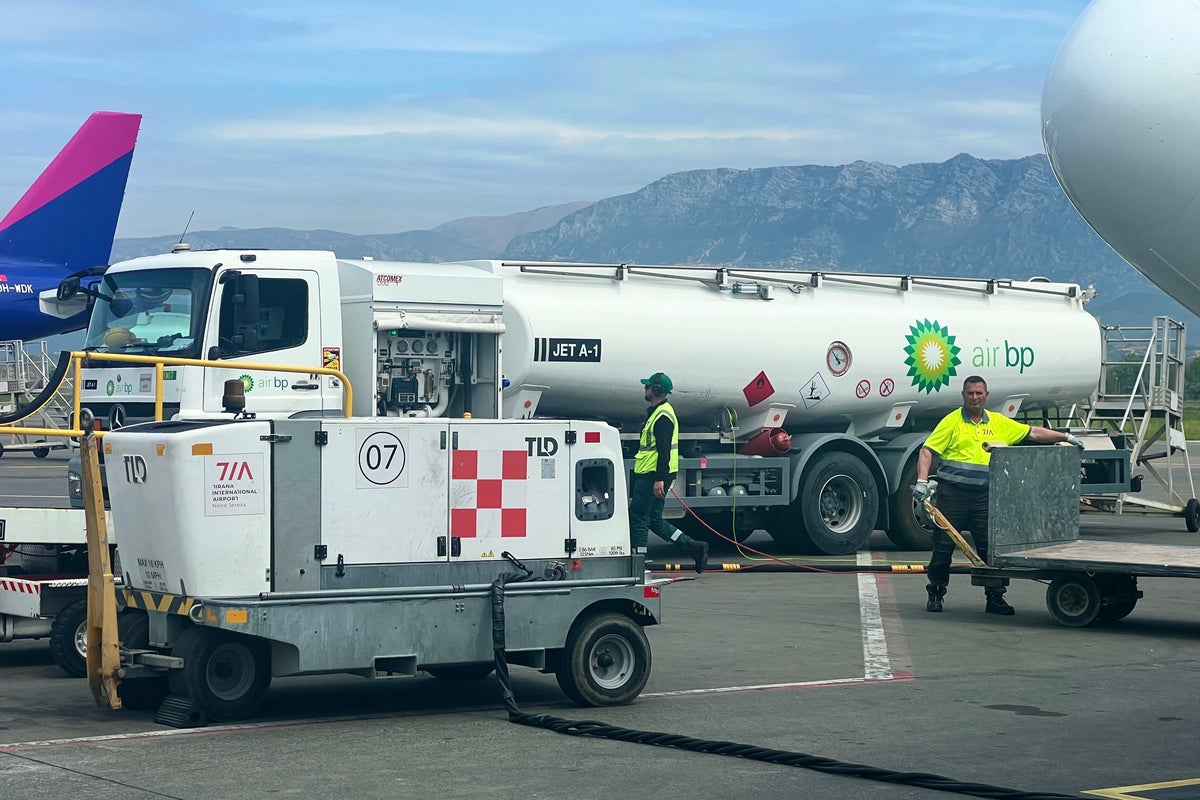
Britain has multiple sources of increasingly valuable Jet A-1 kerosene. But supply is tightening.
A sudden grounding of a majority of flights looks unlikely. Instead, I would expect airlines to organise an orderly reduction in their schedules, either because they have been ordered to do so by the government or to get ahead of any such instructions.
Suppose airlines were told to cancel one-fifth of their planned schedule to ration scarce fuel. As mentioned last week, they would do all they could to combine departures, allowing as many passengers with confirmed bookings to travel as possible. From Gatwick to Nice, for example, easyJet has up to six flights a day. A couple of them could be grounded, and the affected passengers assigned to other departures.
“Yes, but,” Ben B might respond, “there won’t be enough room on board for everyone.” At present, there are about a dozen empty seats on the average easyJet flight. But that is at the point of departure. A couple of weeks ahead, there will usually be significantly more space: airlines expect to sell a significant number of tickets shortly before departure.
In addition, easyJet could “upgauge” flights on affected routes: replacing the Airbus A320 with a longer A321, holding around 50 more passengers.
Elsewhere, other creative solutions would be found. On super-short trips linking London with Paris, Brussels and Amsterdam, Eurostar might be prevailed upon to add extra trips – each train carrying around five planes’ worth of passengers.
Between northwest England and southern Spain, an airline might cancel a Liverpool-Malaga flight but rebook those passengers on “surviving” departures from Manchester airport – with coaches provided to get them to the alternative airport. Providing a couple of weeks’ warning were given, most people will get where they need to be without too much inconvenience.
I have provided all of this context to show how unlikely it is that a passenger with an existing booking would be unable to travel. But it is feasible that some travellers could lose their holiday flights with no suitable alternative available.
The short answer to Ben’s follow-up question – “Would travel insurance cover the cost?” – is probably not. Many policies exclude paying out for losses incurred as a result of “declared or undeclared war or hostilities”. You can trace a direct line from the US-Israel assault on Iran, which began on 28 February, to the growing shortage of fuel.
But I believe the only people who are likely to miss out on holiday flights are those who are currently holding off booking. They may find that seats either vanish overnight or become crazily expensive. In this scenario, fortune does not favour the hesitant.
Simon Calder, also known as The Man Who Pays His Way, has been writing about travel for The Independent since 1994. In his weekly opinion column, he explores a key travel issue – and what it means for you.