



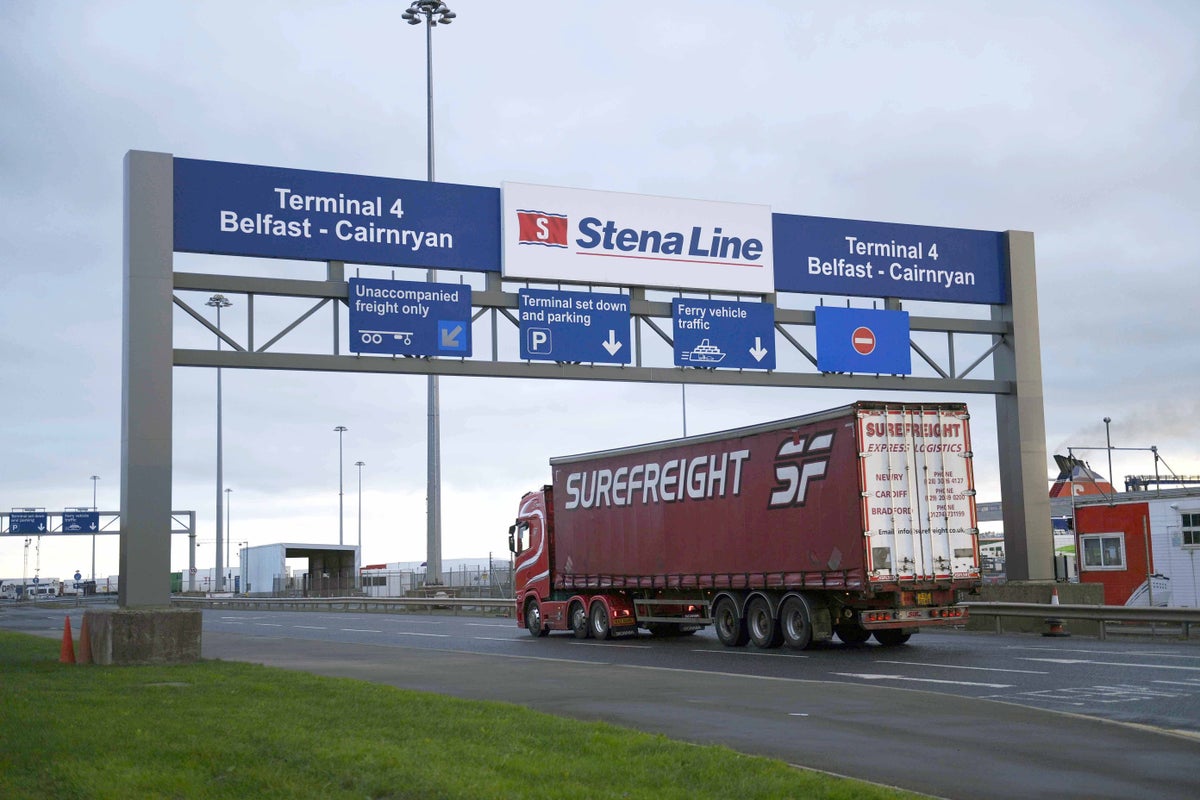
The number of haulage companies going insolvent has almost doubled in the five years since Brexit, sparking fears over supply chain disruption and food prices.
The data, revealed in response to a Parliamentary question submitted by Lib Dem Europe spokesperson Al Pinkerton, shows that 2,051 haulage companies went bust between 2021-2025 – almost double the 1,068 that went bust in the five years prior.
It comes amid growing fears over spiralling prices and shortages as a result of the Iran war, with oil prices having soared in response to Iran’s stranglehold on tankers passing through the Strait of Hormuz.
The figures are expected to only get worse in the coming months, as haulage firms scramble to adapt to the full enforcement of the EU’s Entry-Exit System, with the Road Haulage Association warning that 80 per cent of operators expect a decrease in business.
Meanwhile, industry bodies have previously warned that the hit to the economy arising as a result of the new EES system – which requires UK travellers to have their fingerprints registered and photograph taken to enter the Schengen area – could be as high as £400 million.
The Liberal Democrats are now reiterating calls for the government to urgently secure an agreement from the EU to allow British HGV drivers to register biometric details away from the border.
Liberal Democrat Europe Spokesperson, Al Pinkerton MP told The Independent: “The government must immediately secure an agreement with the EU to allow British hauliers to register biometric details away from the border.
“Failure to do so will have a catastrophic impact, not only for haulage companies who are unable to survive, but also for supply chains and a subsequent increase in food and goods prices for those already facing the effects of the soaring cost of living.
“Ministers must therefore also begin negotiations with our European partners on a Customs Union.
“A Customs Union is the single biggest lever the government can pull to boost business, deliver growth, and slash unnecessary Brexit bureaucracy. The government knows this, and it’s high time they do something about it.”
It comes just days after a Bank of England survey of finance bosses across UK companies revealed that they expect to increase prices more quickly as they come under pressure from surging energy prices linked to the Iran war.
The Decision Maker Panel (DMP) survey showed that firms expected to increase their prices by 3.5 per cent over the next 12 months, according to data for the three months to March.
This is 0.1 percentage point higher than predicted over the three months to February.
While Sir Keir Starmer earlier this week signalled the government will seek stronger ties with the EU in light of the Iran war’s global impact, he has insisted that Labour’s manifesto red lines on closer relations with Europe remain.
At the general election, the party promised to not seek a customs union, to re-join the single market, or establish freedom of movement as part of closer ties with the bloc.
Speaking on Wednesday, the prime minister said the “volatile” international situation caused by the US-Israeli conflict with Tehran meant Britain’s “long-term national interest requires closer partnership with our allies in Europe and with the European Union”.
UK and EU negotiators are due to meet this summer to discuss closer ties on food standards and emissions, as well as a youth mobility scheme.
The Cabinet Office has been contacted for comment.
