

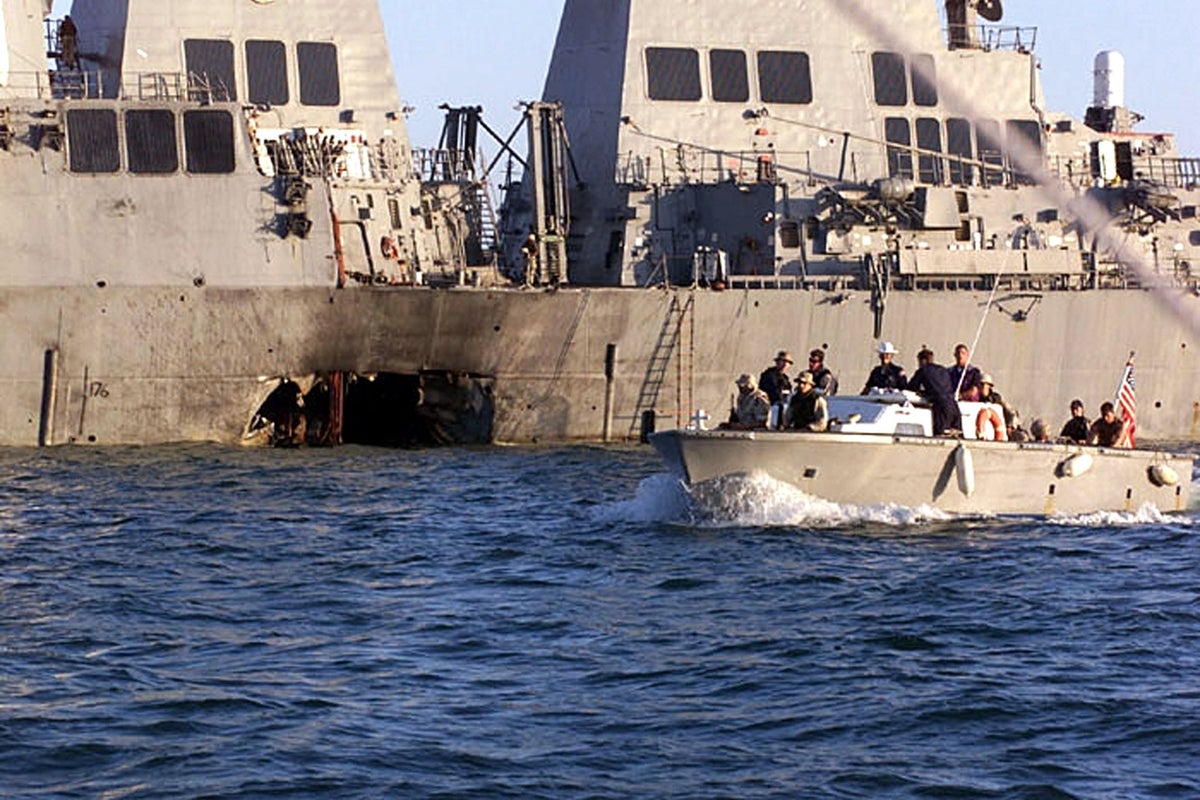
President Donald Trump’s invocation of the 25-year-old bombing of an American warship as part of his justification for launching a massive bombing campaign against Iran could hamper long-running Pentagon efforts to finally bring the alleged terrorists accused of perpetrating the terror attack to justice.
On two occasions over the nearly two weeks since the Defense Department launched Operation Epic Fury against targets across Iran, Trump has claimed Tehran was responsible for the October 2000 bombing of U.S.S. Cole, a grisly attack that killed 17 U.S. Navy sailors and left 37 others injured.
When he announced the start of the joint U.S.-Israeli campaign in the early hours of Feb. 28, Trump claimed Tehran “knew and [was] probably involved” with the Cole attack, and he repeated the allegations during a press conference on Monday when he insisted that Iran had been “involved very strongly” in the attack.
Yet according to the very government he leads — including a blue-ribbon commission’s report on the attacks and filings by military prosecutors seeking to convict the alleged perpetrators — Iran wasn’t involved at all.
And that’s a key detail, because as Trump recklessly tosses out allegations about the Cole, he is also assisting in the defense of the very al-Qaeda terrorist who is awaiting trial for allegedly planning it.
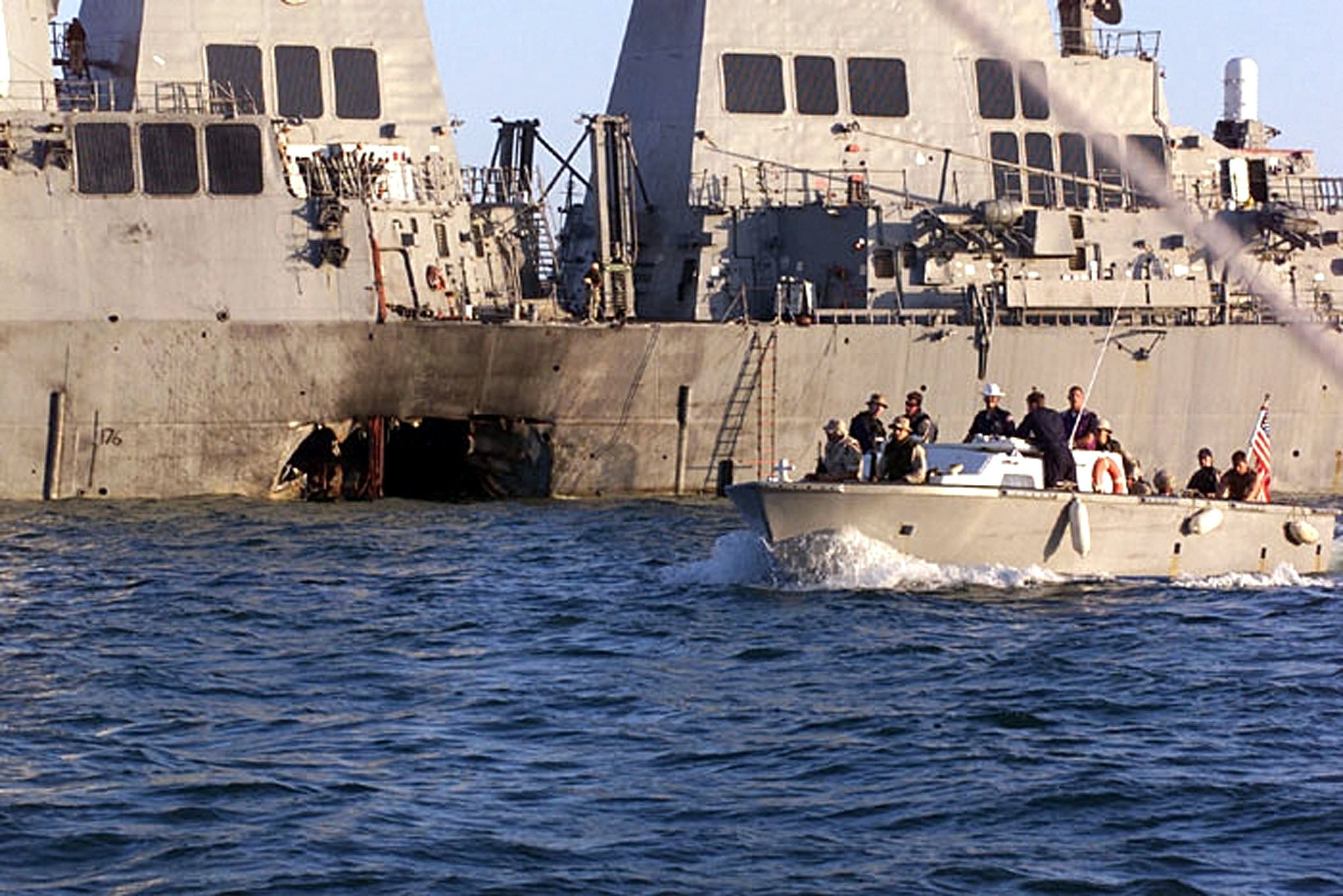
According to the final report of the National Commission on Terrorist Attacks Upon the United States — better known as the 9/11 Commission — the attacks were planned and carried out by Abd al-Rahim al-Nashiri, a Saudi national of Yemeni descent who joined up with al-Qaeda some time between 1996 and 1998 in Afghanistan, allegedly reporting only to the group’s leader, Osama bin Laden.
The commission’s report states that al-Hashiri proposed attacking American warships in “late 1998,” with bin Laden, a Saudi construction scion who was the group’s main financier, giving his approval and providing funds for the operation. After bin Laden allegedly suggested that al-Nashiri look for targets in the Port of Aden on Yemen’s southern coast, al-Nashiri unsuccessfully targeted the American destroyer U.S.S. The Sullivans 10 months before the successful attack on Cole.
He was captured by the Central Intelligence Agency’s Special Activities Division in 2002 as part of the U.S. effort to round up high-level al-Qaeda operatives, and he was moved to the U.S. military brig at Naval Station Guantanamo Bay four years later.
The 61-year-old accused al-Qaeda operative is still at Guantanamo, where the U.S. has housed many of the alleged terrorists captured during the early years of the Global War on Terror. He is set to face trial in June before a military commission, which in 2011 formally accused him of three criminal law-of-war violations, conspiracy and terrorism charges stemming from the Cole attack.
So when the President of the United States twice declared that Iran — not al-Qaeda or any of its members — had masterminded the Cole bombing, al-Nashiri’s legal team took notice.
Allison Miller, the lead attorney responsible for defending the accused terrorist operative, told The Independent in an email that Trump’s comments “impact our defense.”
“We’ve requested additional information from the government regarding the intelligence information that supports President Trump’s now repeated claims that Iran is responsible for the bombing of the USS Cole,” she added.
Because Trump’s claim is at odds with the specific accusations the government has made against al-Nashiri in charging documents, the new accusations against Iran could, in theory, serve as a defense for the accused al-Qaeda operative.
It’s not clear why Trump decided to include the Cole attack among the litany of grievances he’s routinely recited against Tehran’s government as he’s sought to justify a war that has upended financial markets and sent oil prices soaring as Iran has moved to choke off the West’s oil supply by closing the Strait of Hormuz to most commercial traffic.
The federal government has never linked Tehran with the bombing, though a 2015 court decision handed down in Virginia as part of a lawsuit by the family of one bombing victim suggested that Iran’s government had been “complicit” in the attacks by allowing al-Nashiri to travel freely through the country when transiting between Afghanistan and Yemen. Miller, his attorney, told The New York Times last week that her client has never been to Iran.
But regardless of its veracity, Trump’s claim that Tehran was behind the bombing contradicts decades worth of evidence gathered by federal investigators and could imperil the Defense Department’s attempt to prosecute al-Nashiri for the attack.
According to the commission’s charging documents, he allegedly acquired the boat and explosives used in the attack, rented property to surveillance the harbor, modified the boat to turn it into a bomb, and sent the two suicide bombers out in it to attempt to sink the U.S. destroyer.
‘Kind of thing that I think would have stuck out in my mind’
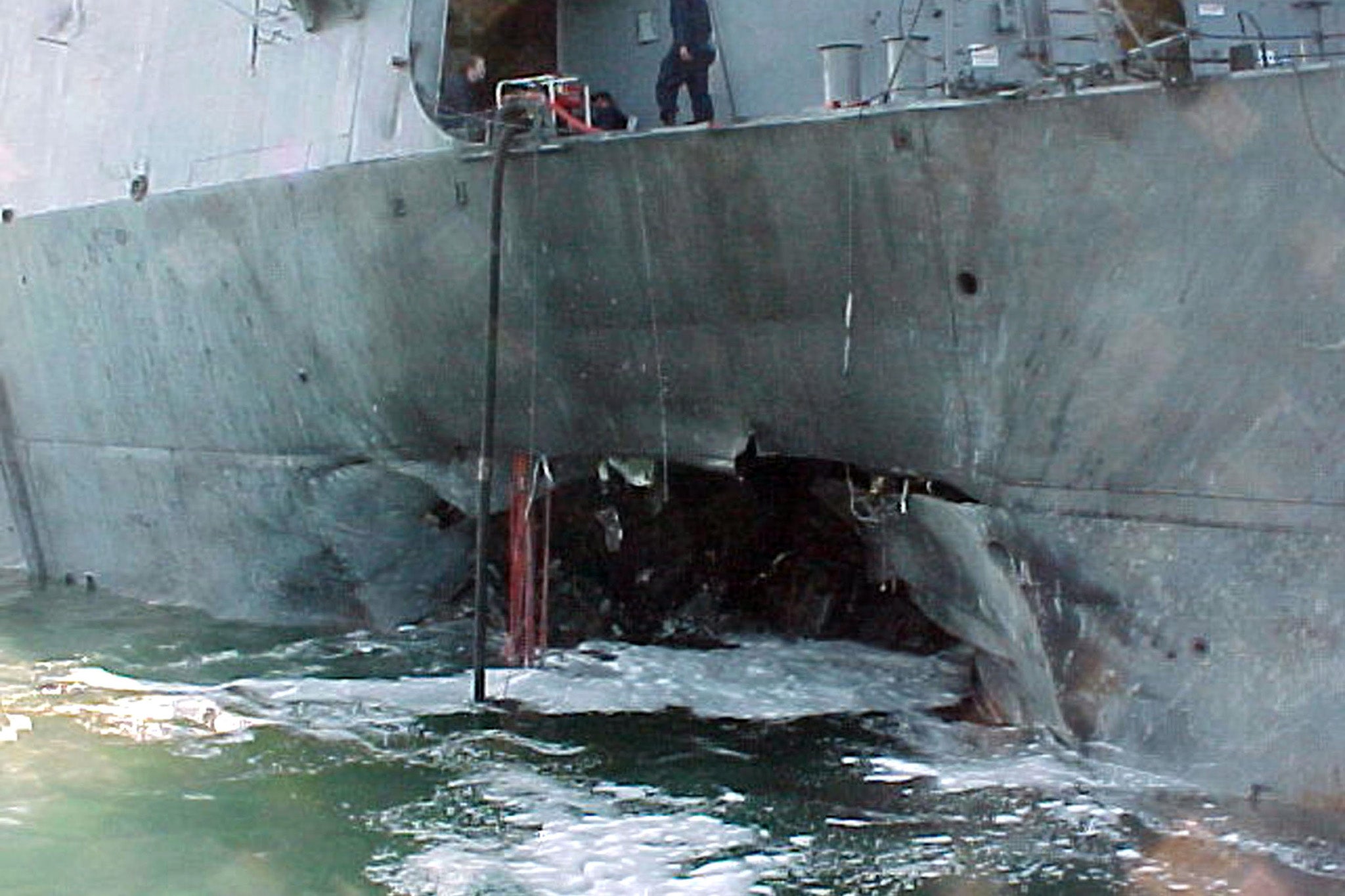
The strike on the Arleigh Burke-class destroyer, which left a 3,200 square foot hole in the ship’s port side as it was making a refueling stop in Yemen’s Aden harbor, was the deadliest strike against an American warship since an Iraqi jet fired two anti-ship missiles at an American frigate, U.S.S. Stark during the Iran-Iraq war in 1987.
It was one of several terrorist attacks carried out by al-Qaeda under the leadership of Osama bin Laden during a three-year period leading up to the September 11, 2001 attacks on New York and Washington.
The charging documents and 9/11 commission report both go into detail about al-Nashiri’s preparations for the attack and his association with bin Laden and other al-Qaeda leaders.
Nowhere in the documents is the Iranian government mentioned.
Morris Davis, a retired U.S. Air Force colonel who served as the chief prosecutor for the Guantanamo military commissions from 2005 to 2007, told The Independent in a phone interview that he had “no recollection at all of there being any mention of Iran” in any documents or evidence relating to al-Nashiri.
“That’s the kind of thing, too, that would have been a pretty significant detail that I think would have stuck out in my mind,” he said.
Davis, who resigned as the head of the military commissions’ prosecution team rather than use evidence obtained through the use of torture, noted that it would have been highly unlikely for Iran to play any role in any al-Qaeda plot.
Not only was al-Qaeda led by citizens of Saudi Arabia — a rival power to Iran — but Davis pointed out that the bin Laden-led organization was made up of Sunni Muslims who would not have wanted any association with the Shiite cleric-led Iranian government.
He also told The Independent that were he al-Hashiri’s lawyer, he’d have already filed a motion to compel disclosure of whatever evidence Trump was citing when he claimed Iran was responsible for the Cole attack.
“If you’ve got the president, who is the ultimate authority over the military commissions, stating as a fact that Iran was involved in the Cole bombing and your client is facing a murder trial, I would make the government state that the evidence exists or admit that the president was mistaken,” he said.
“My guess is he pulled this out of his hat as some additional justification for attacking Iran. But to my knowledge, there’s no evidence to support his assertion.”
The former Air Force Judge-Advocate also warned that Trump’s comments could potentially blow up the years of work that has already been done to prepare for al-Nashiri’s trial because the statements could be exculpatory — or prejudice the jury of military officers who will ultimately determine al-Nashiri’s guilt by linking him to a country with which the United States is now at war.
“It’s an aggravated case to begin with, from the fact that we lost service members, but linking him to Iran just makes it worse. So he potentially taints the jury pool by making irresponsible statements like that,” Davis said.