

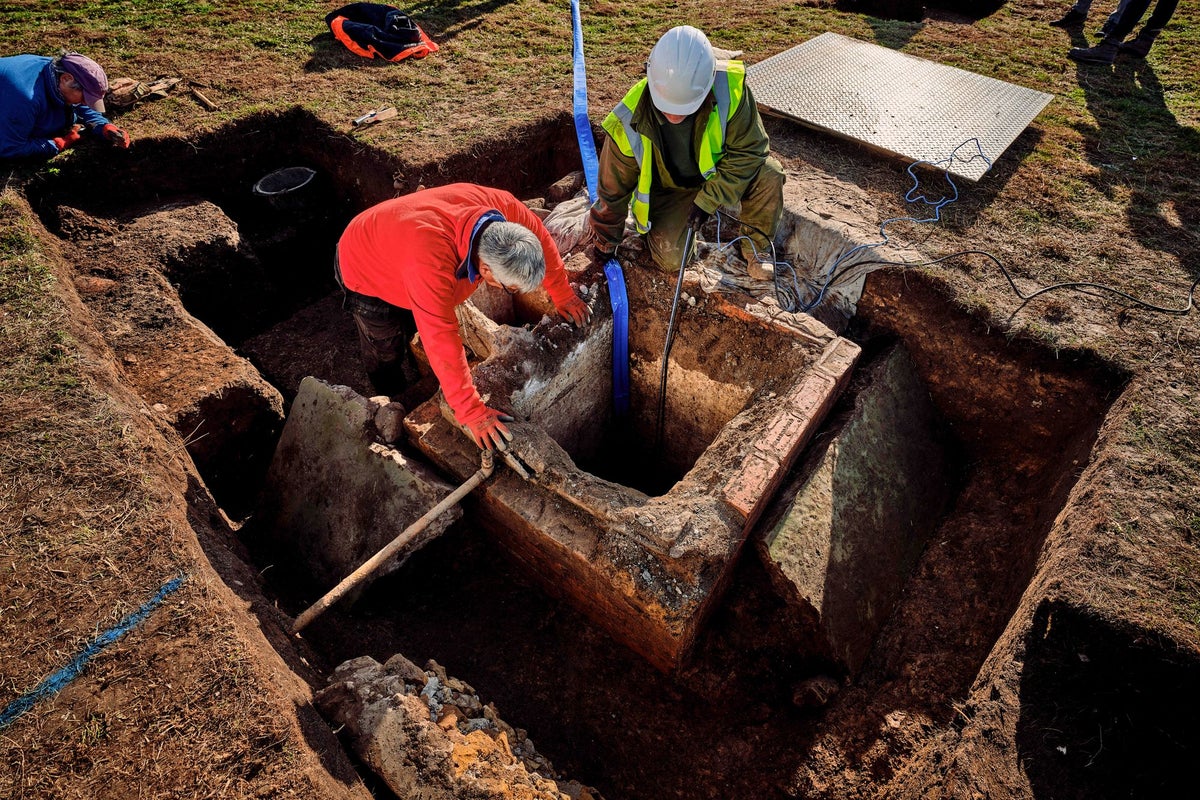
A Cold War-era concrete bunker, once a secret outpost of Britain’s nuclear defence, has been unearthed during an archaeological dig at Scarborough Castle.
The underground facility, built to house Royal Observer Corps (ROC) volunteers tasked with plotting nuclear bomb impacts across Britain, was discovered within the grounds of the historic North Yorkshire landmark.
Experts from English Heritage have now opened the entrance to the chamber and lowered cameras to assess its condition.
The bunker is one of 1,500 constructed nationwide between 1963 and 1964, designed to detect nuclear explosions and withstand an attack.
The vital posts included communications facilities and bunkbeds for the ROC’s largely unsung 20,000-strong volunteer force.
This particular bunker appears to have been sealed and buried in 1968.

Its exact location and state remained unknown until now, according to English Heritage.
The discovery forms part of a wider project led by the charity to mark 100 years of the ROC.
It also includes a search for past members and an event at the York Cold War Bunker.
The excavation began on 7 March. following analysis of existing data and a newly commissioned ground survey.

“Wherever you lived in Britain, you were probably no more than a few miles from an ROC post – yet few people knew they existed,” Kevin Booth, English Heritage head of collections, said.
“It seems strange to have a Cold War bunker built inside Scarborough Castle, but in many ways it is a perfect location: this headland has been an observation post for thousands of years, from a Bronze Age settlement, a Roman signal station, a medieval castle, a Second World War gun battery and, here, a 1960s concrete bunker watching for Armageddon.”
Helen Featherstone, director of England, North at The National Lottery Heritage Fund, said the find was “really exciting”.
It “builds on our understanding” of the ROC and “shines a spotlight on their important work protecting the UK”, she said.
The project was made possible through money raised by National Lottery players.