


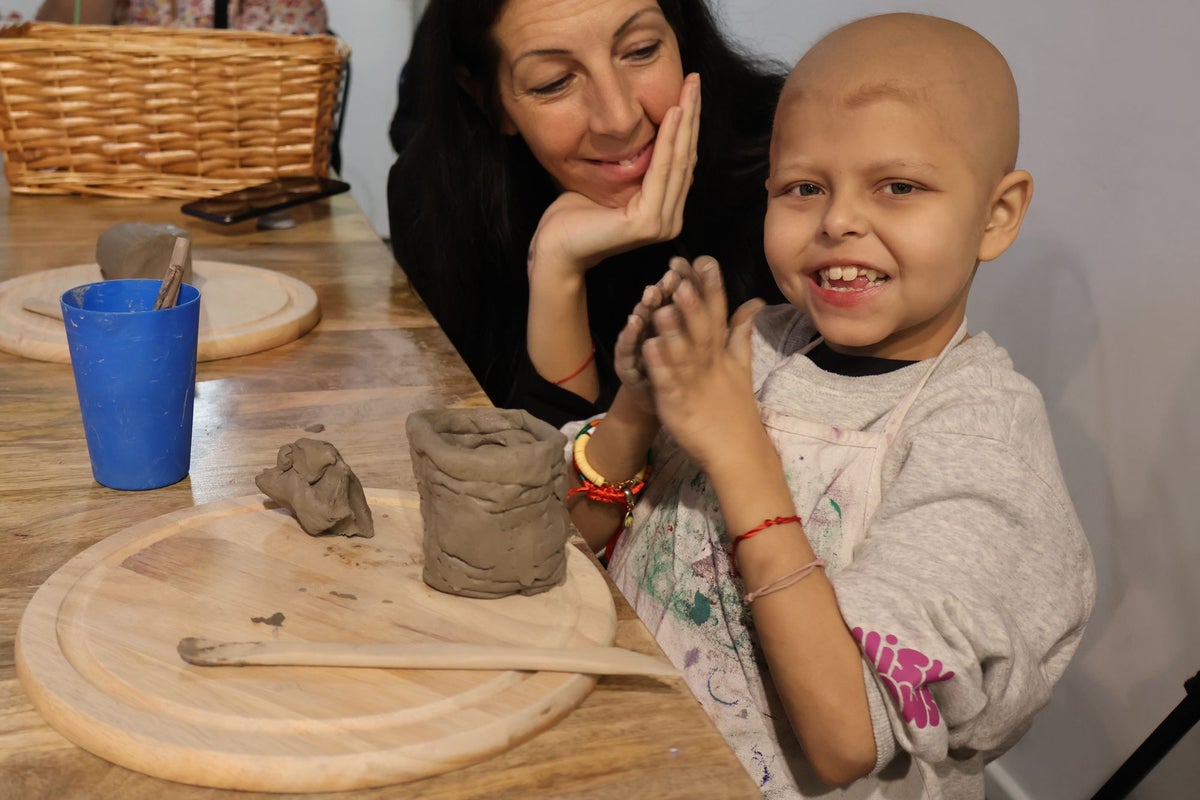
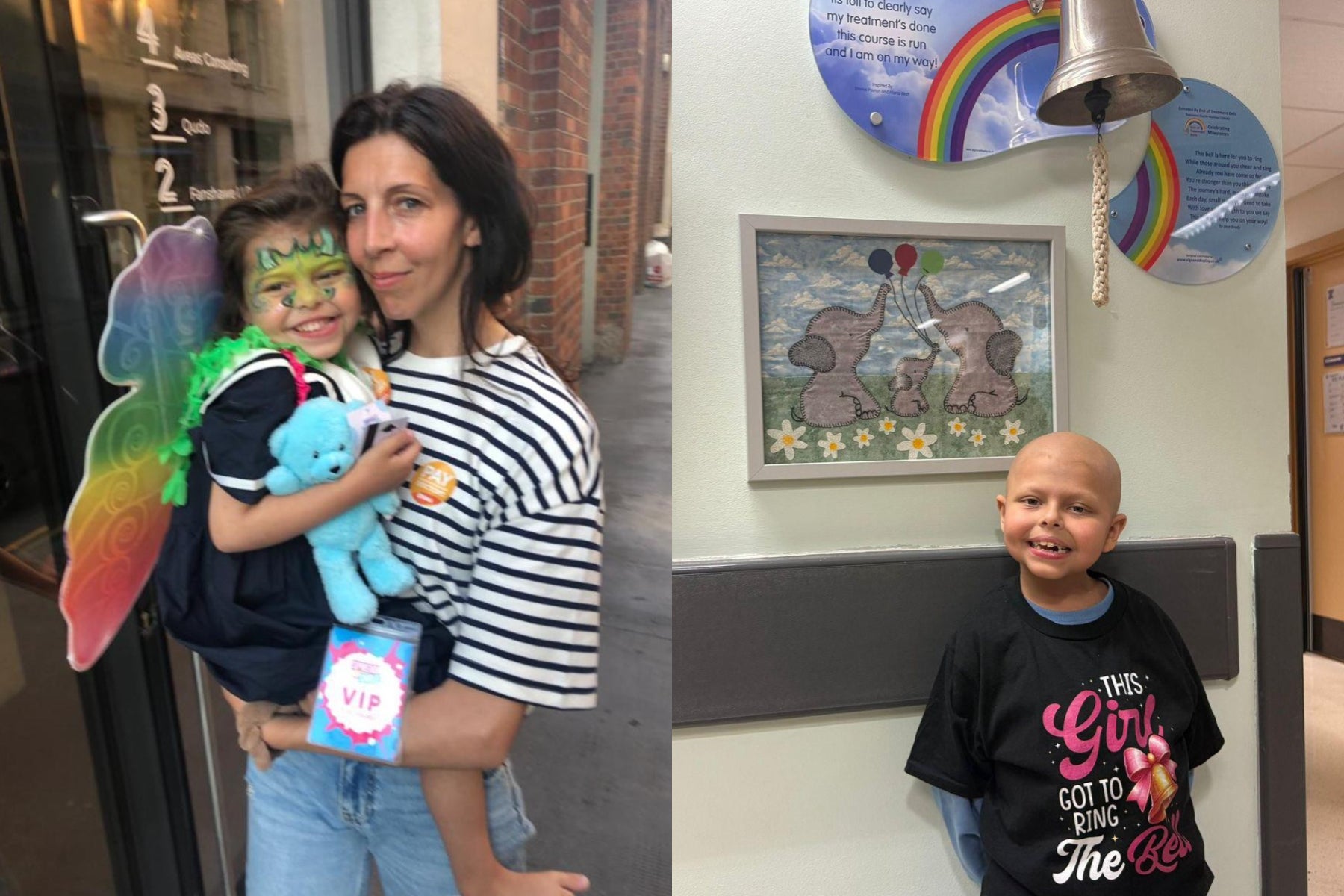
A mother has spoken of her profound awe for her daughter, Bay, who has “beat the odds” repeatedly after facing kidney failure at two years old, undergoing a transplant, and subsequently battling bowel cancer. Jennifer McNeill, 43, from Barking, east London, describes her now nine-year-old daughter’s journey through life-threatening health issues since 2018.
Bay’s early years were marked by frequent hospital visits to London’s Great Ormond Street Hospital (GOSH), as kidney failure necessitated a transplant, followed by a gruelling fight against a bowel tumour, from which she received the all-clear in November 2025. Throughout these immense challenges, the charity Spread a Smile provided crucial moments of joy and laughter, a service Jennifer is “just in absolute awe” of.
Bay’s health crisis began in February 2018 when, at two years old, she developed an illness initially dismissed as a virus. Jennifer recalled to PA Real Life: “We thought it was a virus… like a cold, a malaise.” Despite multiple GP visits and two trips to A&E, doctors continued to believe it was a common virus. However, after three weeks, Bay became “really pale, like an off-colour grey, almost, and she was starting to vomit and walking really funny, losing her balance.”
A third A&E visit saw doctors conducting more tests, yet still preparing to send Bay home. Jennifer remembers Bay being her “normal, chatty, wonderful, energetic self, singing songs.” It was a single doctor who intervened, saying: “Actually, I’m going to do a blood test. She does look a bit of an odd colour.” The results were alarming. “He said, ‘Oh, her potassium is reading quite high. This must be wrong’. Did the test again. Did it for a third time. And then things moved very quickly.”
Bay was swiftly moved to resuscitation. “Suddenly, we were moved into resus. Bay seemed very well – I remember Bay sitting up in resus on the bed – and they said: ‘We think she’s in kidney failure’. I was in utter disbelief and shock.” Jennifer described the ensuing chaos: “things just went at 100 miles an hour,” with dozens of doctors consulting GOSH. Bay was blue-lighted to GOSH, and “within about two minutes of arriving in intensive care, she was intubated, put into a coma, and they very quickly told me that she’s not going to survive the night.” Jennifer remains “unspeakably grateful” to that one doctor who “one million per cent saved her life.”
Doctors advised Jennifer to “prepare for the worst” as Bay was placed on dialysis. It became clear Bay would need a kidney transplant, but Jennifer had previously donated a kidney to her mother, making her unable to be Bay’s donor. Thankfully, her identical twin sister, Mimi, “instantly” volunteered to donate.
Bay could not undergo the transplant immediately, requiring stabilisation. She spent three months as an inpatient at GOSH, “in and out of ICU,” before Jennifer was trained to administer dialysis at home. “I remember that day a nurse from the hospital came home with us and set up all the machines at home, and I remember that feeling of feeling very vulnerable,” Jennifer said. “I’m at home now, with her having dialysis. We’ve got a big machine that alarms, and I’m really in charge of her… That became our normality, our new normal, and we did that for three years.”
In August 2021, following health improvements and Covid-related delays, Bay received Mimi’s kidney. The transplant was successful, and Jennifer noted: “you could see the instant colour in Bay’s face” after the then-five-year-old received an adult kidney. However, complications arose; Bay’s lymphatic system was damaged during the operation, keeping her in hospital until December 2021. “We had some very horrible conversations around if they can keep her safe, if they can save her, but Bay being Bay, she did beat the odds again,” Jennifer said, adding that Bay returned home for Christmas 2021.
Jennifer described the emotional rollercoaster: “It felt terrifying, to be honest, because of the gravity of the situation that we were in… You feel so euphoric, the last few years have been building up to this transplant. You understand that things can always happen, but for the majority, it’s going to go fine.” The sudden return to ICU was devastating. “When the doctors don’t feel certain that they can put things right, it’s really just an uneasy, terrifying feeling.” Mimi also suffered septicaemia after her surgery, adding to Jennifer’s distress. “But you have to just put your faith in the teams, and just take each day as it comes.”
Bay’s recovery from the transplant took about a year, allowing her to catch up on her childhood. Jennifer homeschooled Bay, who joined performing arts, Brownies, and chess club. However, in early 2024, Bay’s blood tests became irregular, and she started to look “quite puffy,” with the alarming symptom of “some blood in her poo.” Jennifer knew that for immunosuppressed Bay, the Epstein-Barr virus (EBV) could lead to post-transplant lymphoproliferative disorder (PTLD), a form of lymphoma.
“Eventually, in December 2024 we had an ultrasound, because I was digging my heels in a little bit. There’s something very wrong,” Jennifer explained. “They found a mass in her bowel, which I think in my heart of hearts it was almost like a relief, because we just knew, for almost a year, that something was wrong.” On December 18, 2024, Bay was diagnosed with PTLD. “Things started moving very quickly again.” Bay was admitted, underwent a biopsy and lumbar puncture, confirming a malignancy in her bowel requiring chemotherapy and immunotherapy. “I think it’s every parent’s worst nightmare, to be honest,” Jennifer said.
Initially, Bay’s prognosis “wasn’t great” due to her fragility. Doctors opted for a lower dose of chemotherapy, fearing her body couldn’t cope with aggressive treatment, but Bay only had “a partial response.” By March 2025, doctors considered alternative treatments. “Reading between the lines, we knew what that meant,” Jennifer said, preparing for the worst again. However, consultants decided to try aggressive chemotherapy, which Jennifer “fully supported.”
Bay endured 10 cycles of aggressive chemotherapy. “To get the cancer that Bay had – she had it quite aggressively in her bowel – was quite rare,” Jennifer noted. “The protocol they followed, they’ve only used it I think nine times in 20-plus years.” In November 2025, a PET scan confirmed “no more evidence of cancer,” which Jennifer called “the most wonderful news, considering she went in with one arm behind her back.”
Bay now requires twice-yearly PET scans, with a low but present chance of relapse. “We live for now, until the next scan,” Jennifer said. “We are just completely going to grab life with both hands. It’s really hard to put into words how much you appreciate life. You’re just thankful and grateful, and I can’t believe it, almost, I cannot believe it. It’s this feeling you’ve been waiting for and wishing and praying for the whole time, and you don’t ever think you’re going to get there and hear it, but it’s wonderful.”
Throughout Bay’s journey, Spread a Smile provided invaluable support. The charity offers virtual and in-person visits from entertainers to seriously ill children in NHS hospitals and hospices across the UK. In 2025 and 2026, they plan over 18,411 in-person and 2,860 virtual visits. Jennifer and Bay first encountered the charity in a park near GOSH when Bay was two, and they have been actively involved ever since.
Bay continues to be homeschooled and has returned to her performing arts academy, Brownies, and chess club. She remains connected with her “Spread a Smile family.” Jennifer recounted Bay’s words at a winter party: “‘What does Spread a Smile mean to you?’ She said: ‘I get to meet lots of children like me’.”
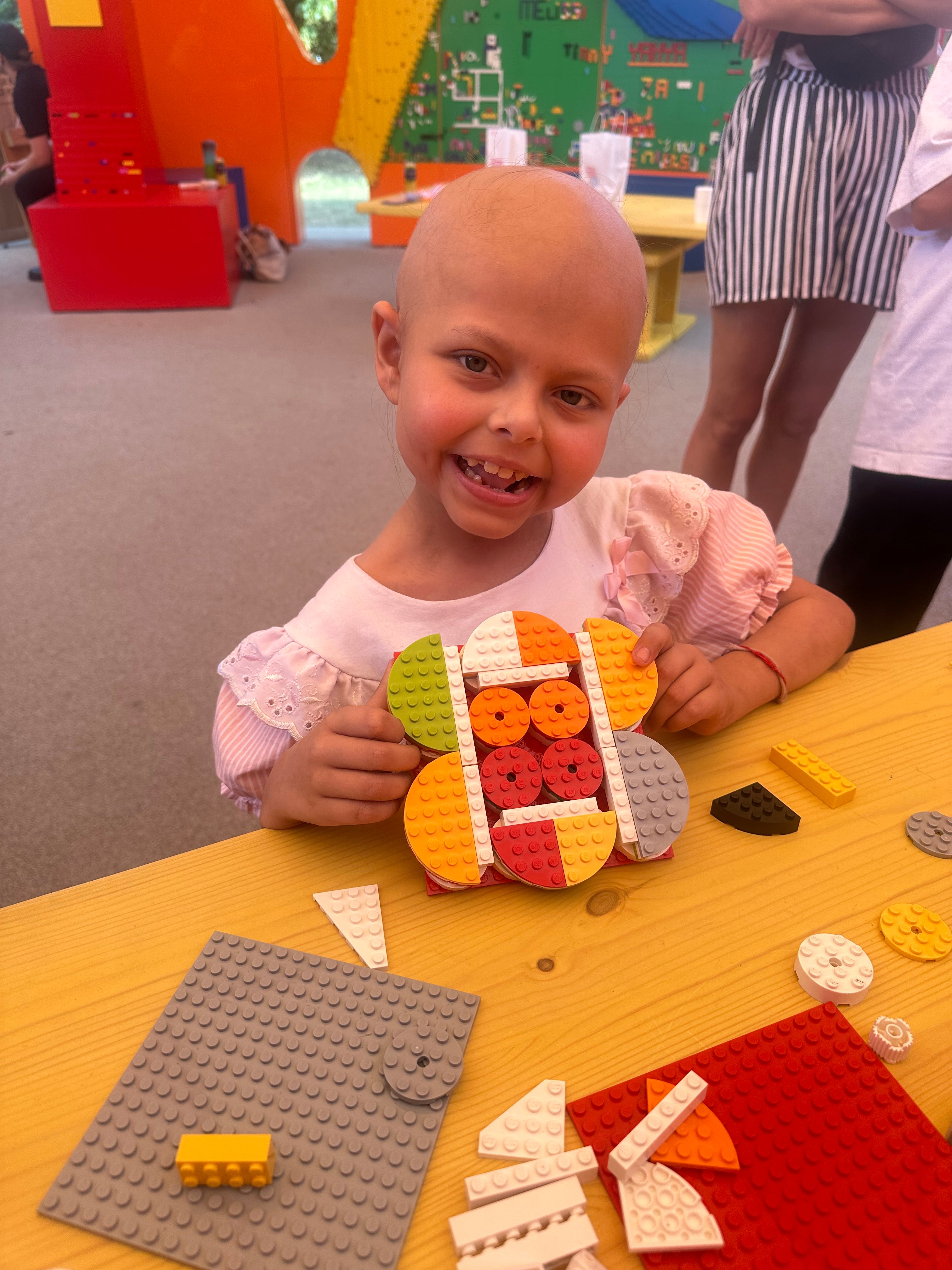
Jennifer highlighted the significance of these events: “She didn’t go to nursery or school, she didn’t get invited to parties, but she went to a party every year, with Spread a Smile.” For vulnerable children, social events are often risky, but with Spread a Smile, “we know that we’re with like-minded families, we know it’s going to be – as much as we can predict – a safe environment. We will always go.”
To learn more about Spread a Smile, visit spreadasmile.org.
.jpeg?trim=0,0,0,0&width=1200&height=800&crop=1200:800 "What is ‘wildflowering’? The latest dating trend that promotes stronger connections – UK Times")