

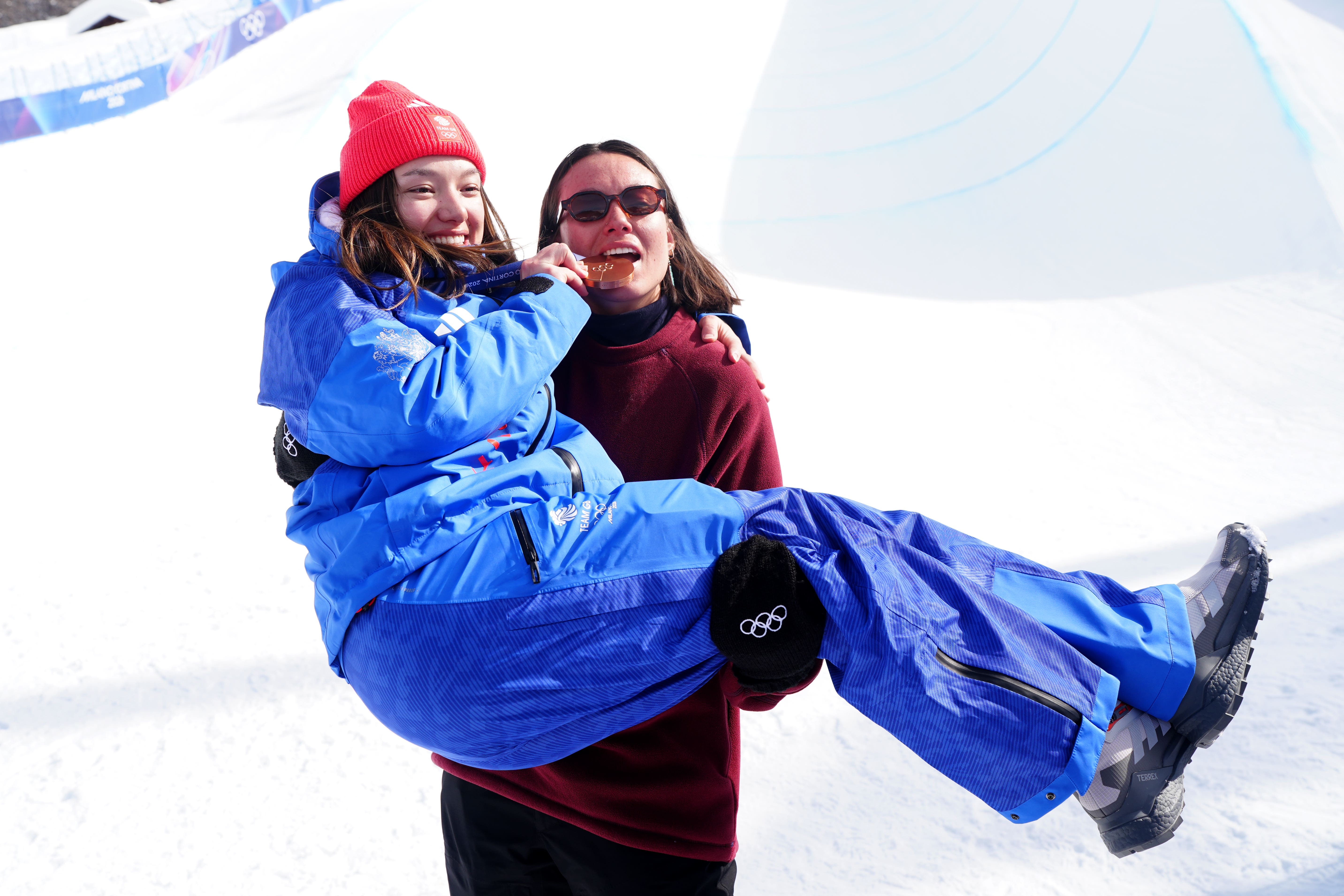
Before she flew to Italy for the 2026 Winter Olympics, freestyle skier Zoe Atkin had a pressing matter of interior design to attend to. Her many half-pipe medals hang on a shelf in a corner of her room in Park City, Utah. And she thought she might need space for one more.
“I left this little spot in my trophy shelf before I left, just in case, to manifest,” she tells The Independent a week after adding one of the biggest prizes of all to her collection. “And here she is!”
Even filtered through the lens of a Zoom call, the Olympic bronze is dazzling, weighty and shimmering in the light. While most people will never have even one, the Atkin family home has two, with older sister Izzy’s slopestyle bronze from PyeongChang 2018 hanging in the guest room.
The entire family, including Izzy, were there in Livigno to cheer Atkin onto the podium. She says: “She’s the whole reason I started skiing and she’s always been a big role model to me. I was watching her in 2018, and then she was spectating me here in 2026 and it was just a full circle moment for us.
“Obviously part of me wanted to one-up her and have a better medal than she does, but I’ll accept the bronze because I think it’s really cute that we have, like, little twin medals,” she grins.
The 23-year-old had been one of the heavy favourites to win in Livigno, winning gold at the X Games – the sport’s premier competition outside the Olympics – only a couple of weeks prior and recording the top score in qualifying. A solid first run in Sunday’s final gave her breathing space at the top of the leaderboard.
She recalls: “Once I landed that first run, the relief I felt was so palpable. It was such a relief to be like, at the end of the day, this did not go as badly as Beijing,” she laughs (she finished ninth on her Olympic debut in 2022).
And even a fall on her second run wasn’t enough to dislodge her from the podium: she could drop in last of 11 competitors on the third run, knowing she was guaranteed a medal.
Ultimately, her long-time rival Eileen Gu took gold for China, with Gu’s compatriot Li Fanghui, who was joint-overall World Cup crystal globe winner alongside Atkin last season, pushing the Brit into bronze by merely half a point.

While Atkin’s joy at winning a medal was clear, many observers felt it should have been a different colour. Atkin’s major advantage over her rivals is her amplitude – the height she gets on her jumps – and it was striking just how much higher than the others she flew in Livigno, reaching a maximum height of 5.4m above the half-pipe, with the best of the rest around the 3m mark. The walls of the pipe itself are over 7m tall; when Atkin fell it was straight down 12m of hard ice.
So much emphasis is placed on the importance of amplitude in scoring that even GB Snowsport chief executive Vicky Gosling raised an eyebrow when Atkin was only given 92.50 for her superb final run, compared to Fanghui’s 93. She said: “The minimum I thought she was going to get on the back of that run was silver.”
Atkin smiles wryly when I bring this up. Was she surprised? “I mean… yeah. I stepped up my run on my third run, I landed a trick that I’d never landed in a competition before [a switch 900 on her final jump]. I kind of thought that maybe, because I was sitting in third, and improving on my run that I already had, I thought I’d bump up a place or two.
“I had quite a few people coming up to me and saying that [that she was underscored]. I think if I ended up in fifth and I felt like I should have been in second or whatever, I would be really bummed. I’m just stoked to walk away with the medal, but obviously, in any judged sport, there’s going to be discourse around which athletes should have been in what position and not everyone’s going to be 100% satisfied. But I think that’s a little bit of the beauty of our sport, it is subjective, and we can all push our own skiing in the way that we decide to.
“For me to say that I’m the one going the biggest and doing kind of the scariest part of skiing, which is that amplitude, and being able to connect with the wider audience through that, I’m really proud to be that person.”
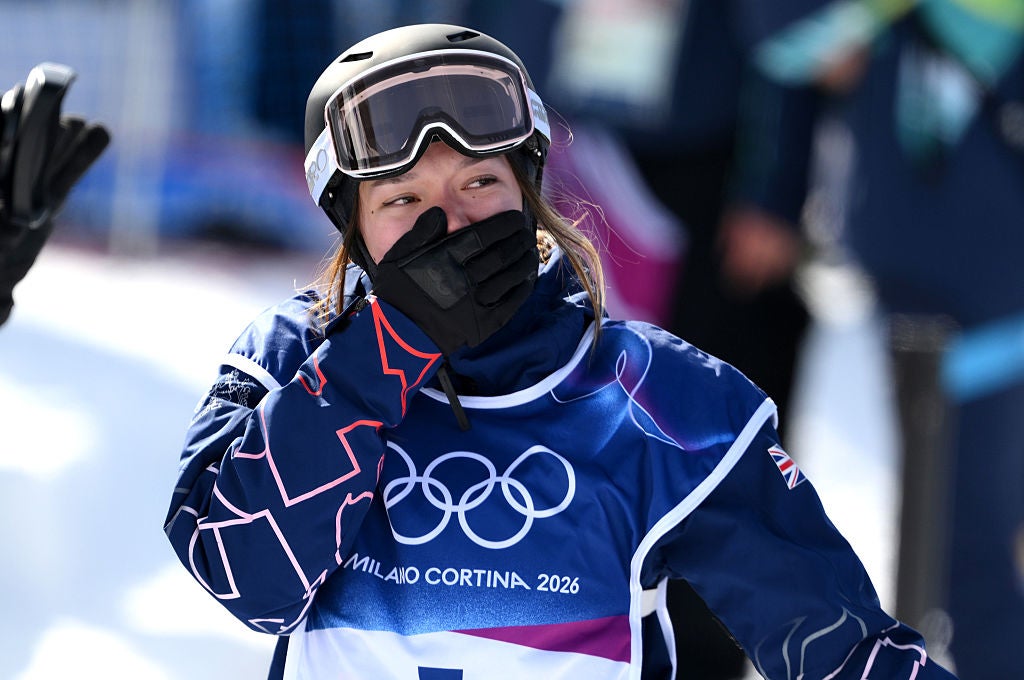
It’s a typically mature response from one of British snowsport’s deep thinkers: Atkin, like her rival Gu, is a student at Stanford. Now in her third year of full-time study alongside skiing, her classes – particularly in psychology and cognitive science – have influenced her approach to her sport. She has been open about rejecting the ‘daredevil’ label that follows freestyle athletes, having struggled “acutely” with fear while doing her sport in the past.
In comments which echo Gu’s viral press conference on the idea of neuroplasticity and becoming the person you want to be, Atkin says: “Before I tried to avoid [fear] as much as possible, but I think that now I’ve just learned how much power you have over your own mind. It’s a little bit more of a challenge to myself of being like, can I feel this fear and can I do it anyway? I think that in those moments where you’re really resistant to doing something, it’s like a window into yourself.
“I’ve received a lot of messages about that, younger girls or anybody really, feeling inspired about my ability to, I guess, push myself and be that person leading that charge in something that’s really scary. I think it’s really cool to be able to show, especially young girls, that we can have that bravery, but we’re all scared when we’re doing it, it’s not easy.”
The women’s half-pipe was one of the very last events to conclude in Milano-Cortina, and it made for a “bittersweet” experience, Atkin says, with much of her Games spent in a training camp in Switzerland.
But she attended the Opening Ceremony in Milan – something she couldn’t do under the strict Covid-19 regulations of Beijing – and spent time in the Olympic village, as well as with her sponsors. Atkin is a Team Samsung Galaxy athlete and swapped the half-pipe for the company’s Milano-Cortina base, a grand 18th-century palazzo once visited by Napoleon.
She has felt something of a post-Olympic comedown, but is insistent that there is always more to strive for. “It’s weird because I kind of thought it [being an Olympic medallist] would feel a certain way for so long and it is such a dream come true, but at the end of the day I’m still me. I’ve had so many moments post-medal ceremony where I’ve just been like, what now? Like, I can’t believe that I achieved this.
“But at the same time I’m super proud of the way that I performed and the kind of skiing that I’m pushing and showing the world, and I think that that was definitely more of my focus going into the games rather than ‘what medal am I going to walk away with’. It’s a dream come true to medal, but it’s a culmination of all the work and the work doesn’t stop just because the Olympics are over, it’s about pushing my limits and skiing every single day.”
And in four years, in the French Alps? “Maybe in four years we’ll finally one-up my sister, but we’ll see,” she smiles.