

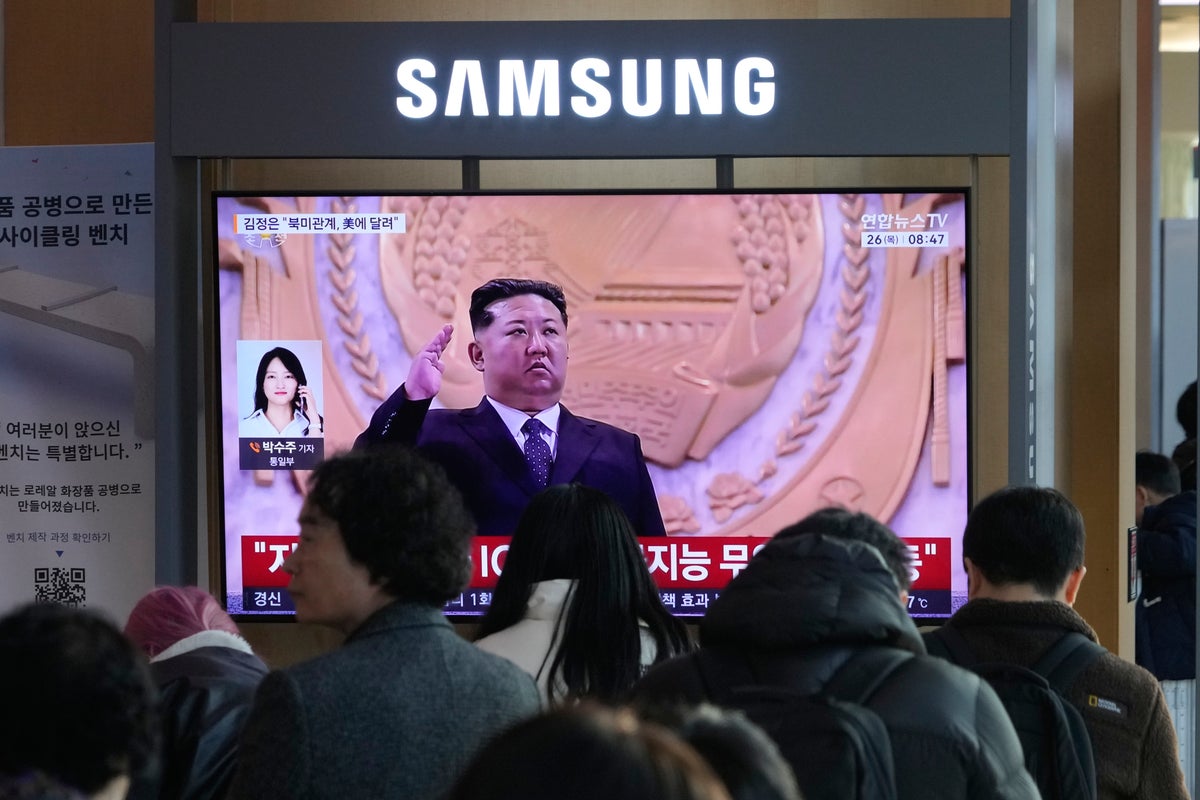
Kim Jong Un said North Korea could “get along well” with the US only if it recognised the Asian nation’s status as a nuclear state and abandoned its “hostile policy” towards Pyongyang.
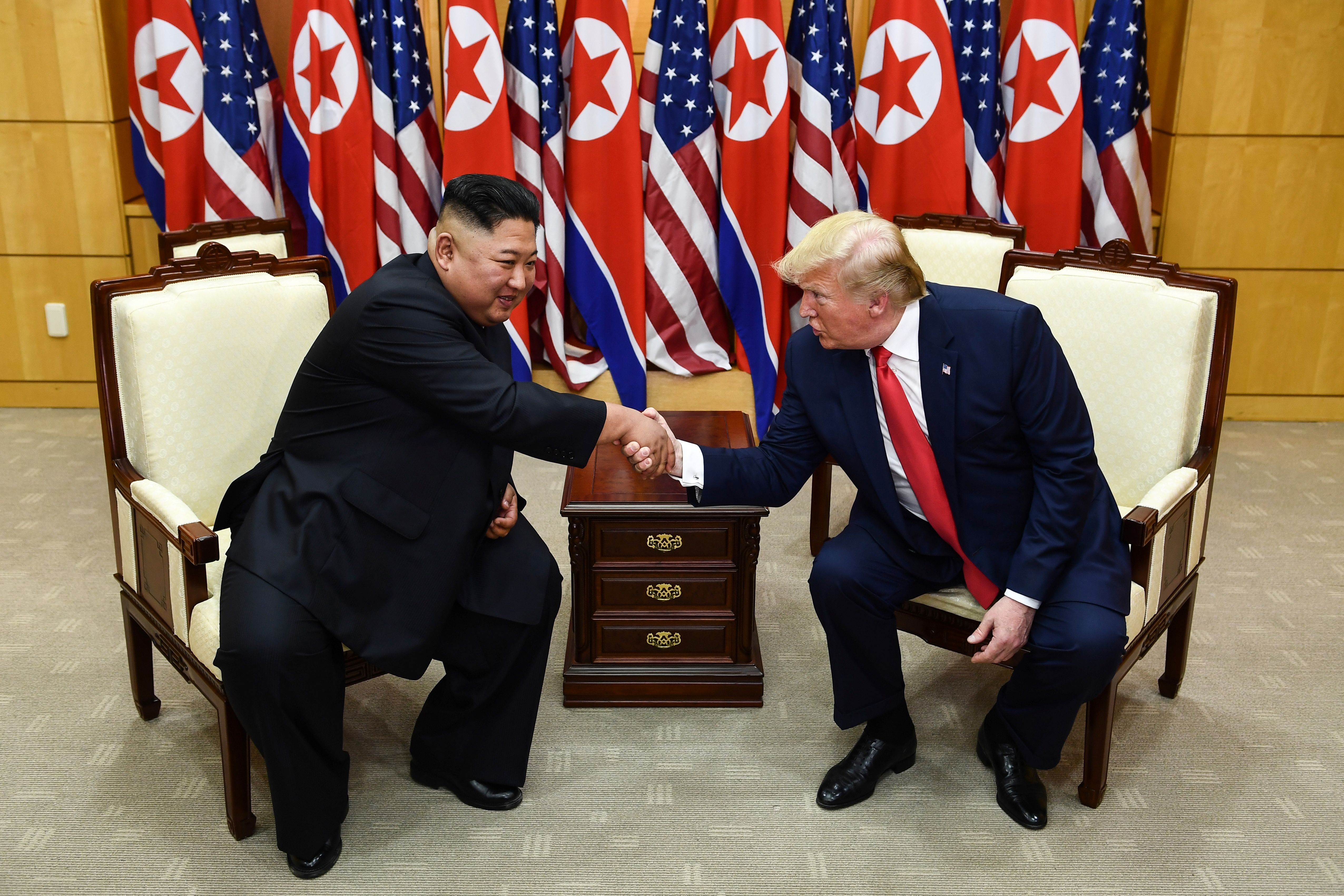
His remarks promptly fuelled speculation that Donald Trump could seek a meeting with the North Korean leader during his planned April trip to China, likely reviving diplomacy after the collapse of their 2019 Hanoi Summit over sanctions relief and denuclearisation disputes.
Mr Kim, however, made clear that he would reject any negotiations premised on Pyongyang giving up its nuclear weapons.
If the US “respects our country’s current status as stipulated in the constitution, and withdraws its hostile policy,” the leader was quoted as saying by the state news agency KCNA, “there’s no reason why we cannot get along well.”
At the same time, Mr Kim struck a sharply confrontational tone towards South Korea, declaring it a hostile state and ruling out reconciliation.
North Korea had “absolutely no business dealing with South Korea”, he said, describing the rival neighbour as the “most hostile entity”. His nation, he added, would “permanently exclude South Korea from the category of compatriots”.
“As long as South Korea cannot escape the geopolitical conditions of having a border with us, the only way to live safely is to give up everything related to us and leave us alone.”
Mr Kim made the remarks as a landmark congress of the ruling Workers’ Party concluded on the evening of 25 February.
The comments “signal an intention to pursue relations with the US independently, without going through South Korea”, Yang Moo Jin, former president of the University of North Korean Studies, Seoul, told the AFP news agency.
Mr Kim was also making clear that he would “reject any negotiations premised on denuclearisation”, Prof Yang added.
Mr Kim, meanwhile, warned that the North Korean military would “immediately launch a fierce retaliatory attack against any military hostile act committed by any force that infringes upon the sovereignty of our country”.
North Korea assembled around 50 warheads, possesses enough fissile material to produce up to more and is accelerating the production of further fissile material, think tank Stockholm International Peace Research Institute (SIPRI) estimated last year.
Mr Kim also laid out North Korea’s plans to develop stronger intercontinental ballistic missiles including ones that can be launched from underwater, attack systems using artificial intelligence, unmanned drones, and weapons that can hit enemy satellites, KCNA said.
State media photos of the military parade showed formations of soldiers marching through brightly-lit Kim Il Sung square under a podium where Mr Kim and his daughter stood with senior officials. Some troops in the parade wore camouflage and special warfare gear, and jets conducted a fly-by.
There was no military hardware visible in photos nor reference by KCNA to strategic weapons such as those that were shown off in a military parade in October.
The presence of Mr Kim’s daughter, known as Ju Ae, will fuel further speculation over whether she is being groomed as his successor.