

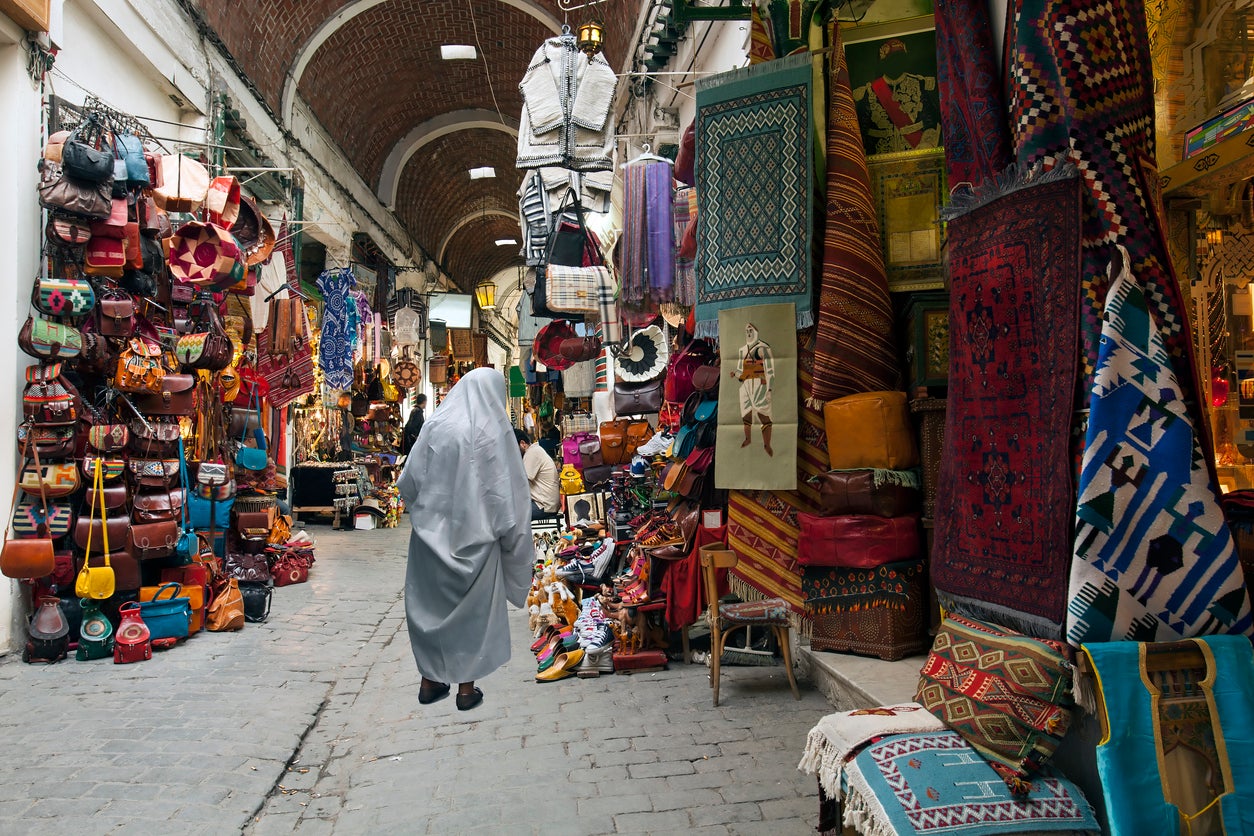
You quickly realise that the cats and shoppers of Tunis’s medina have a lot in common. They move easily through the narrow alleys, sweeping past slow-moving tourists, the shoppers in billowing abayas, the cats with their backs arched haughtily, both utterly confident in their direction of travel.
The same can’t be said for me.
The walkways all look identical and the clamour is relentless: carts piled high with vegetables while locals sip tea from low stools and debating animatedly.
The stallholders, meanwhile, are masters at tailoring their language and sales patter to the perceived nationality of the tourist. I’m clocked immediately as a wandering Brit.
Read more: Algeria is the breathtaking, crowd-free alternative to busy Morocco
“Good price for you, guv’nor. Cheap as chips, my friend.”
I try – and fail – to suppress a smile, which gives the game away. Moments later I’m being ushered inside, falling for a centuries-old trick that still works to perfection.
After a difficult decade between the 2015 Sousse terrorist attack and the Covid pandemic, tourism to Tunisia has firmly rebounded. In the past year alone, nearly 450,000 British holidaymakers have visited, supported by over fifty daily flights from across the country.
So why go now? This spring marks seventy years since Tunisia gained independence from France – a milestone that feels particularly apt for travellers re-encountering a country long defined by others.
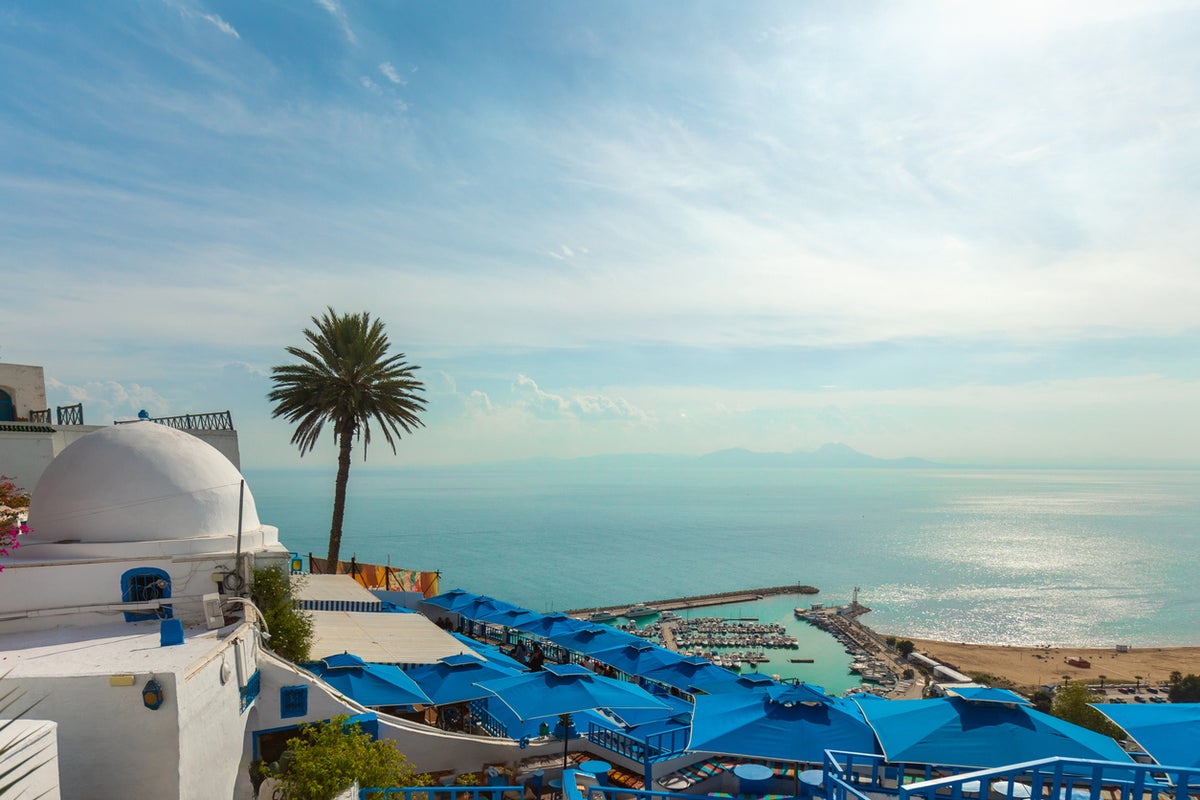
Alongside its Mediterranean coastline and some 300 days of sunshine a year, Tunisia offers an unusually concentrated sweep of history for its size and a country that still feels rooted in its geography and heritage, rather than chasing the tourist dollar. Prices remain considerably more affordable for visitors than regional tourism heavyweights Morocco and Egypt.
Tunisia’s geography has always made it irresistible to occupying civilisations. Phoenician traders were followed by Carthaginians, Romans, Arabs, Ottomans and finally the French, whose departure in 1956 gave birth to the modern state. Each era, plus the indigenous Berber population, layered itself onto the landscape, leaving fingerprints on the architecture, culture and cuisine.
Modern Tunis sits beside the pre-Roman city of Carthage, whose ruins remain one of the country’s pre-eminent attractions. Our guide, Ahmed, explains Carthage was “ill-treated by history”, destroyed repeatedly by successive conquerors. When the Arabs arrived in the seventh century, they chose to build Tunis’s medina slightly inland, a far more defensible position.
Tunis’s past is never far from the surface. Delicately carved blue doors open onto what might be the best patisserie this side of Paris, while intricate Ottoman tombs at the recently rediscovered royal mausoleum of Tourbet El-Bey sit beside carpet shops with flaking paint, like coin scrapings on a scratch card.

Hidden behind an eye-catching yellow door in the heart of the medina, Dar Slah restaurant pays homage to multiple eras at once, from Ottoman tiling and an Arabic balcony to its French chandelier. The menu follows suit: dates and quince accompany fish and couscous alongside hsou – a spicy semolina soup finished with a squirt of lemon – and a creamy tart for dessert.
Each dish arrives with a hearty “sahtein”, an Arabic wish for double health, which seems optimistic given the amount of sugar involved.
“Forget Taylor Swift,” Ahmed says cryptically as we leave Tunis. “Come to Tunisia and you have the original Eras Tour right here.”
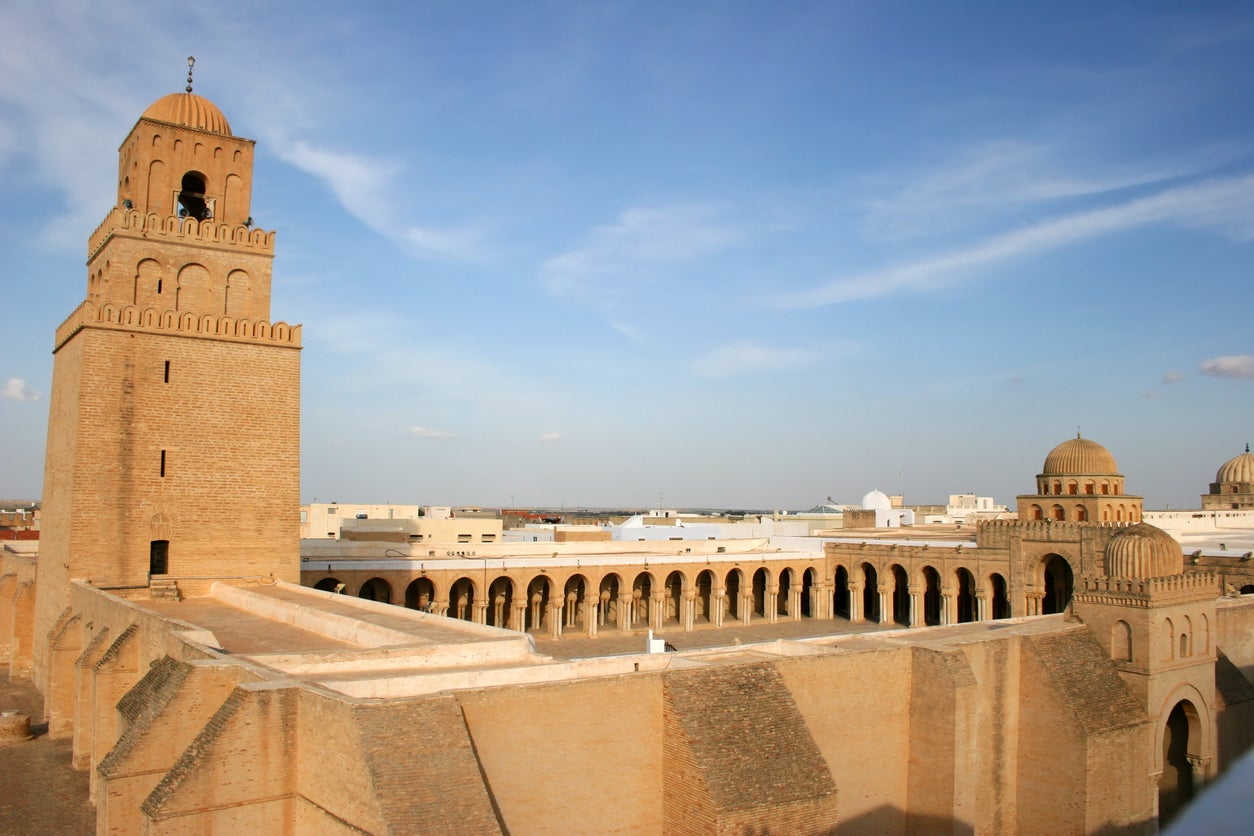
Nowhere proves the point more clearly than the Great Mosque of Kairouan. Founded in the seventh century and embellished by countless rulers since, it is one of the oldest mosques in the world and, according to some Islamic traditions, the fourth holiest site in Islam after Mecca, Medina and Jerusalem.
Read more: Is this Ibiza’s best baby-friendly hotel?
On a bright winter morning the courtyard is quiet. A handful of students sit inside the dimly lit prayer hall, mouthing Quranic verses silently.
“Notice anything unusual?” Ahmed whispers, tilting his head towards the interior columns.
Look closer and it becomes obvious. No pillar matches its neighbour. Some are Carrara marble, others Aswan granite – all examples of spoila, reused material taken from older buildings and conquered civilisations. Even the exterior walls bear slabs of marble with Latin inscriptions cut deep into the marble, sitting incongruously within a structure more than a millennium old.
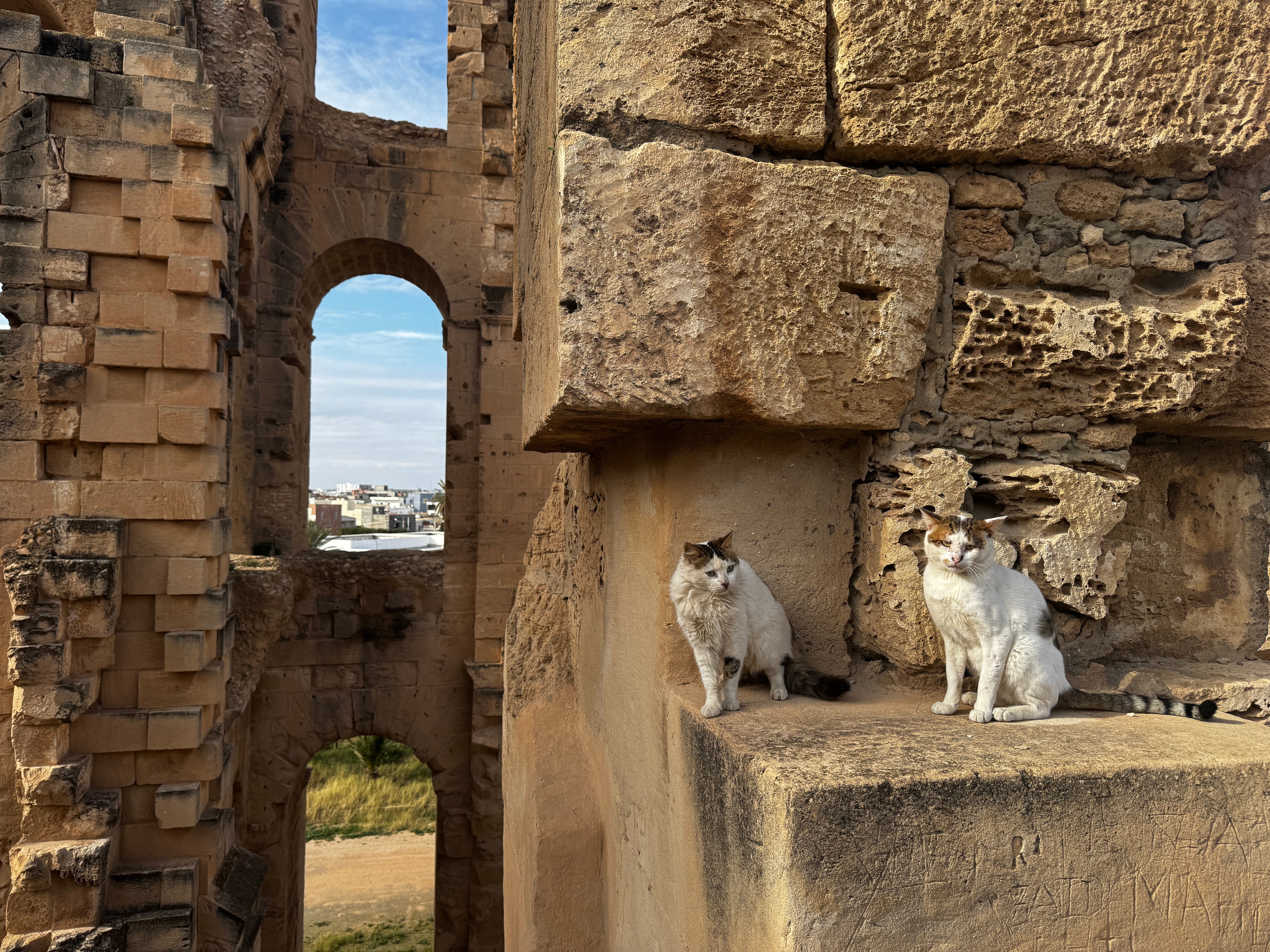
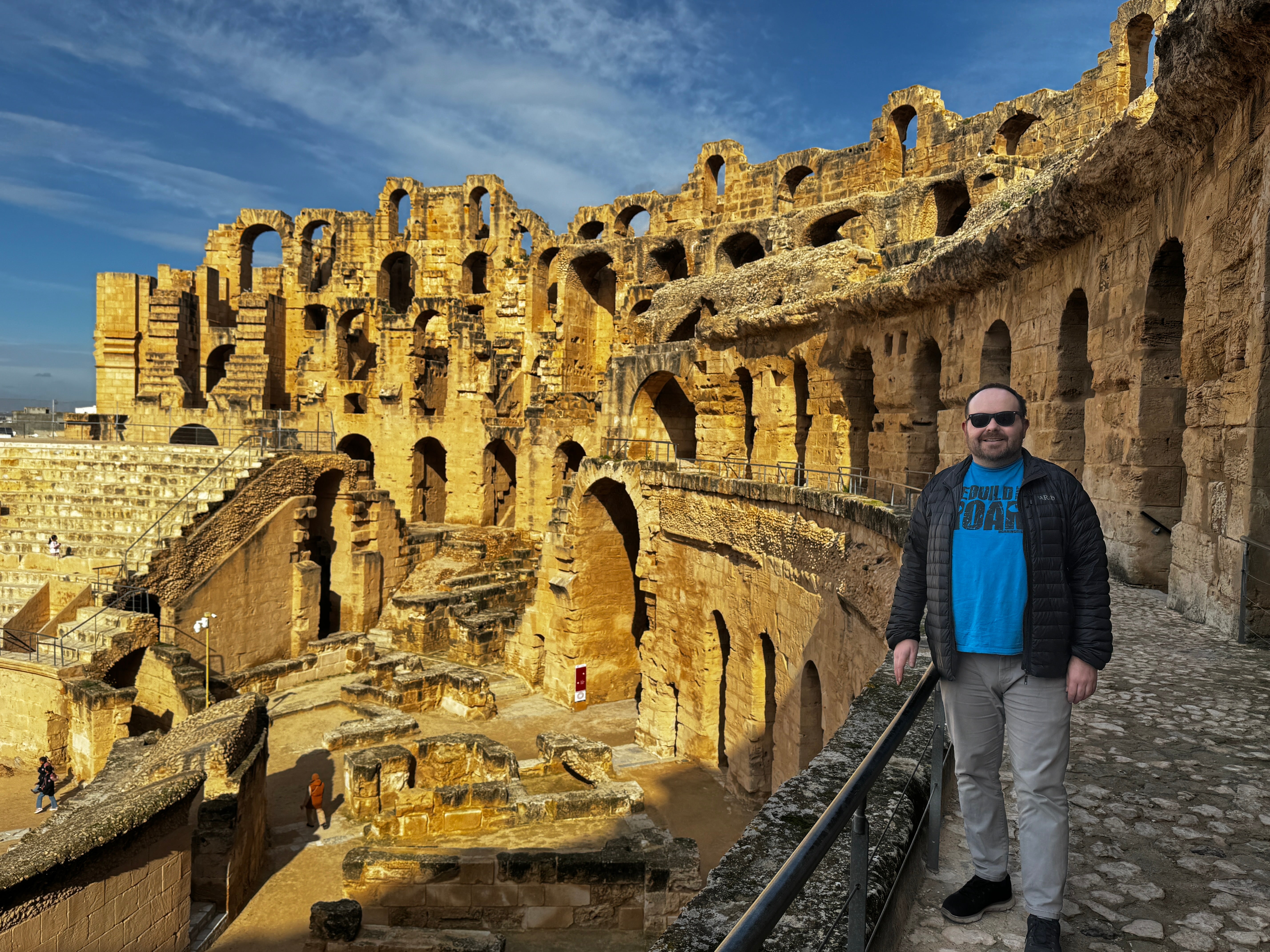
Nearby, the Roman amphitheatre at El Djem is a wonder from even further back. Built without foundations, it has stood for 1,800 years on the same spot, holding up to 35,000 spectators at its peak. Its Corinthian columns and vaulted basement galleries, where gladiators and animals were hoisted into the arena via pulley lifts beneath a retractable wooden floor — are so well preserved they require no interpretive panels or VR headsets.
Climbing between the three levels of the arena takes me away from the crowds. Sitting on limestone blocks polished by two millennia’s worth of buttocks, it takes little imagination to see this site in its heyday.
The old city of Sousse feels less like a town and more like a giant labyrinth.
While its six miles of white-sand beach remain the draw for many visitors, its medina is another historic heavyweight. Relative to El Djem and Kairouan, it’s rather modern, dating to the ninth century. The crenelated walls of the Ribat, a real fortress, and the Great Mosque, which merely looks like one, dominate the skyline. Ahmed quietly points out a more recent landmark: the wall from the stoning scene in Monty Python’s Life of Brian. “Don’t say Jehovah” he grins at us.
As dusk falls, the muezzin’s call to prayer drifts across the rooftops and the casbah momentarily stills. Worshippers gravitate towards the mosque’s small doorway, dwarfed by its fortified walls. Even the stallholders pause their cries, though their eyes continue to scan the crowds for would-be buyers.
For a moment everything feels suspended. It’s easy to imagine this scene playing out every evening for the past millennium, outlasting one empire after another. Seventy years after independence, it’s this sense of continuity that continues to makes Tunisia feel like the most intriguing destination on the Mediterranean. One whose history has many more eras to span.
How to do it
Arrival: The majority of UK flights to Tunisia land at Enfidha-Hammamet airport, which sits between Tunis and Sousse. Easyjet and Tui serve multiple routes from Birmingham, Bristol, East Midlands, Edinburgh, Liverpool, London, Manchester and Newcastle. Flights take around three hours and start at £98 return.
For those traveling overland from mainland Europe, ferries from Marseilles and Genoa both sail to Tunis every two or three days in summer and less frequently in winter. Book with Corsica Linea or Tunisian ferry operator CTN.
Between Tunis and Sousse: Four daily trains connect Tunis and Sousse, taking two hours and 10 minutes and priced at £3 one-way. An onward connection between Sousse and El Djem runs three times daily (£1.50 one-way). Timetables are available from Tunisian Railways.
To see Kerouan and El Djem from either Tunis or Sousse, a private tour is recommended. Viator offers several good options.
Where to stay
The Dar El Medina is located in heart of Tunis, offering the heritage of a traditional riad with an open-air terrace. From £95 per night.
In Sousse, Dar Lekbira Boutique Hotel is centrally located within the medina, with beautifully decorated rooms and freshly baked breakfast. From £75 per night.