



French art experts have backed British painter David Hockney in furiously opposing the Bayeux Tapestry being sent to London.
They said it would be a “crime against our heritage” to see the medieval masterpiece leave their country, where it has been kept for almost a thousand years.
The 230ft-long, 20-inch-tall embroidered cloth depicts events around William, Duke of Normandy, defeating King Harold at the Battle of Hastings in 1066, thus conquering England.
But the Bayeux museum, where it is currently kept, is being renovated, and French president Emmanuel Macron wants the tapestry to be loaned to the British Museum in London for almost a year, during the works.

Hockney, who lives in Normandy, described the scheme as “madness” because the cloth is too delicate to be transported.
The 88-year-old wrote in The Independent: “Some things are too precious to take a risk with. Moving the Bayeux Tapestry is one of them.”
More than 77,000 people in France have now signed a petition saying, “No, to the loan of the Bayeux Tapestry”.
Those behind it are furious at President Macron’s announcement that the tapestry would disappear from France from September to July 2027.
Art specialist Didier Rykner, editor of the influential La Tribune de l’Art website, which organised the petition, said the upcoming move was “a true crime against our heritage”.
Mr Rykner said: “Tapestry specialists, the restorers working on it, and the curators, say there is a risk of tears and material loss due to handling and vibrations during transport.
“It is unacceptable to risk this absolutely unique work being damaged.”

The tapestry is set to be insured by the UK Government Indemnity Scheme – an alternative to commercial insurance – for almost £1bn (The Treasury will not confirm the exact figure, but confirms estimates of approximately £800,000 as being in the “right range”.)
This astronomical sum is far more than twice the price of the most expensive artwork ever sold at artwork – Leonardo Da Vinci’s Salvator Mundi, which went for around £330m – yet many French still don’t think it is enough.
Mr Rykner points out that a stolen or seriously damaged Bayeux Tapestry could “never be replaced”, making it priceless.
Cécile Binet, of Normandy’s Directorate of Cultural Affairs, said there was a real danger of destroying it: “The tapestry is relatively well preserved considering its age, but it is very fragile.
“The linen canvas is oxidised and has holes – wear, tears, and repairs that sometimes cause tension.”
Ms Binet said more work was needed to “assess the state of conservation” because the last assessment was back in 1983.
Pierre Bouet, a professor at the University of Caen, said the tapestry “is not something that moves easily. It’s currently in a hermetically sealed container”.

Professor Bouet added that the journey to England would require “disassembling and rolling it up,” and this could be perilous.
Natalie Avel, from Normandy, said she was “about the same age as Monsieur Hockney” and added: “Like many in France, I’ve been visiting the tapestry since I was at school, and completely agree with him.
“It belongs in Bayeux, and not on a long and potentially very dangerous trip to Great Britain. It is part of our heritage – Normandy’s heritage, and France’s heritage.”
It is not certain where the tapestry was made, but according to one legend, it was actually created by Anglo-Saxon artists in England.
King William I’s half-brother, Bishop Odo of Bayeux, who was made the Earl of Kent after the Norman Conquest, is said to have commissioned it while William was back in Normandy.
What is certain, is that the tapestry has not been back to Britain since (if it was ever there in the first place), and its movement has been limited to France.
In 1803, Napoleon Bonaparte took it to the Louvre art museum in Paris, to show it off in preparation for his planned and later abandoned invasion of England.
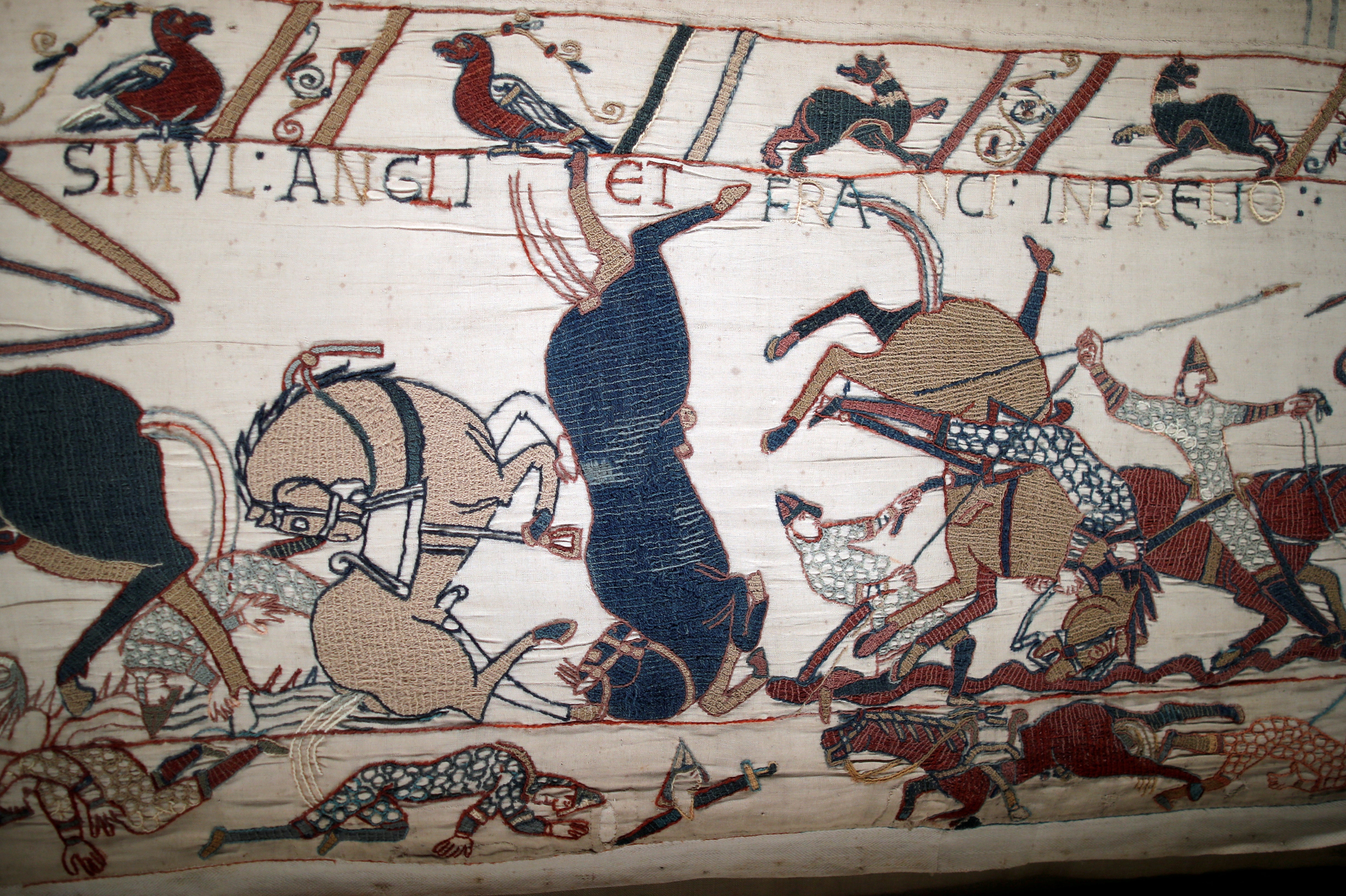
Britain asked to be loaned the tapestry twice – in 1953, for the Coronation of Elizabeth II, and in 1966, for the 900th anniversary of the Battle of Hastings – but both requests were rejected.
As President Macron himself admitted during a visit to the British Museum last July: “This is the first time that this national treasure will leave French soil.”
As opposition continues, there are a few people in France who are in favour of the move.
Cyril Glot, who runs La Gamelle souvenir shop in Bayeux, said the tapestry had to go somewhere while its official museum was being renovated, so why not London, where millions of people will be interested in it.
Moreover, the Normandy town has plenty of other attractions to offer, with Mr Glot saying: “Tourists don’t just come for the tapestry. Bayeux is attractive. The city organises many events that draw crowds, such as the gourmet markets and the medieval festival.”