

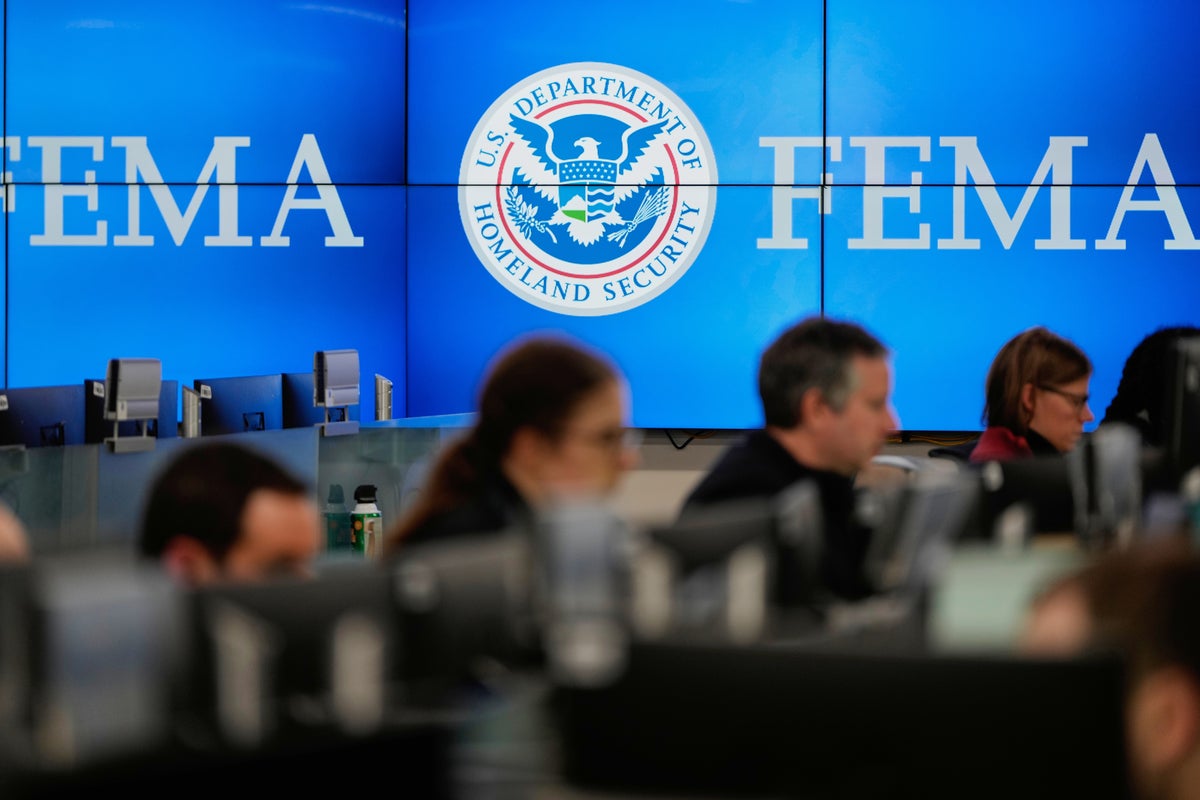
The Federal Emergency Management Agency will resume staff cuts that were briefly paused during January’s severe winter storm, according to two FEMA managers, stoking concern across the agency over its ability to address disasters with fewer workers.
FEMA at the start of January abruptly stopped renewing employment contracts for a group of staffers known as Cadre of On-Call Response/Recovery, or CORE employees, term-limited hires who can hold senior roles and play an important role in emergency response.
But FEMA then paused the cuts in late January as the nation braced for the gigantic winter storm that was set to impact half the country’s population. FEMA did not say whether that decision was linked to the storm.
The two FEMA team managers, who spoke on condition of anonymity because they were not authorized to discuss the staffing changes with the media, were told this week that dismissals were going to resume soon but were not given a specific date. It was not clear how many people would be impacted.
FEMA staff told The Associated Press that the policy indiscriminately terminates employees without taking into account the importance of their role or their years of experience. The hundreds of CORE dismissals have wiped out entire teams, or left groups without managers, they said.
“It’s a big impact to our ability to implement and carry out the programs entrusted to us to carry out,” one FEMA manager told The Associated Press.
The officials said it was unclear who at the Department of Homeland Security or FEMA was driving the decision. Managers used to make the case to extend a contract months in advance, they said, but now leaders were often finding out about terminations at the same time as their employee.
DHS and FEMA did not immediately respond to requests for comment.
There are over 10,000 CORE workers, making up nearly half of FEMA’s workforce. While they are employed on two- and four-year contracts, those terms are “routinely renewed,” one manager said, calling CORE the “primary backbone” for FEMA’s response and recovery work. Many CORE are supervisors and it’s not uncommon for them to have worked at the agency for many years, if not decades.
CORE employees are paid out of FEMA’s Disaster Relief Fund and are not subject to as long a hiring process as permanent full-time federal employees. That allows the agency to be more nimble in its hiring and onboard employees more quickly as needs arise. With DHS funded only temporarily because of a battle in Congress over immigration tactics, CORE employees can work and be paid during a government shutdown, so long as the disaster fund still has money.
The administration’s efforts to reduce the workforce come as the Trump administration has been promising reforms for FEMA that it says will reduce waste and shift emergency management responsibilities over to states.
It also comes as DHS faces increasing criticism over how it manages FEMA, including delays in getting disaster funding to states and workforce reductions.
FEMA lost nearly 10% of its workforce between January and June 2025, according to the Government Accountability Office. Concern has grown in recent months among FEMA staff and disaster experts that larger cuts are coming.
A draft report from the Trump-appointed FEMA Review Council included a recommendation to cut the agency’s workforce in half, according to a person familiar with the matter who spoke on the condition of anonymity because they were not authorized to discuss the report with media. The council’s final report, due last November, has not been published.
“Based on past disasters, we know that slashing FEMA’s workforce will put Americans at risk, plain and simple,” Rep. Bennie Thompson of Mississippi, ranking member of the House Homeland Security Committee, said after introducing a resolution Wednesday condemning FEMA staff cuts.
Last week, a coalition of unions and nonprofits led by the American Federation of Government Employees filed a legal complaint against the Trump Administration over the FEMA reductions.
A CORE employee at FEMA headquarters who asked not to be named for fear of losing their job said that even though FEMA was able to support states during Winter Storm Fern, a year of staff losses could already be felt. There were fewer people available for backup, they said, and staff were burned out from ongoing uncertainty.