

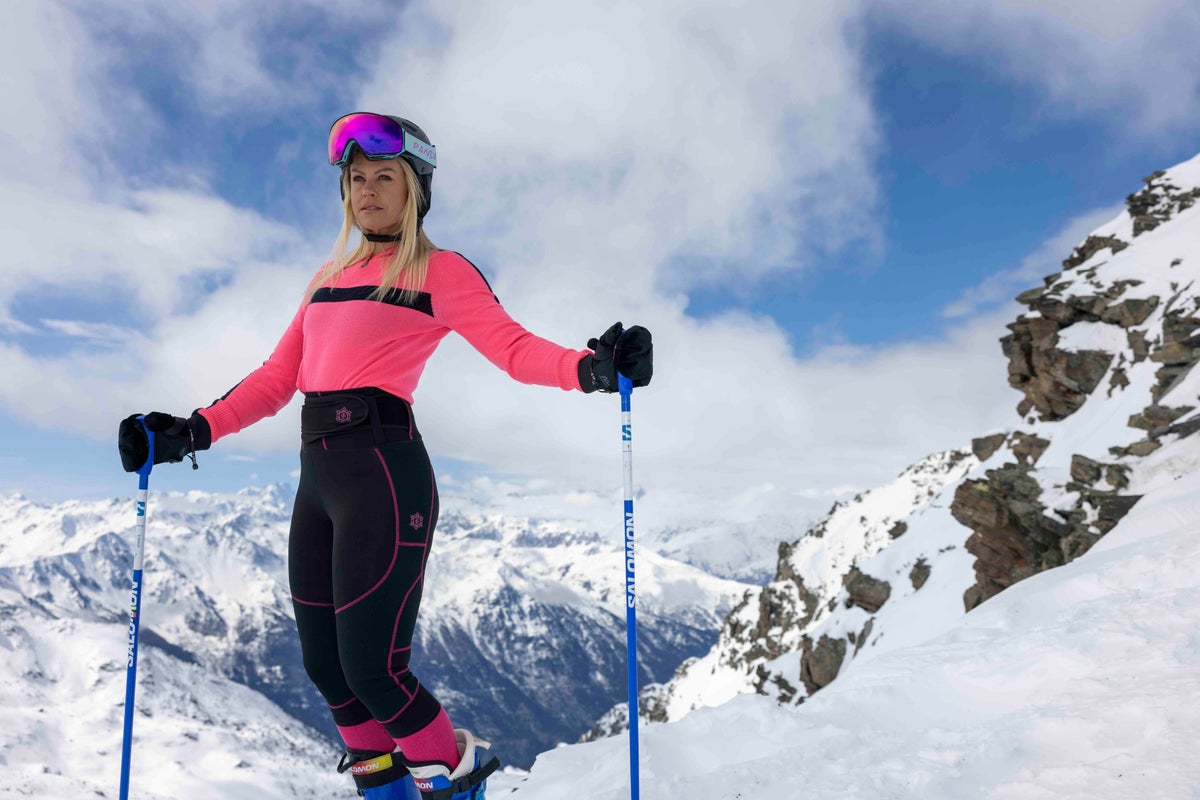
As one of Britain’s greatest-ever female skiers, Chemmy Alcott has had her fair share of injuries – some of them very serious.
During her 20-year skiing career, in which she became the eighth ranked skier in the world, the four-time Olympian broke more than 40 bones, including her back, neck, legs and ribs, as well as suffering a multitude of tendon and ligament injuries.
“Unfortunately, I’m probably more known as someone who broke bones in my career than anything I achieved in the sport,” she jokes.
“But I’m actually quite proud, very sadistically, about the injuries I’ve had, because those were moments where I had the confidence to push myself to my limits, and if I hadn’t got hurt, then I wouldn’t know where my limit is.”
Alcott, now 43, retired from competitive skiing in 2014 and as well as now presenting Ski Sunday (“my dream job”), she’ll join Clare Balding as a presenter of the BBC’s Winter Olympics coverage from Milano Cortina in February.
She says she has no health repercussions from her injuries, and although some athletes can have a mental block that affects their return to sport after serious injury, that didn’t happened to her.
“I just knew I’d get injured – you don’t become a downhill skier and be afraid of injury,” she insists. “It’s part of your journey in the sport, and I was very lucky that none of my injuries fell in an Olympic year, so I managed to ski those four Olympics, and I’m very proud of that.”
She says there were eight years where she didn’t get injured, but admits at that time she didn’t give 100% to her performances. “I chose to be 80% and it was an incredibly unsatisfactory, maybe safe, way to ski, but it wasn’t why I became a downhiller,” she says.
“Because I’m fuelled by passion, I never skied because it was my career, or because I thought I’d make money out of it. I’ve always been a skier, and still am, because I absolutely love it – the injuries just meant I had to fight to get back to something I loved.”
She says she’s got “a healthy relationship” with coming back from injury, as she learned that competitors need to take care of their brains when they get hurt physically. “So I used to break bones and always think about the physio needed, and the repercussions of how to get back to the slopes physically.
“And then I’d strap into my skis, and my brain would go ‘Oh my gosh’, and I’d have this influx of fear because I hadn’t thought about the mental challenge that injury had caused.
“That’s something that’s really important for athletes to consider, the trauma that you go through with your brain, and how to heal that.”
One of the major ways Alcott used to help heal mentally after a skiing injury was to go back to where she crashed and finish the run. “I try and change the format and the memory in my brain of the crash,” she explains, “and instead I finish and execute the run and stop at the bottom and feel the emotions of satisfaction that I’ve done it, as opposed to the pain and the sadness I felt when I crashed.
“Quite often, our brain can take the easiest path, and that’s remembering tragedy or crashes or injuries. So I try to change that pathway into a more positive one by changing the outcome of what happened.”
She believes it’s a tactic that can help in many aspects of life, and points out: “I think it can give you confidence to go back to where the injury happened, because a lot of people get an injury in a certain sphere of life, and then will never go back there, and they’ll limit their enjoyment in life.
“So it’s a way of being able to readdress what happened, and change the outcome.”
It’s a valuable mantra, and one Alcott, who’s married to Britain’s former number one downhill skier Dougie Crawford, may well pass on to their children – Cooper, aged six, and Lochlan, aged eight.
She proudly says they’re both “absolutely savage” little skiers, and admits: “Probably my biggest success in life is that our children like to ski, because we love the mountains and they brought us so much joy that if the boys didn’t like it, it would be very, very challenging. But we’re very lucky that they do.”
The risk of injury to the boys, as well as herself and her husband, who’s now a ski racing coach, is one of the reasons Alcott is supporting a new NHS campaign to encourage people to use the full range of NHS services, including NHS 111, community pharmacies, the NHS app and online form GP contact, instead of going to A&E when they don’t need to.
Alcott recalls how Cooper recently trapped his finger in the door and she called NHS 111 to get a clearer idea of what treatment he needed. “My youngest son is very much hard as nails, so I called the NHS to explain what happened and what I was seeing, because my son was telling me he was absolutely fine, but I was second-guessing what he was telling me.”
She says the NHS was “amazing”, and after she described the alignment of his finger, the NHS 111 call handler told her to take him to hospital immediately.
She says: “It didn’t look great, but he was telling me that it was okay. I didn’t want to go to A&E straight away and panic him, so he was on the call with 111 at the same time as me – it helped him feel more relaxed about it and take control of the situation.”
The hospital said the finger was broken and out of alignment, and the next day Cooper had surgery to put metal work through the finger, before it was encased in a cast for three weeks.
Alcott understands that many parents can panic when their child’s injured, and rush them to A&E when it’s not always necessary. However, she says she’s definitely not a panicky parent.
“I’m probably the opposite, where because I’ve seen a lot of injuries, I don’t do the panicking. I remember when I broke my leg, I thought I was being a hypochondriac for going to hospital. So we are probably the other side of parenting, the more risk side.”
Pointing out that both her husband’s parents are doctors, she says: “The generation under doctors, they’re hardy. So we do treat our sons that way, and I needed the NHS to tell me to go to A&E, and it was obviously an incredibly right call.
“I think there needs to be a bit more education into what NHS services we need, so we’re trying to get people to understand what to use, the right time, the right place.”
Chemmy Alcott is supporting an NHS campaign encouraging people to use the full range of NHS services, and get the right care while keeping A&E free for those who need it most. This includes using NHS 111, community pharmacies for common conditions, the NHS App, and contacting your GP using an online form.